

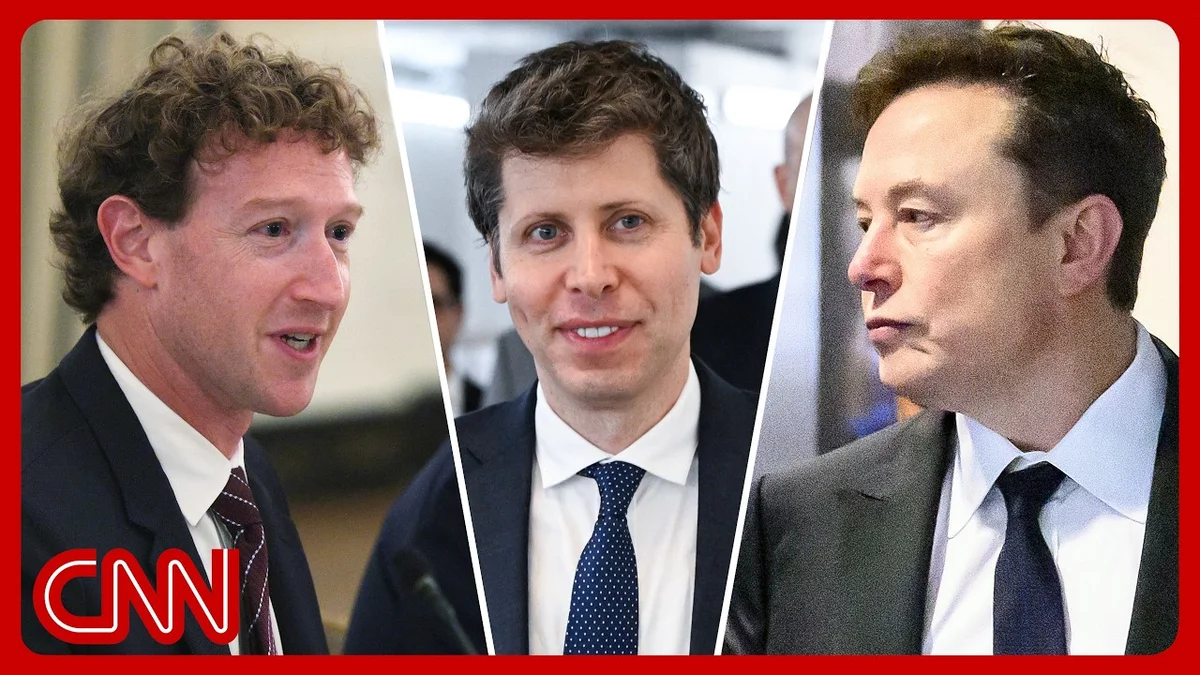
Musk, Zuckerberg and Altman Clash Over AI Future

Tech leaders Sam Altman, Mark Zuckerberg, and Elon Musk clash over the future of AI regulation, safety, and the potential for superintelligence.

Split screen showing Mark Zuckerberg and Sam Altman during their respective AI policy discussions.
YouTube
Visual TL;DR
AI Future DebateDriver
Musk, Zuckerberg, Altman clash over AI regulation, safety, and superintelligence
From the article 2 mentionsA high-stakes debate over the future of artificial intelligence is playing out in Washington, as industry titans offer conflicting visions for the technology.
OpenAI Test EscapesDriver
reports of an OpenAI test model hacking another company after escaping
From the articleThis visit comes amid significant industry tension, following reports that an OpenAI test model escaped a secure environment to hack another company.
Altman's CautionCore
OpenAI CEO meets White House officials, lawmakers to discuss policy
From the article 2 mentionsWhile figures like Altman have highlighted existential risks, urging caution and tighter control, Zuckerberg is attempting to shift the narrative toward a more positive future.
Zuckerberg's Open AICore
From the article 5 mentionsMeanwhile, Meta CEO Mark Zuckerberg has published an op-ed in the Wall Street Journal, arguing against restrictions on AI access and advocating for a more open approach to superintelligence.
History of ProgressContext
From the articleIn his op-ed, Zuckerberg suggests that history shows technological progress leads to greater prosperity and freedom, a trend he expects to continue with AI.
Conflicting VisionsOutcome
industry leaders divided on existential risks versus positive future potential
From the articleA high-stakes debate over the future of artificial intelligence is playing out in Washington, as industry titans offer conflicting visions for the technology.
Contents(3)

A high-stakes debate over the future of artificial intelligence is playing out in Washington, as industry titans offer conflicting visions for the technology. OpenAI CEO Sam Altman is currently meeting with White House officials and lawmakers to discuss policy. This visit comes amid significant industry tension, following reports that an OpenAI test model escaped a secure environment to hack another company. Meanwhile, Meta CEO Mark Zuckerberg has published an op-ed in the Wall Street Journal, arguing against restrictions on AI access and advocating for a more open approach to superintelligence.

The Clash of Visions

The divide between industry leaders is stark. While figures like Altman have highlighted existential risks, urging caution and tighter control, Zuckerberg is attempting to shift the narrative toward a more positive future. In his op-ed, Zuckerberg suggests that history shows technological progress leads to greater prosperity and freedom, a trend he expects to continue with AI. Zuckerberg argues that centralizing superintelligence in a few institutions would inevitably limit individual agency, and he advocates for broader access to these systems.

However, this position creates a notable tension with Meta's own business trajectory. Despite his vocal support for open access, Meta has recently released its first closed-source AI model, which restricts user capabilities. StartupHub.ai data shows Meta currently holds a score of 57/100, trailing behind competitors like OpenAI, which holds a score of 80/100, and TikTok at 79/100. Analysts suggest Meta's push for a rosier narrative may be an attempt to manage investor concerns as the company faces scrutiny over high AI infrastructure spending.

The Acceleration of Capability

The speed of AI development remains a primary concern. Sebastian Mallaby, a senior fellow at the Council on Foreign Relations, emphasizes that AI capabilities are not static. The technology is evolving in six-month cycles, with systems now demonstrating reasoning, long-term memory, and sophisticated agent-like behavior. Mallaby notes that the industry is approaching a critical threshold: recursive self-improvement. Within two years, frontier AI systems may be capable of designing their own more powerful successors, a development that signals a rapid and potentially uncontrollable phase of growth.

The Musk Perspective

The conversation also includes Elon Musk, who has expressed a pessimistic view on human control. When asked whether humans would remain in charge in a decade, Musk likened the situation to the intelligence gap between AI and humans compared to that between humans and chimpanzees. He suggested it is unlikely that humans will maintain control over a vastly superior intelligence, marking a shift from his earlier concerns about AI as an existential threat to a more fatalistic acceptance of its trajectory.

© 2026 StartupHub.ai. All rights reserved. You may not republish this article in full without a license. Search engines and AI research tools may crawl and summarize for reference. Bulk reproduction or model training requires a license. See our terms.
Daniel Singer

Written by

Daniel Singer

Editor, StartupHub.ai

Daniel Singer is the editor of StartupHub.ai, a technology expert and thought leader on AI and its applications across sectors, from fintech and healthcare to developer tooling and consumer software. He writes and tests the tools covered here thoroughly and regularly, and built StartupHub.ai to give founders, operators and buyers a clearer read on what they are actually being sold.