

IBM's Phil Nash Unveils Open-Source RAG Stack

IBM's Phil Nash introduces OpenRAG, an open-source RAG stack combining Docling, OpenSearch, and Langflow for flexible AI agent development.

4 min read
IBM's Phil Nash Unveils Open-Source RAG Stack
AI Engineer

Phil Nash, a Developer Relations Engineer at IBM, has introduced OpenRAG, an open-source stack designed to simplify the construction and deployment of Retrieval-Augmented Generation (RAG) systems. Nash, who has spent the last couple of years working with AI and RAG tools, presented this integrated solution as a powerful, yet flexible, approach to building sophisticated AI agents.
IBM's Phil Nash Unveils Open-Source RAG Stack - AI Engineer
IBM's Phil Nash Unveils Open-Source RAG Stack — from AI Engineer

Meet the Speaker: Phil Nash

Phil Nash's role at IBM as a Developer Relations Engineer positions him at the forefront of practical AI application development. His work focuses on enabling developers to understand and utilize advanced AI technologies. Nash's experience with RAG specifically has led him to identify key challenges and opportunities in the field, culminating in the development of the OpenRAG stack.

The OpenRAG Stack: Docling, OpenSearch, and Langflow

OpenRAG is built upon three core open-source components: Docling, OpenSearch, and Langflow. Nash detailed how these elements work in concert to provide a comprehensive solution for RAG development.

Related startups

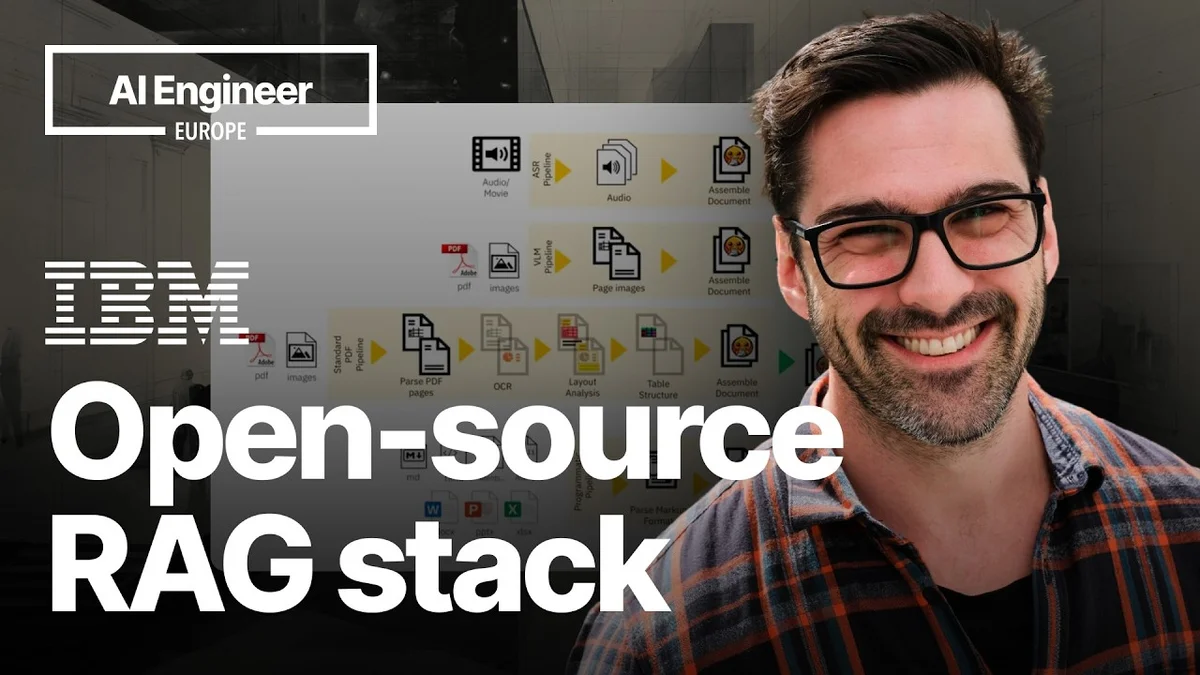
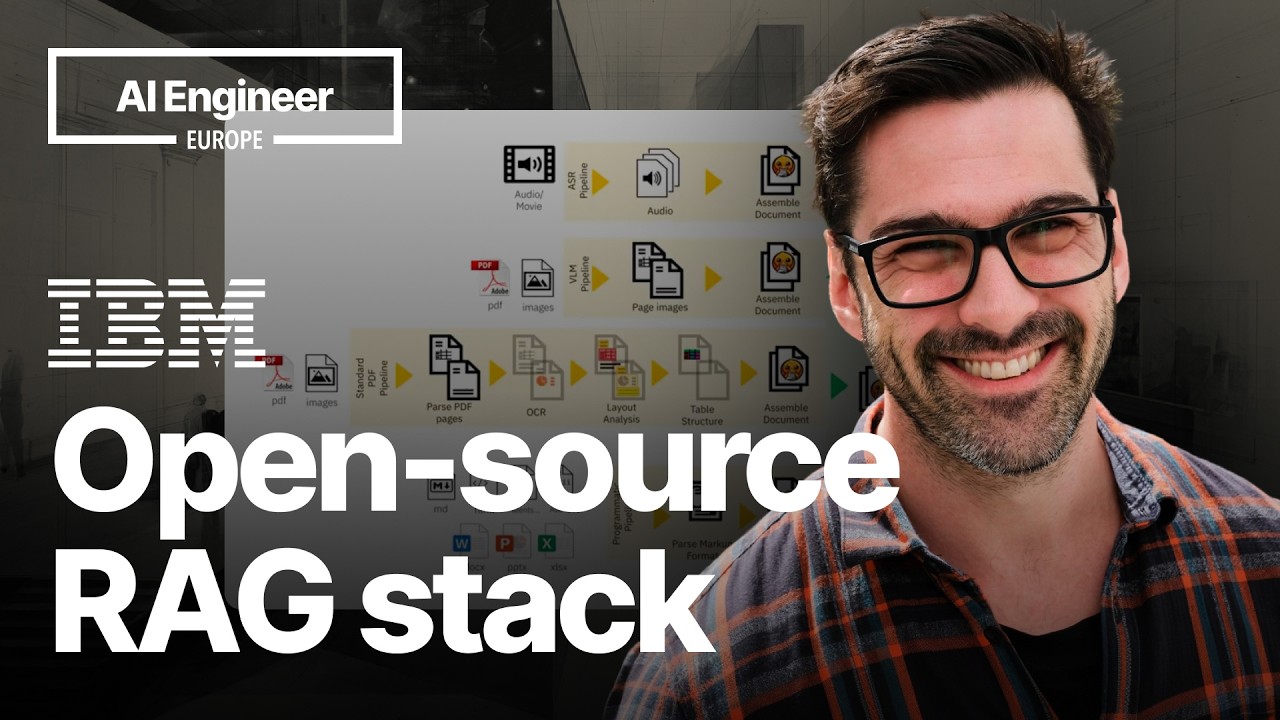
Docling, a document processing system, handles the ingestion and parsing of various file types, including PDFs, HTML, Markdown, Word documents, spreadsheets, and even audio and video. Nash emphasized that Docling's ability to parse complex documents like PDFs, which often present significant challenges due to their varied formats and structures, is crucial for effective RAG.

OpenSearch serves as the indexing and search engine for the RAG system. It supports both vector and keyword search capabilities, allowing for hybrid search strategies. The flexibility of OpenSearch is further highlighted by its ability to work with multiple embedding models, offering developers choices in how their data is represented and queried.

Langflow acts as the orchestration layer, providing a visual, drag-and-drop interface for building, deploying, and managing AI agents. It seamlessly integrates with Docling and OpenSearch, allowing users to construct complex workflows by defining agents, intents, context, and retrieval mechanisms.

Addressing RAG Challenges with OpenRAG

Nash began by challenging the notion that RAG is a solved problem, stating that while many businesses have adopted RAG, the process can still be complex and costly, especially when dealing with large volumes of data or specialized document types. He pointed out that the common approach of simply dumping all information into a RAG system is not always effective.

He elaborated on the difficulties encountered in RAG, such as the intricacies of document parsing, particularly with PDFs, and the challenges of optimizing chunking strategies and embedding models. Nash argued that a one-size-fits-all approach to RAG is insufficient, as different projects have unique data, user, and interaction pattern requirements.

OpenRAG aims to address these challenges by providing a modular and adaptable framework. The stack allows for fine-tuning each component, from the document parsing pipeline to the agent's search and generation logic. This customization is key to achieving optimal RAG performance for specific use cases.

Key Features and Functionality

The OpenRAG stack offers several key features that enhance its usability and power:

  • Versatile Document Ingestion: Docling supports a wide array of file formats, ensuring that data from various sources can be readily incorporated into the RAG system.
  • Flexible Search Capabilities: OpenSearch provides both vector and keyword search, along with advanced filtering and aggregation options, enabling precise data retrieval.
  • Local Model Support: The stack's integration with tools like Ollama allows for the use of locally hosted models, providing greater control and privacy for sensitive data.
  • Agent Orchestration: Langflow's visual interface simplifies the creation and management of AI agents, making it easier to define their behavior, tools, and workflows.
  • Customizable Agent Logic: Developers can edit agent instructions and flows within Langflow, allowing for fine-grained control over how agents interact with data and respond to user queries.
  • Cloud Connector Integration: OpenRAG supports connectors for cloud services like Google Drive, SharePoint, and OneDrive, enabling seamless data synchronization from various repositories.

The Future of OpenRAG

Nash concluded by emphasizing the open-source nature of OpenRAG, inviting developers to contribute and collaborate in refining the stack. He highlighted that the project is continuously evolving, with ongoing efforts to improve its capabilities and expand its integrations. The availability of OpenRAG as a foundational stack aims to democratize the development of powerful RAG applications.

For those interested in exploring OpenRAG further, Nash provided a QR code and link to the project's GitHub repository, encouraging the community to try it out and provide feedback.

© 2026 StartupHub.ai. All rights reserved. Do not enter, scrape, copy, reproduce, or republish this article in whole or in part. Use as input to AI training, fine-tuning, retrieval-augmented generation, or any machine-learning system is prohibited without written license. Substantially-similar derivative works will be pursued to the fullest extent of applicable copyright, database, and computer-misuse laws. See our terms.