


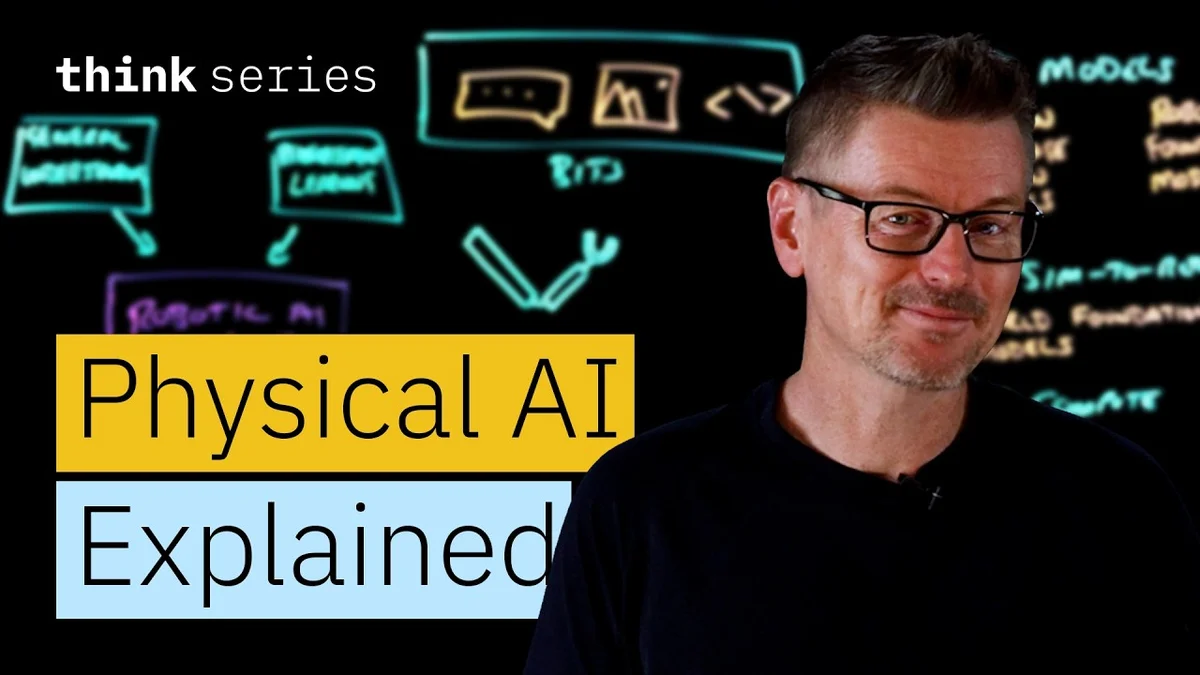
Martin Keen, a Master Inventor at IBM, recently shared insights into the evolving field of Physical AI, explaining its core concepts and the challenges in its development. Keen articulated that while much of today's AI operates within the digital realm of 'bits,' Physical AI aims to bridge this to the physical world of 'atoms.' This new frontier involves AI systems that can not only process information but also interact with and influence their physical environment.
Understanding Physical AI
Keen defines Physical AI as AI systems capable of perceiving their environment, reasoning about it, and taking actions within it. These are not just abstract models but agents that can, for example, manipulate objects, navigate complex spaces, or even perform tasks in manufacturing or logistics. He draws a parallel to current AI applications like chatbots or image generators, which operate purely in the digital space, distinguishing them from the tangible interactions of Physical AI.
The Rise of robotic AI agents
Keen highlights that the development of physical AI is closely tied to the creation of 'robotic AI agents.' These agents are characterized by their ability to learn and adapt. Unlike traditional robots with fixed, rule-based behaviors, these AI-powered agents can acquire new skills and improve their performance through experience. This learning process is often a combination of general understanding derived from large datasets and specific skill acquisition through methods like reinforcement learning.
The full discussion can be found on IBM's YouTube channel.
Bridging the Simulation-Reality Gap
A significant challenge in training Physical AI is the discrepancy between simulated environments and the complexities of the real world. Keen explains that simulations are crucial for generating vast amounts of training data efficiently. However, simply training in a perfect simulation often leads to models that perform poorly when deployed in the messy, unpredictable physical world. To address this, the concept of 'domain randomization' is employed, where simulations are intentionally varied with different parameters, such as lighting, friction, and object properties, to expose the AI to a wider range of conditions. This process helps the AI learn to generalize better and transfer its learned skills to real-world scenarios.