Foundation Models: A Commodity, Says Benedict Evans

Tech analyst Benedict Evans argues that foundation models are becoming commoditized, shifting the focus from model ownership to application development.

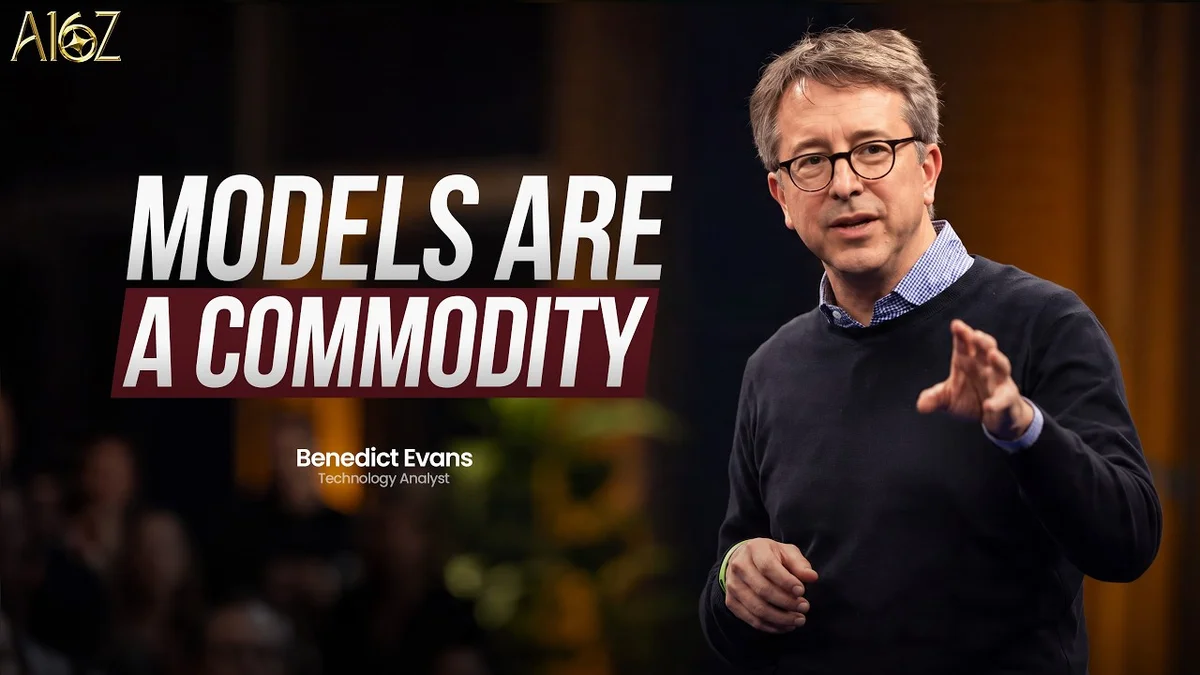
Benedict Evans speaking on a stage.
a16z
Visual TL;DR
Foundation Models MatureDriver
powerful AI models rapidly transitioning from novel research breakthroughs
From the article 3 mentionsEvans elaborated on this point, suggesting that as foundation models become more accessible and their underlying technology matures, the competitive advantage will shift from owning the model itself to building innovative applications and services on top of them.
CommoditizationContext
becoming accessible and underlying technology matures, shifting competitive advantage
Benedict EvansCore
From the article 6 mentionsIn a recent discussion on The a16z Show, renowned technology analyst Benedict Evans shared his perspective on the current state of artificial intelligence, specifically focusing on the concept of foundation models.
Focus ShiftsOutcome
From the articleEvans elaborated on this point, suggesting that as foundation models become more accessible and their underlying technology matures, the competitive advantage will shift from owning the model itself to building innovative applications and services on top of them.
Historical ParallelsContext
likened to internet and personal computer development
From the article 2 mentionsHe drew parallels to the early days of the internet, where companies that focused on creating services like email or web browsers, rather than just building the internet infrastructure, ultimately captured more value.
Application DevelopmentEffect
creating services like email or web browsers on top of infrastructure
From the article 3 mentionsThe conversation also touched upon the rapid pace of AI development and the challenges of predicting future breakthroughs and their ultimate applications.
Value CaptureOutcome
companies focusing on services ultimately capture more value
From the article 2 mentionsEvans emphasized that while the underlying technology is impressive, its true impact will be realized through the ingenuity of developers and entrepreneurs who can translate its capabilities into tangible value for users.
Contents(3)

In a recent discussion on The a16z Show, renowned technology analyst Benedict Evans shared his perspective on the current state of artificial intelligence, specifically focusing on the concept of foundation models. Evans posited that these powerful AI models are rapidly transitioning from novel research breakthroughs to becoming a commodity, a trend he likened to the historical development of critical technological infrastructure like the internet and personal computers.

Foundation Models: A Commodity, Says Benedict Evans - a16z
Foundation Models: A Commodity, Says Benedict Evans, from a16z

The Commoditization of Foundation Models

Evans elaborated on this point, suggesting that as foundation models become more accessible and their underlying technology matures, the competitive advantage will shift from owning the model itself to building innovative applications and services on top of them. He drew parallels to the early days of the internet, where companies that focused on creating services like email or web browsers, rather than just building the internet infrastructure, ultimately captured more value.

Shifting Focus to Applications

The implication for startups and the broader technology landscape, according to Evans, is a need to look beyond the foundational AI models themselves and concentrate on identifying unique use cases and user needs that can be addressed with this new technology. This means moving from the "what can AI do?" phase to the "what problems can AI solve for me?" phase. He highlighted that the real innovation will lie in how these models are integrated into existing workflows or used to create entirely new experiences and efficiencies.

The Future of AI Development

Evans’s perspective suggests a future where the barrier to entry for AI-powered products will lower significantly. Startups will be able to leverage readily available foundation models, much like developers today use cloud infrastructure or open-source software, to build and iterate on their ideas rapidly. This democratization of AI capabilities will likely foster a surge of creativity and entrepreneurship across various sectors.

The conversation also touched upon the rapid pace of AI development and the challenges of predicting future breakthroughs and their ultimate applications. Evans emphasized that while the underlying technology is impressive, its true impact will be realized through the ingenuity of developers and entrepreneurs who can translate its capabilities into tangible value for users.

© 2026 StartupHub.ai. All rights reserved. You may not republish this article in full without a license. Search engines and AI research tools may crawl and summarize for reference. Bulk reproduction or model training requires a license. See our terms.
Daniel Singer

Written by

Daniel Singer

Editor, StartupHub.ai

Daniel Singer is the editor of StartupHub.ai, a technology expert and thought leader on AI and its applications across sectors, from fintech and healthcare to developer tooling and consumer software. He writes and tests the tools covered here thoroughly and regularly, and built StartupHub.ai to give founders, operators and buyers a clearer read on what they are actually being sold.

More from Daniel Singer

