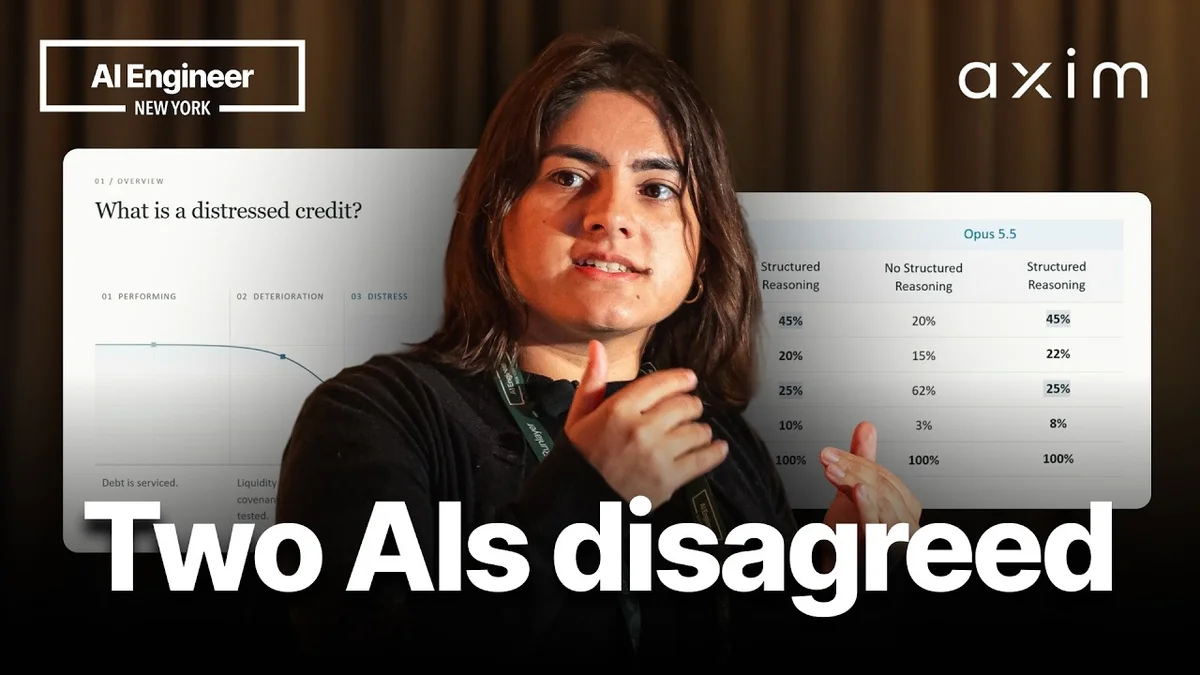
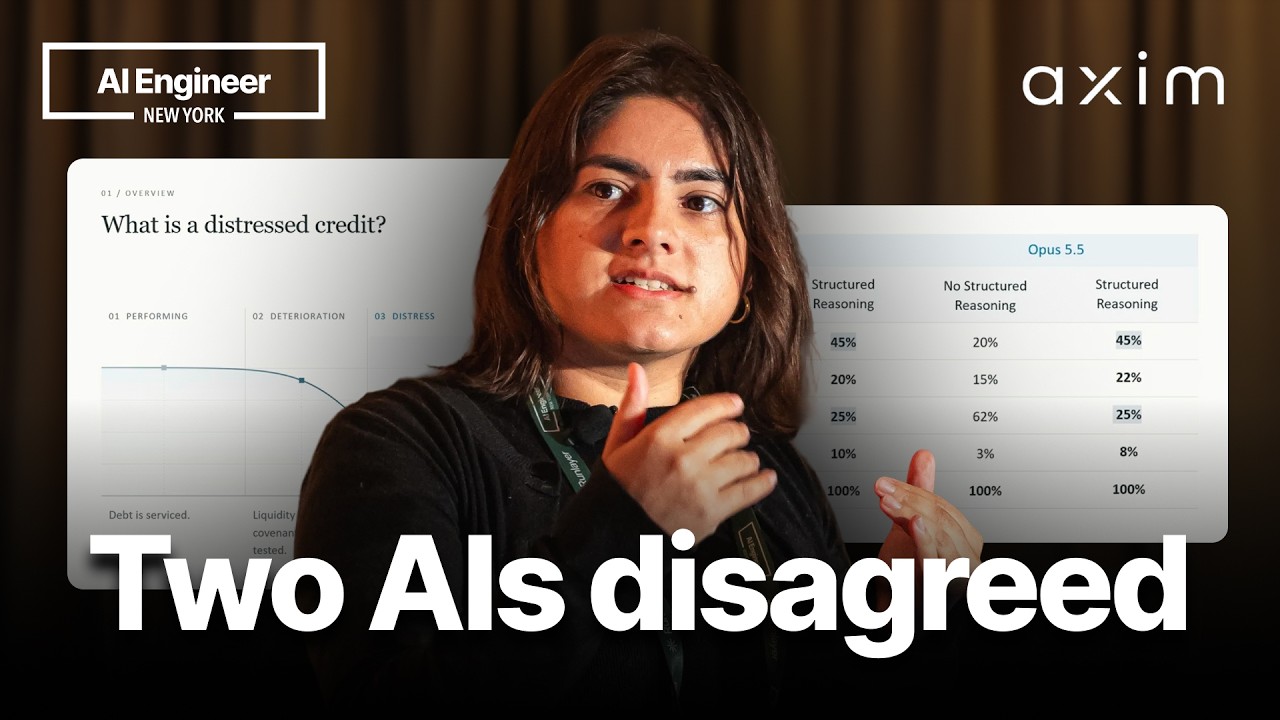
Harneet Kaur, founder and CEO of Axim Intelligence, put two frontier models on the same live distressed credit at AI Engineer and got two different futures. She ran iHeartMedia, a company that filed for bankruptcy in 2018 and went through another stressed transaction in 2024, through Astra 6 on Max Intelligence and Opus 5.5. Kaur said one model put bankruptcy at 62% and the other at 25%, even with the same structured context.
A distressed credit is a corporate bond or loan where the borrower might run out of cash or fail to repay, and distress itself is not one outcome. Bankruptcy is one path, Kaur said, but a liability management exercise is a set of creditor negotiations to rework obligations outside bankruptcy and a negotiated exchange or out-of-court restructuring are others. Historically the engineering question was binary, default or not, and the Altman Z-score was a workhorse. Kaur argued that method is now static for a market that moves monthly and has gone more opaque as private credit has grown and pricing has thinned.
That opacity makes understanding the credit hard because an investor has to answer financial, legal and operational questions at once. Liquidity and capital structure sit next to structural priority, which is whether your debt ranks senior or junior in repayment, and next to the business itself, whether revenue will rise or fall. Kaur said the manual work is reading credit docs, parsing lender dynamics and reconciling financials, and recent efforts like Pro Go or Harvey style benchmarking have tested how well AI answers each sub-question in isolation, which she called the big finance bench approach.
The disagreement is the point.
Kaur said she then imposed a layered reasoning pipeline and re-ran the same question. The layers were extraction where the model pulls EBITDA, a reconciliation or derivation layer where it computes leverage from EBITDA and debt, a judgment layer where it decides if the name is stressed, and a prediction layer where it assigns probabilities to future paths. With public companies extraction is largely solved, Kaur said, but with private loans held in Excel and PDFs it still fails. Once the pipeline enforced clean data and consistent derivations, she said, both models converged to about 25% for bankruptcy and agreed a negotiated restructuring was more likely than bankruptcy for iHeartMedia.
Convergence is not correctness and Kaur was explicit about it. There is no ground truth for a live situation and no way to say the 25% is right until events play out, and any use of historical outcomes to validate would introduce look-ahead bias. She argued the convergence matters because a stable, repeatable probability for future paths is effectively what a price is in a credit market, but she also left the core question open: with the same organized context as a human, she said, models showed no predictive edge on non-verifiable questions, and systematizing the process only got different intelligences to agree.