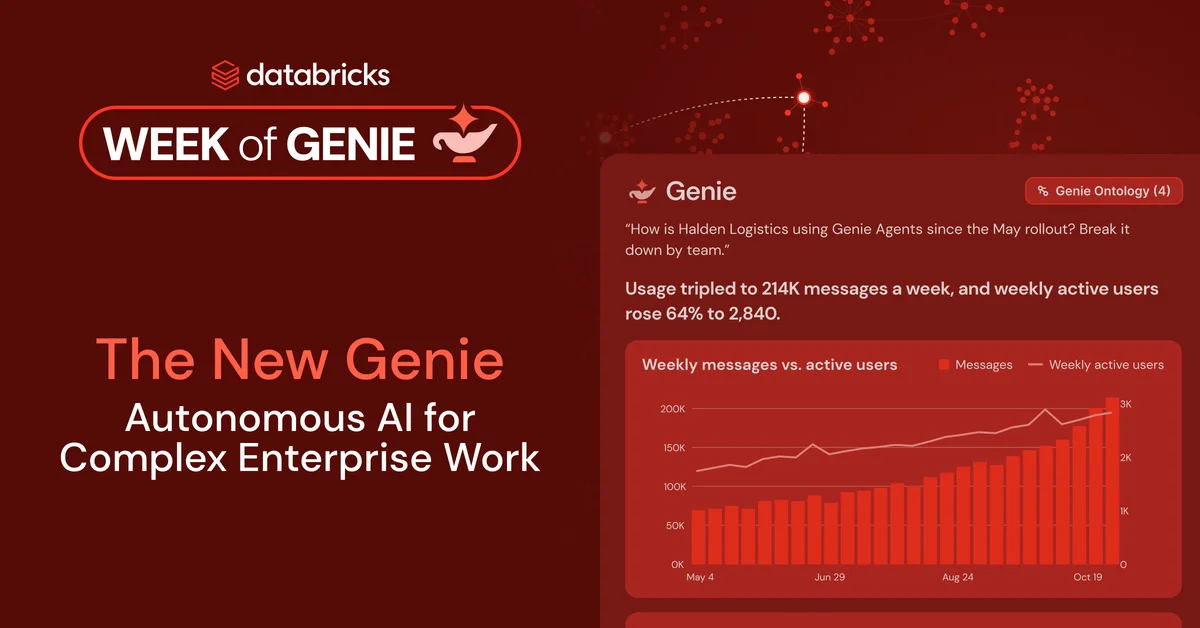
Databricks introduced the new Genie as an always-on coworker for long-running enterprise jobs.
Update, Nov 12, 01:51 UTC · via Databricks
Databricks reported that Genie Ontology is now Generally Available with "expanded knowledge sources and new tools to curate and refine it". Databricks said the release "adds Ontology Manager for curation" and "brings Unity Catalog Domains and Pages to General Availability".
Databricks also reported that the release "extends learned context to BI tools and organizational directories". Databricks said "Thousands of customers now run Genie Agents in production this way, including 7-Eleven, Virgin Atlantic and General Motors".
In a Turing-built test cited by Databricks, Genie answered correctly in 91% of task runs, 1.6 times the rate of the stronger frontier agent, while using less than half the tokens.
That comparison matters because the tasks required joining tables, dashboards and notebooks in the same workspace, not single-shot retrieval.
Databricks said thousands of teams already use Genie in production, including Zillow, Unilever, adidas, Atlassian and AstraZeneca.
Unity Gateway provides the control plane for that autonomy with tool access limits, action traces and spending caps under Unity Catalog permissions.
That control claim has a prior scale reference, as Ubisoft centralized AI governance for more than 4,000 developers on Unity Gateway with cost visibility, per Databricks customer reporting.
Genie Ontology supplies business definitions through OntoRank and Workday directories, while Genie Search joins indexed Drive, SharePoint, Jira, Confluence and Workday content with live MCP and SQL.
Access extends to Slack, Microsoft Teams and email plus plugins for ChatGPT and Claude, with MCP connectors to Zoom, Microsoft 365, Jira, GitHub, ServiceNow and PagerDuty.
Through Unity Gateway, Claude Code can route through governed Databricks models and external providers, per Databricks docs, which frames Genie as the governed alternative rather than a separate assistant.
The personal memory pitch extends the memory work covered in Databricks bets its HQ on agents that remember.
The 91% figure does not disclose task count, rival names or dollar cost per run, and Databricks has not published failure handling for jobs that need repeated approvals.
Independent reproduction of the Turing test and list pricing for scheduled jobs would change the read on token savings.
Will the sub-half token advantage hold once Genie runs weeks of monitored jobs under spending caps instead of benchmark tasks?