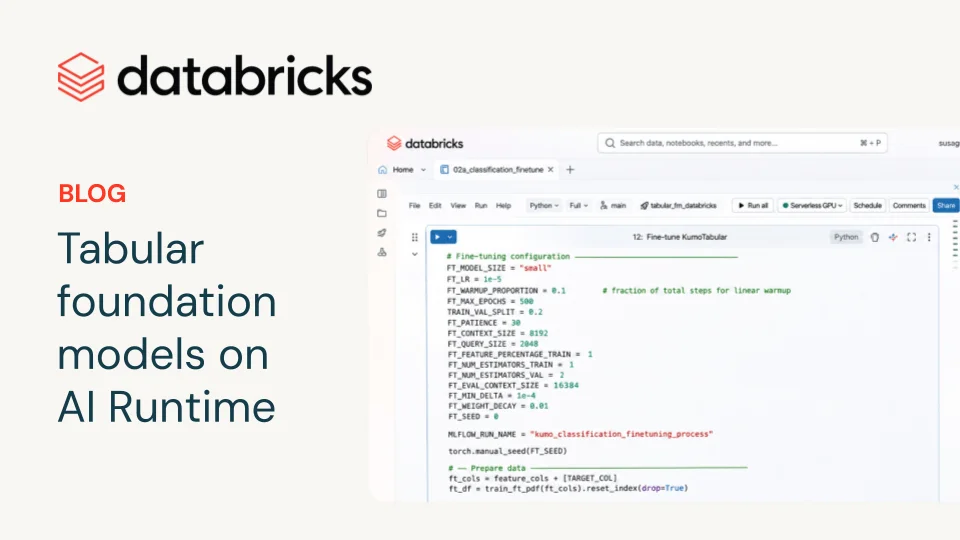
Databricks puts AI Runtime forward as managed H100 capacity for tabular foundation models at up to 1M rows by 200 features, per Databricks.
The spread is stark: TabICLv2 runs about 28M parameters under BSD 3-Clause while TabFM lists about 400M under a non-commercial license, per Databricks.
KumoTabular at about 215M parameters and Mitra v2 at about 77M both claim commercially permissive terms, unlike TabPFNv3.5 at about 220M, per Databricks.
TabICL compresses each row to four tokens so test rows attend only to training rows, a design TabFM and KumoTabular extend, while DeepLearning AI notes LLMs are not built for tabular prediction and teaches TFMs as the in-context alternative.
Databricks says GPU inference costs more per prediction than XGBoost on CPU but publishes no latency, memory or dollar figures, per Databricks.
Published cost per 100,000 predictions would change the read, so will buyers pay H100 rates for faster experiments when XGBoost still runs cheap on CPUs?