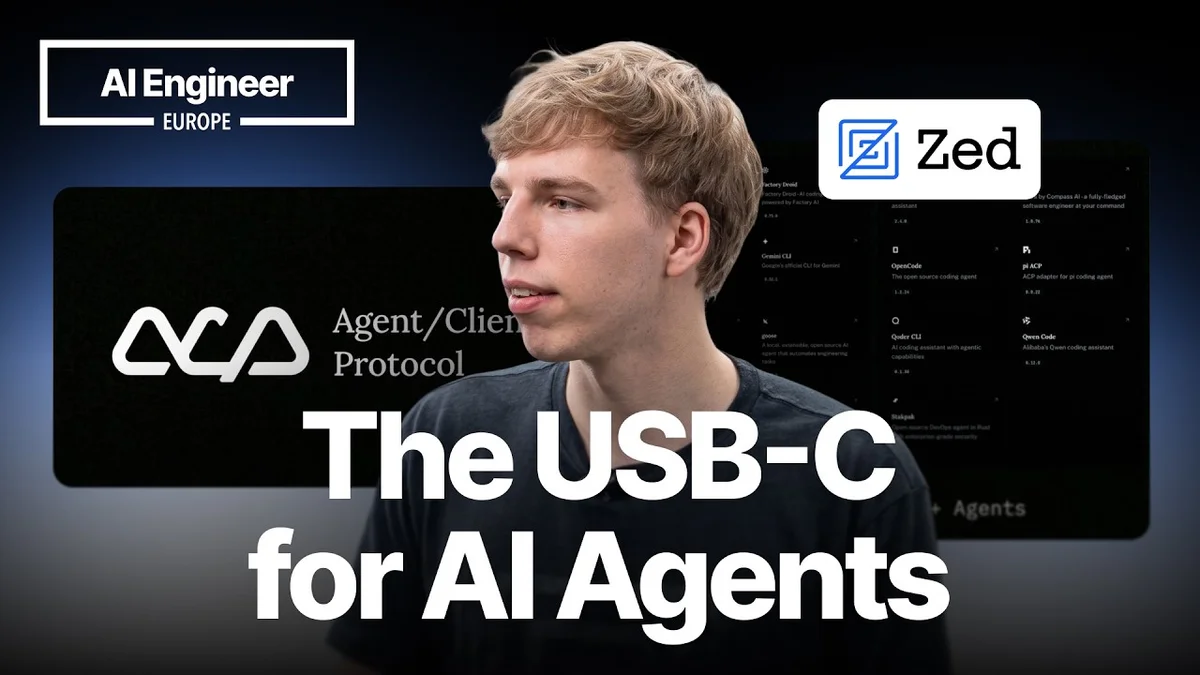
In a live demonstration, Bennet Fenner from Zed showcased the process of building an Agent/Client Protocol (ACP) compatible agent. Fenner, who works at Zed and has extensive experience in Rust development, detailed the steps involved in creating an agent that adheres to the ACP, a protocol designed to standardize communication between AI agents and their clients.
Understanding the Agent/Client Protocol (ACP)
Fenner began by explaining the core concept of the ACP, which aims to provide a unified interface for various AI models and their applications. The protocol allows users to bring their agent of choice to a tool, ensuring a consistent user experience across different AI models. He highlighted that the ACP is open-source and encourages community contributions.
Key ACP Interfaces and Implementation
The demonstration delved into the essential interfaces an ACP-compatible agent must implement. These include:
- Initialize: For the agent to respond with its protocol version.
- Authenticate: To handle client authentication.
- NewSession: To create a new session for a client.
- Prompt: To process user prompts and return responses.
- Cancel: To notify the agent of ongoing operations that need to be canceled.
Fenner walked through the TypeScript code for a basic coding agent, demonstrating how to define these interfaces and handle incoming requests from the client. He emphasized that while the underlying AI models might be stateless, the agent itself maintains state through sessions.
Tool Definition and Usage
A crucial aspect of building ACP agents is defining and using tools. Fenner showcased how to define tools with specific input schemas and descriptions. For the coding agent example, he demonstrated two tools: 'read_file' and 'edit_file'. The 'read_file' tool takes a file path and returns its content, while 'edit_file' allows for replacing specific text within a file. These tools are essential for enabling agents to perform actions in the real world or interact with other systems.
Live Coding and Demonstration
Fenner proceeded with a live coding session, building a minimal ACP-compatible agent. He showed how to set up the agent's constructor to receive the current working directory, connection details, and session ID. The agent's core loop involves receiving prompts, processing them using the defined tools, and sending back session updates to the client. He demonstrated how to handle different types of session updates, such as 'agent_message_chunk' for streaming output and 'tool_call_update' for tool execution status.
The Power of ACP Adoption
The presentation highlighted the growing adoption of the ACP, with over 40 clients and 30+ agents already supporting the protocol. This widespread adoption signifies the protocol's effectiveness in fostering interoperability within the AI agent ecosystem. Fenner mentioned that various popular tools and platforms are integrating ACP, further solidifying its position as a standard for AI agent development.
Conclusion and Resources
Fenner concluded by encouraging viewers to explore the ACP and contribute to its development. He shared the GitHub repository for the demo, providing a resource for those interested in learning more or getting started with building their own ACP-compatible agents. The session underscored the collaborative and open-source nature of AI development and the importance of standardization in driving innovation.