

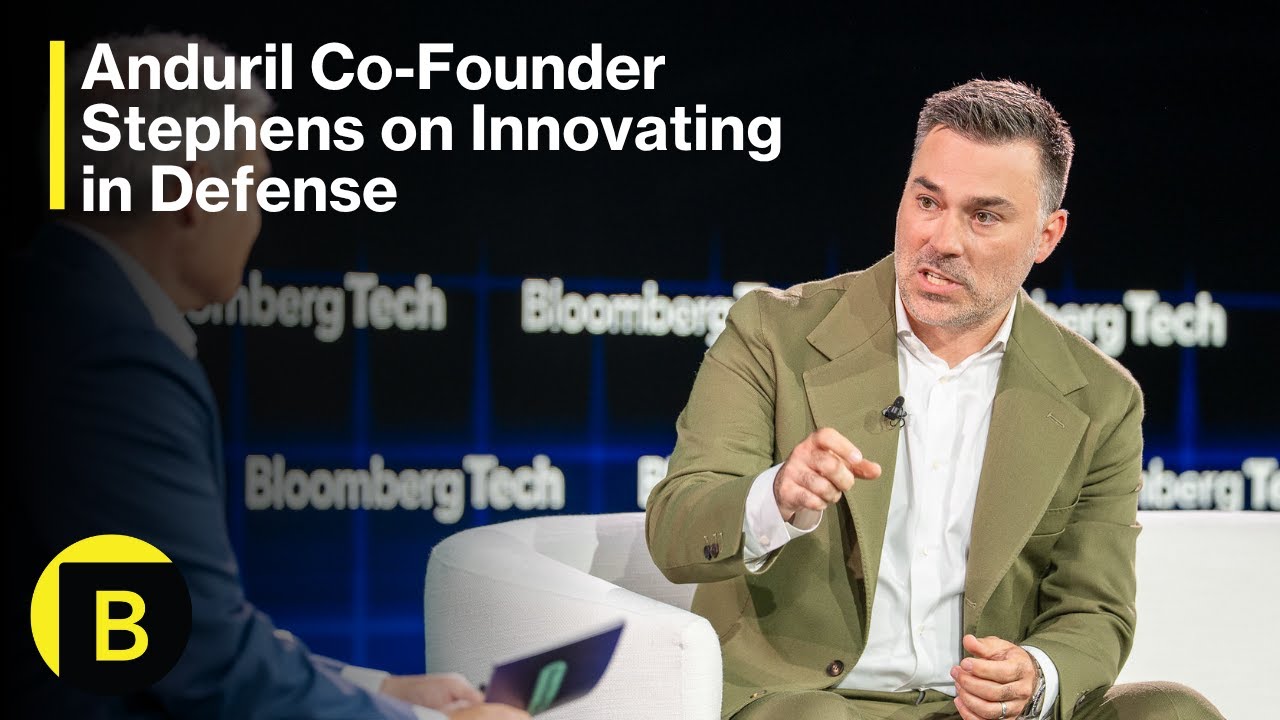
“More time has passed between the first flight of the SR-71 to today than passed between the Wright Flyer to the SR-71. That’s crazy. We used to move really fast.” This stark observation from Trae Stephens, co-founder and executive chairman of Anduril Industries, cuts through the typical tech-bro bravado, laying bare a critical truth about the state of global defense innovation. Speaking with Bloomberg’s Senior Executive Editor Tom Giles at Bloomberg Tech, Stephens articulated a vision for defense that is less about incremental upgrades and more about a wholesale paradigm shift, fueled by a recent $2.5 billion funding round that rocketed Anduril’s valuation to a staggering $30.5 billion post-money. The conversation wasn't just about capital; it was a deep dive into the very philosophy of how the free world defends itself in an era of accelerating threats.
Stephens wasted no time in highlighting Anduril’s radical departure from the entrenched defense contracting model. Unlike the traditional “cost-plus” system, where the government bankrolls every stage of development, production, and decades of maintenance, Anduril operates as a "defense products company." As Stephens put it, "We're actually doing it ourselves. We're taking on the cost of development, we're taking on the cost of production, and then we're selling a product, a completed product to the government." This self-funded, product-centric approach is a direct challenge to the slow, bureaucratic behemoths that have dominated the defense industrial base for half a century. It’s a capital-intensive gamble, but one that allows Anduril to bypass the endless, often inefficient, development cycles that plague traditional primes.
The urgency underpinning this model isn't abstract; it’s a direct response to the brutal realities of modern conflict. Stephens pointed to the theaters of Ukraine and Israel, noting, "Things move very quickly and we need to move at a speed of relevance." This isn't just about deploying existing tech faster; it's about continuously developing and scaling new capabilities at a pace unheard of in the traditional defense sector. A significant portion of Anduril’s recent funding, "North of a billion dollars of that is just purely reserved for scaling production," Stephens revealed, underscoring the company’s commitment to mass manufacturing and rapid deployment of autonomous systems across all domains, from undersea to space.
This expansion isn't confined to digital blueprints. Anduril is building out its physical footprint, with Arsenal One in Ohio leading the charge. This initial 800,000-square-foot facility is just the beginning, set to expand to five million square feet in the coming years. But Anduril’s ambitions stretch beyond Ohio, with plans for additional manufacturing sites for solid rocket motors and even shipyards for undersea systems. Stephens also emphasized the international dimension, stating, "We're working with our allies and partners, we could stand up manufacturing capacity in those countries as well, which, as you might imagine from the perspective of a national prosperity agenda, these are really important signals of partnership to our closest friends abroad." This strategy is not just about domestic capacity but about bolstering allied industrial bases and fostering a more resilient, distributed defense ecosystem.
The broader context of US defense modernization efforts has seen its share of false starts, but Stephens expressed optimism about the current trajectory. He credited former Obama administration Secretary of Defense Ash Carter with initiating crucial reforms, including the Defense Innovation Unit (DIU) and the Defense Digital Service. "He really had this vision that conflict was changing," Stephens said, referring to Carter’s foresight about the shift from non-nation state conflict to great power competition. While acknowledging the "fits and starts" since then, Stephens observed that the civilian and political leadership across agencies are now "aligned behind the idea that we really have to move quickly into these new capability sets." This alignment, he suggested, is finally directing budgets to the right places, focusing on next-generation capabilities rather than merely maintaining legacy systems.