
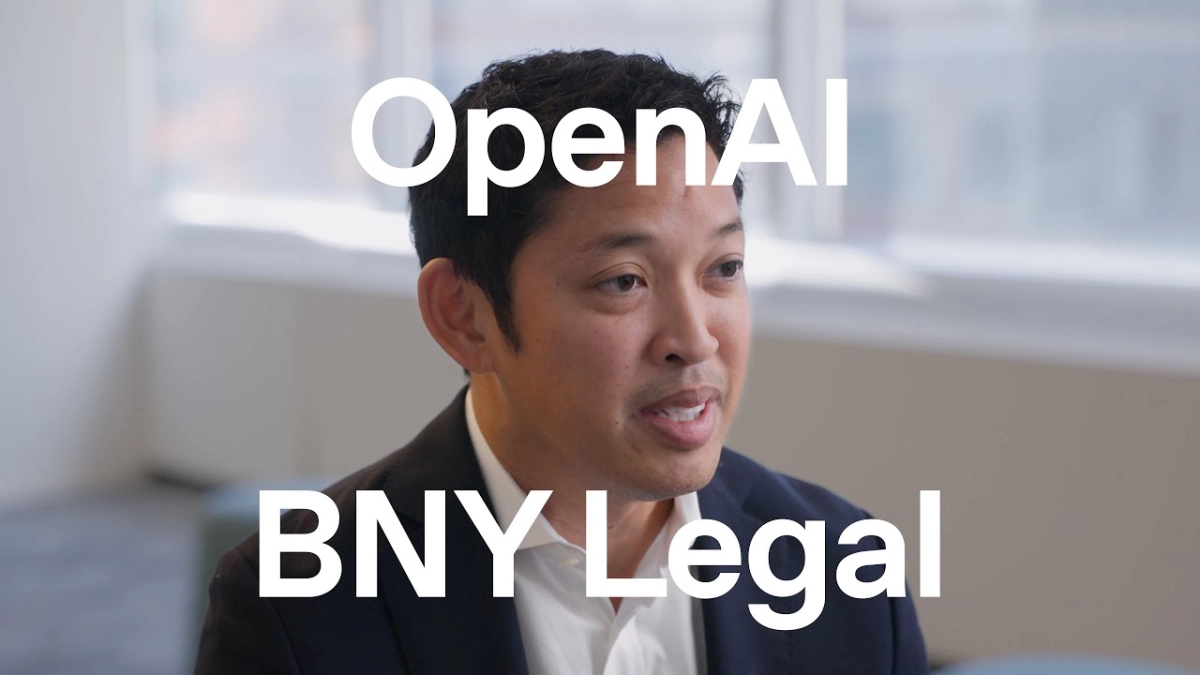
The deployment of generative AI within BNY Mellon’s legal department has delivered a staggering 75% reduction in average contract review time, proving that even the most risk-averse, highly regulated industries can unlock monumental efficiency gains through large language models. This is not merely a tale of technological integration; it is a blueprint for scaling AI safely within the enterprise environment. The core challenge for any financial services giant is translating the raw power of foundational models into trustworthy, auditable, and compliant internal tools. BNY’s success provides critical insight into how this translation can be achieved.

Watt Wanapha, Deputy General Counsel and Chief Technology Counsel, alongside Sarthak Pattanaik, Chief AI and Data Officer, discussed BNY’s internal AI platform, Eliza, and its collaboration with OpenAI. Their commentary focused heavily on the necessity of operationalizing AI within a stringent risk management framework, a non-negotiable requirement for a global financial institution operating in a position of trust within the financial markets. For BNY, which prides itself on having a very mature and robust resiliency and risk management framework, the adoption of generative AI was less about speed-to-market and more about controlled, secure integration.
The specific application centers on high-volume, high-stakes documentation: a contract review assistant built on BNY’s proprietary Eliza platform, utilizing OpenAI’s models for document analysis and summarization. This tool is purpose-built to handle the repetitive, detail-intensive labor inherent in legal workflow. Wanapha confirmed that this agent helps attorneys “improve the speed, quality, [and] consistency of their reviews.” The quantifiable impact is stark: the system has reduced the time spent on reviews by 75% on average. This efficiency gain is not just a marginal improvement; it represents a fundamental restructuring of legal workload, freeing high-value legal talent from rote analysis and allowing them to focus on novel legal questions and strategic counsel.
For founders and investors targeting the enterprise market, BNY’s approach to governance is perhaps the most salient lesson. In highly regulated sectors, the technological capability of the model is secondary to the reliability of its deployment framework. The financial industry cannot afford hallucinations, bias, or data leakage. Therefore, the implementation strategy focused on embedding safety from the outset. Sarthak Pattanaik stressed that they approached this challenge by “building the governance guardrails and having responsible AI principles by design.” This perspective frames governance not as a restrictive barrier, but as a critical enabler that provides the necessary assurance for widespread adoption.
The governance structure acts as the crucial middleware layer. BNY’s Eliza platform serves as the secure wrapper, ensuring that the external power of OpenAI is channeled safely within the firm’s regulatory and ethical boundaries. This internal orchestration allows BNY to leverage the rapid advancements of external large language models while maintaining full control over data handling, bias mitigation, and audit trails. This commitment to controlled deployment is essential for internal buy-in. It transforms perceived complexity into operational certainty.
This shift transforms the role of the legal professional. The AI is not replacing the attorney; it is augmenting their capacity for judgment. Wanapha highlighted that when confronting complex or "novel question about the law," the AI provides a comprehensive first pass, efficiently synthesizing vast amounts of data. This allows the human expert to move directly to the analysis and application of the law, rather than spending days on basic research and document comparison. The technology fundamentally redefines productivity metrics within professional services, shifting value creation from processing volume to delivering strategic insight.
The team recognized that while some might view the requisite governance structure as a constraint, BNY’s experience shows the opposite. Wanapha stated: “Some might see AI governance as a barrier, but in our experience, we have seen it as an enabler.” This enabling function is rooted in trust. By ensuring that the AI adheres to the same rigorous standards of resilience and risk management applied across all other critical financial operations, BNY has successfully positioned AI as a reliable, strategic partner.
This partnership is key to BNY’s forward-looking strategy. The integration of AI allows the legal department to be more proactive, transforming from a necessary cost center into a strategic asset that can accelerate business velocity. The ultimate opportunity, Wanapha concluded, is that AI can be a strategic partner, deeply integrated into core business functions to drive both efficiency and competitive advantage. The ability to deploy generative AI at scale, safely and consistently, in a complex environment like BNY Mellon sets a benchmark for all enterprises navigating the current technological inflection point.




