

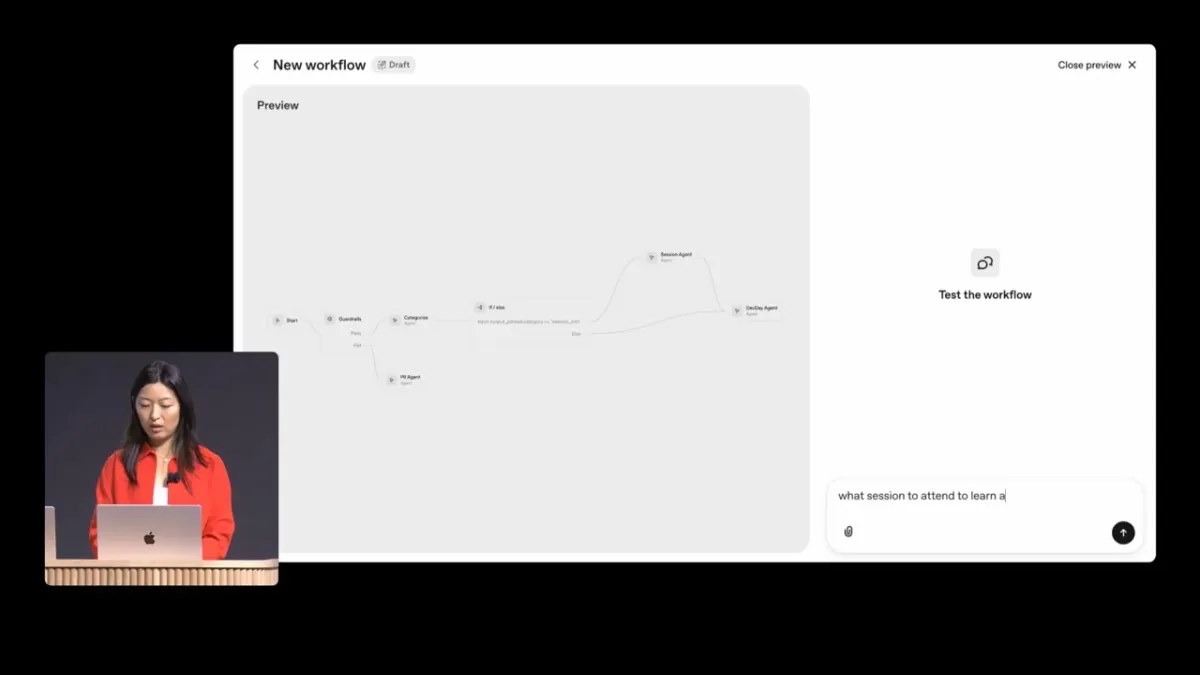
"We need to have AI in our Dev Day website." This statement encapsulates the drive behind OpenAI's AgentKit, a tool designed to accelerate the development and deployment of AI agents. At OpenAI's Dev Day, Christina Huang showcased AgentKit, demonstrating how developers can create intelligent assistants with remarkable speed and flexibility. Her demo involved building and embedding an AI agent directly into the OpenAI Dev Day website in under eight minutes.
Huang, from the Platform Experience team at OpenAI, revealed AgentKit's potential to revolutionize agent creation. She illustrated how AgentKit empowers developers to design, deploy, and embed intelligent assistants using OpenAI's platform tools. One key insight from the demo is the platform's emphasis on visual workflow building. "Instead of starting with code, we can actually wire nodes up visually," Huang explained, highlighting the intuitive interface that simplifies complex processes.
AgentKit's ability to model complex workflows in a visual way is a game-changer. The platform provides common building blocks like file search, MCP, guardrails, and user approval, streamlining the agent creation process. Huang emphasized that these building blocks are derived from "common patterns that we've learned from building agents ourselves," ensuring that developers have access to the most effective tools and strategies.
Huang's eight-minute challenge illustrated AgentKit's efficiency. The agent she constructed was designed to: create personalized agendas based on attendees' interests, provide real-time answers about sessions, speakers, and logistics, and answer general questions about Dev Day. This underscores AgentKit's capacity to build agents that can deliver personalized and context-aware assistance.
The demonstration also highlighted the importance of guardrails in AI development. She noted that "one of the most important things when building agents is being able to trust them, and guardrails help you have that confidence." AgentKit's pre-built guardrails address critical concerns such as hallucinations, moderation, and PII, fostering trust and reliability in AI agents.