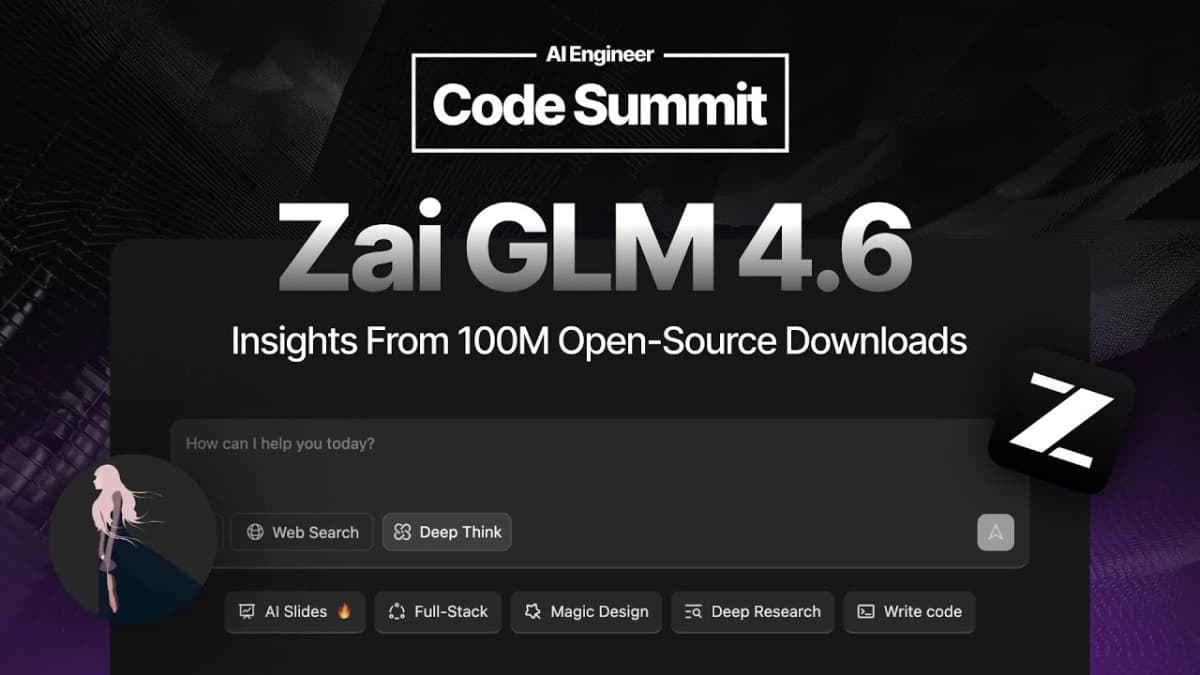
The open-source model GLM 4.6 has achieved a remarkable feat, standing shoulder-to-shoulder with proprietary giants like GPT-4o and Claude 3.5 Sonnet as a top performer on the LMSYS Chatbot Arena. This accomplishment, detailed by Yuxuan Zhang from Z.ai, signals a pivotal moment for the AI community, demonstrating that cutting-edge capabilities are no longer exclusively within the domain of closed-source development. Zhang, a key figure behind the GLM family, recently discussed the intricate technical roadmap that propelled the models to over 100 million downloads, offering a rare glimpse into the architectural and training innovations that underpin such frontier-class performance.
During his presentation, Yuxuan Zhang from Z.ai elucidated the strategic decisions and engineering breakthroughs that allowed GLM 4.6 to compete at the highest echelons of AI. He emphasized Z.ai's core mission, stating, "Our mission is to build the most capable general purpose open-source foundation model," a vision now visibly manifesting in GLM 4.6's benchmark results. This commitment to open-source leadership, coupled with relentless technical refinement, has positioned the GLM family as a formidable force, proving that democratized access to advanced AI is not just aspirational but achievable.
A cornerstone of GLM 4.6's success lies in its meticulously curated data recipe. The model was pre-trained on an colossal 15 trillion tokens, but mere volume was not the driving factor. Zhang highlighted the intensive effort dedicated to data quality and filtering, a process he described as consuming "a lot of time." This rigorous approach extended to incorporating "repo-level code contexts," moving beyond traditional file-level understanding to provide the model with a richer, more holistic comprehension of software projects. Furthermore, the integration of "agentic reasoning data" was crucial, equipping GLM 4.6 with enhanced capabilities for complex problem-solving and sequential task execution, a critical element for future AI applications.
One of the most significant architectural innovations presented was the SLIME framework, an acronym for Synchronous-asynchronous Large-scale Imitation and Reinforcement Learning. This hybrid architecture was specifically designed to tackle the inherent challenges of training AI agents at scale without creating bottlenecks in expensive GPU clusters. By efficiently managing the interplay between synchronous and asynchronous learning processes, SLIME enables robust and scalable reinforcement learning, a vital component for developing sophisticated, agent-driven AI systems.
Perhaps the most counter-intuitive yet impactful training decision was Z.ai's abandonment of multi-stage Reinforcement Learning in favor of a single-stage approach. This choice directly addressed a critical limitation observed in multi-stage methods. Zhang revealed a profound insight: "We found that single-stage RL is much better at preserving the long context capabilities." This discovery runs contrary to some prevailing wisdom in LLM training, where multi-stage RL is often employed. However, Z.ai’s research demonstrated that the iterative refinement of multi-stage processes could inadvertently degrade the model's ability to maintain coherence and understanding over extended text sequences, a capability paramount for advanced applications.
The dedication to specialized optimization extended to coding tasks through the implementation of token-weighted loss. This technique specifically enhances the model's proficiency in generating high-quality code, a critical feature for developers and a testament to GLM 4.6's versatility beyond general text generation. This granular focus on improving specific domains showcases a strategic depth in their training methodology, directly addressing the practical needs of a developer-centric audience.
Related Reading
- Claude's Evolution: From Chatbot to Cognitive Collaborator
- GPT-5's Scientific Revolution: From Niche Proofs to Accelerated Discovery
Beyond its textual prowess, the GLM family is also expanding into multimodal capabilities with GLM 4.5V. This iteration boasts "native resolution processing," enabling superior UI navigation, comprehensive video understanding, and a broader range of general multimodal interactions. This advancement signifies Z.ai’s ambition to build not just a text-based foundation model, but a truly general-purpose AI capable of perceiving and interacting with the world across diverse data types, a crucial step towards more human-like intelligence.
The emphasis on practical deployment is another hallmark of Z.ai's open-source philosophy. Recognizing that even the most capable models require efficient and accessible deployment mechanisms, GLM models are integrated with popular tools such as vLLM, SGLang, and Hugging Face. This strategic integration ensures that the GLM family is not only performant but also readily usable by the wider AI community, fostering adoption and further innovation within the open-source ecosystem. The commitment to making frontier AI accessible and deployable underlines a pragmatic approach vital for widespread impact.