

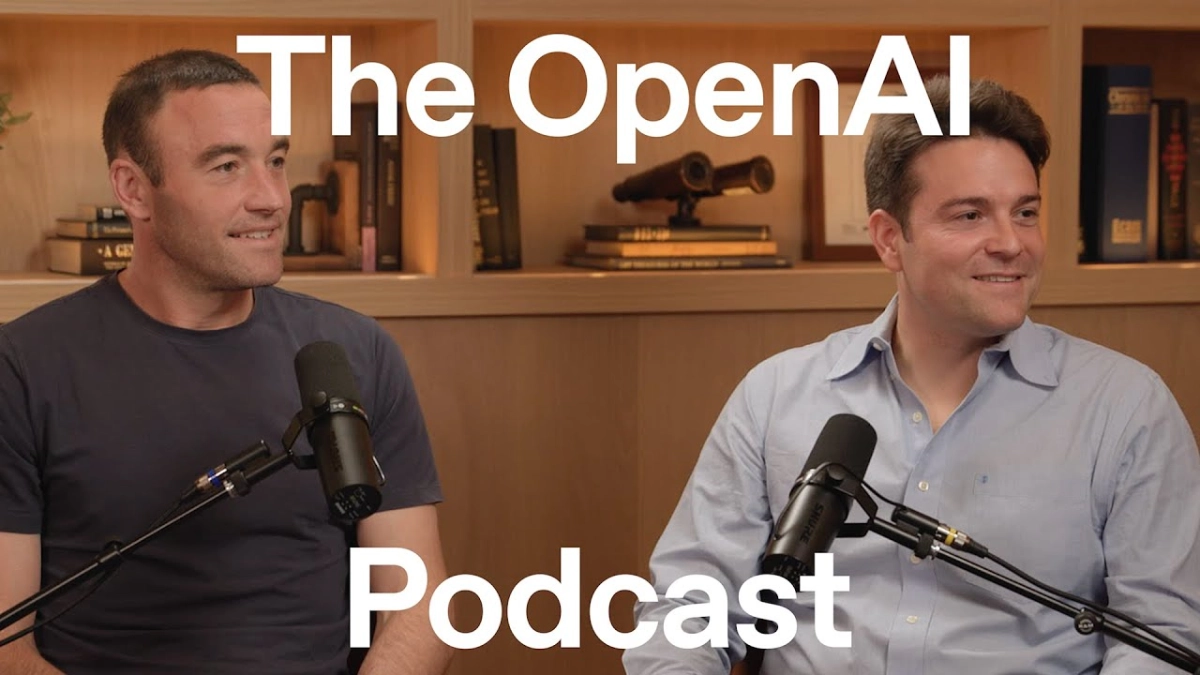
"Perhaps the most profound way that people are going to feel AGI in their lives is through science." This bold statement by Kevin Weil, Head of OpenAI for Science, encapsulates the central theme of a recent OpenAI podcast. Weil and Alex Lupsasca, an OpenAI research scientist and Professor of Physics at Vanderbilt University, conversed with Andrew Mayne about the transformative impact of artificial intelligence on scientific discovery, highlighting the nascent yet profound capabilities of models like GPT-5. Their discussion painted a compelling picture of a future where AI acts as a potent accelerator, compressing decades of research into mere years and fundamentally reshaping the scientific landscape.
The core mission of OpenAI for Science, as Weil articulated, is precisely this acceleration: "Can we help scientists do the next, say, 25 years of scientific research and scientific discovery in five years instead?" This ambitious goal is now within reach, he explains, because "we're just starting to see our frontier AI models being able to do novel science." These aren't just incremental improvements; they represent initial "existence proofs" where GPT-5 is breaking past the known frontiers of human knowledge, venturing into the unknown.
Lupsasca, initially an "AI skeptic," shared a compelling personal anecdote illustrating this shift. Tasked with finding a specific magnetic field solution for a pulsar, a problem involving partial differential equations and infinite sums of Legendre polynomials, he leveraged a friend's access to GPT-5 Pro. After thinking for an unprecedented 11 minutes, the model provided a "beautiful answer," correctly identifying a complex identity from a 1950s Norwegian mathematics journal. Though the final output contained a minor typo, easily corrected by human review, the process demonstrated AI's capacity for complex, cross-disciplinary problem-solving.
This capacity for rapid calculation and cross-disciplinary insight extends beyond individual proofs. Weil noted that AI enables scientists to explore multiple research paths in parallel, dramatically increasing the volume of ideas that can be tested. "Instead of exploring two paths over the course of a week... you can explore ten paths in parallel in an hour," he explained. This qualitative change in exploration significantly broadens the scope of inquiry.
Another critical area of acceleration lies in literature search and interdisciplinary connections. Scientists often struggle to keep abreast of developments outside their narrow specializations. GPT-5, with its vast knowledge base, can bridge these gaps. Weil recounted a researcher exploring high-dimensional optimization who was convinced similar work must exist but couldn't find it. GPT-5 identified a relevant PhD thesis in German, from the field of economics, using completely different terminology. This conceptual-level literature search unearthed "lost to time" work, proving invaluable.