

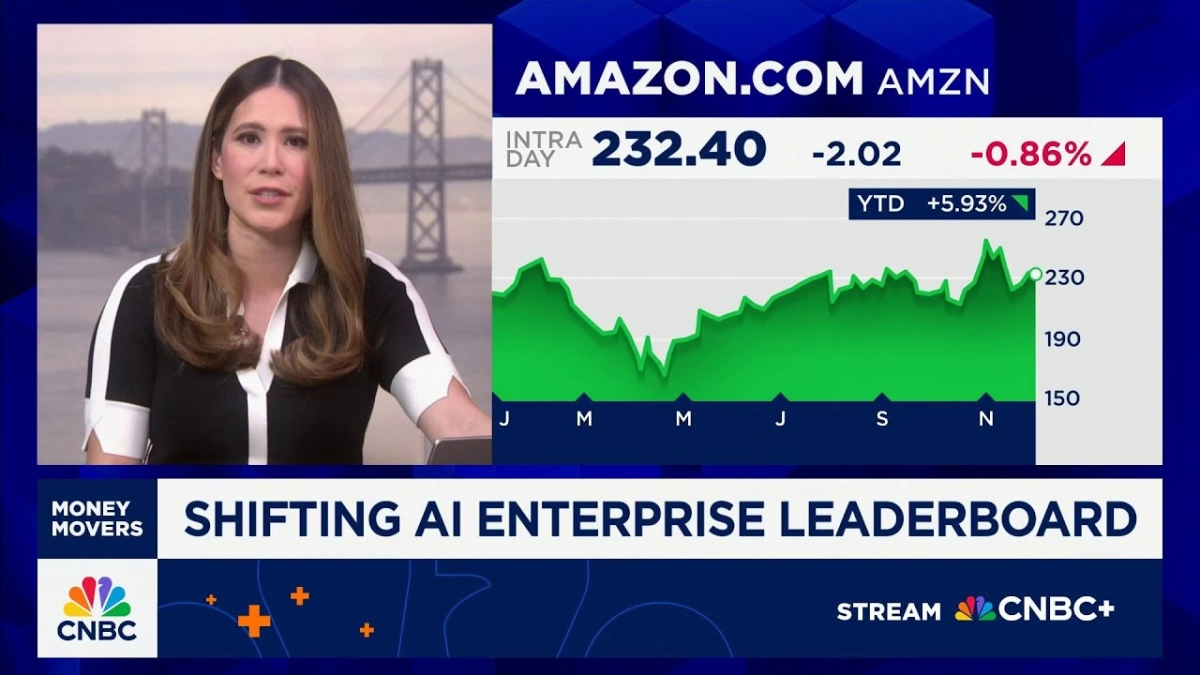
The much-touted narrative of AI agents revolutionizing enterprise workflows is facing a significant recalibration, as recent data and corporate maneuvers suggest a more nuanced and complex adoption curve than initially projected. This evolving landscape, marked by a tempering of expectations for direct AI agent deployment and a surge in API-driven model usage, was a central theme in CNBC's "Money Movers" segment, where TechCheck Anchor Deirdre Bosa reported on the pressures facing the AI enterprise agent narrative and the shifting leaderboard.
The discussion opened with a critical clarification from Microsoft regarding reports of lowered AI software sales targets. Microsoft stated that "The Information’s story inaccurately combines the concepts of growth and sales quotas, which shows their lack of understanding of the way a sales organization works and is compensated. Aggregate sales quotas for AI products have not been lowered, as we informed them prior to publication." This subtle but important distinction underscores a broader challenge: while the potential for AI remains immense, the immediate, executive-level adoption of fully autonomous AI agents is encountering resistance. It appears that growth targets, reflecting the pace of market absorption, are being adjusted, even if overall sales quotas for AI products remain ambitious.
Further evidence of this market recalibration comes from OpenAI, a key Microsoft partner. Sam Altman's internal "Code Red" memo reportedly directed a refocus of resources on improving the core ChatGPT experience, while delaying initiatives on AI agents and advertising. This strategic pivot from one of the leading AI innovators signals a recognition that the foundational large language models require further refinement and stability before complex agentic applications can achieve widespread, reliable deployment. The immediate utility and user experience of conversational AI are taking precedence over the more ambitious, multi-step automation promised by agents.
Amidst this tempering of expectations for AI agents, a new competitive dynamic is emerging in the enterprise AI space. Data from Ramp, highlighted by Bosa, reveals that while OpenAI remains the overall leader in model adoption, its growth is moderating. Concurrently, Anthropic, a rival AI developer, has experienced one of its biggest monthly gains in AI enterprise adoption. This shift points to a critical distinction in how AI is being consumed by businesses.
Deirdre Bosa succinctly captured this divergence: "Agents are top-down, they're sold to executives. APIs, they're bottom-up, adopted by the builders at these organizations." The data indicates that Anthropic's impressive gains are primarily driven by API spend, meaning developers are integrating Anthropic’s models directly into their applications and workflows, rather than enterprises adopting packaged, executive-mandated agent solutions. This bottom-up adoption by technical teams, who are actively building and experimenting, suggests a more organic and practical path to AI integration within organizations. It highlights a preference for modular, flexible AI components that can be customized and embedded, rather than monolithic, pre-built agents.