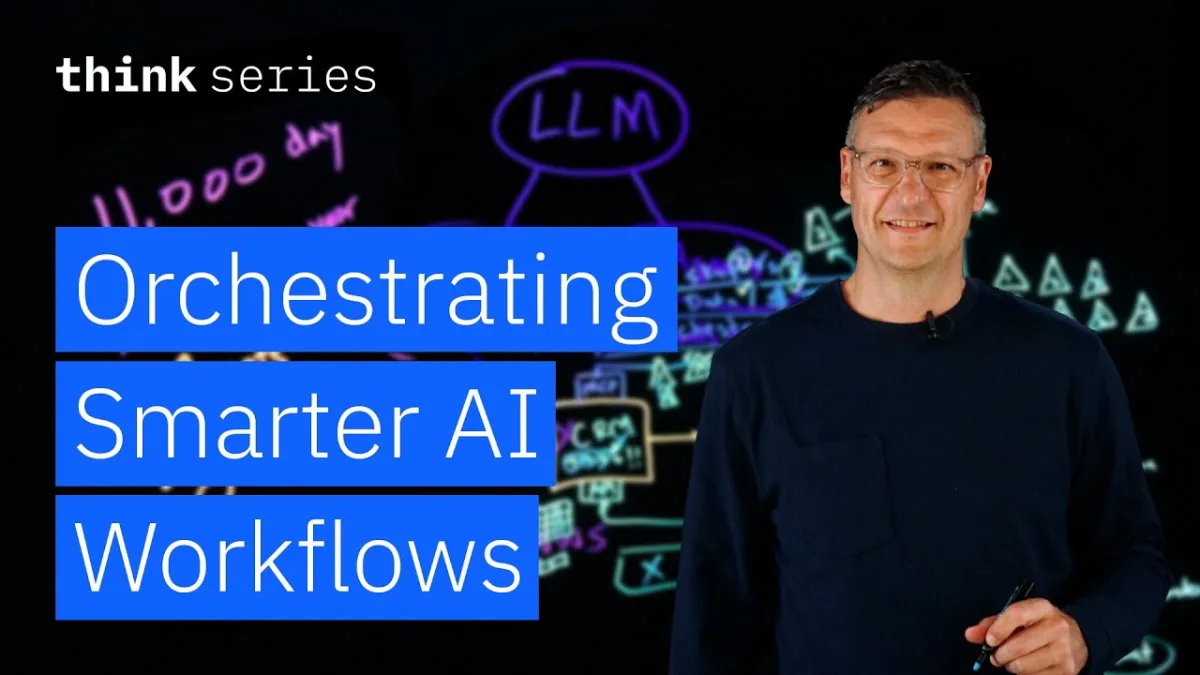
"Artificial intelligence is set to transform IT," declared Eric Pritchett, President and COO of Terzo, inaugurating a compelling discussion on the profound impact of AI agents and Large Language Models (LLMs) on enterprise workflow orchestration. His presentation, delivered with clarity and illustrative diagrams, transcended mere technical exposition, offering a strategic blueprint for founders, VCs, and AI professionals navigating this rapidly evolving landscape. Pritchett’s central thesis underscored that the integration of AI agents and LLMs represents not just an incremental advancement in automation, but a fundamental paradigm shift in how complex business processes can be conceived and executed.
Pritchett began by contextualizing the sheer scale of current AI agent deployment, estimating a staggering 11,000 new AI agents being created daily, culminating in over a million deployed this year alone. This explosive growth signals an undeniable imperative for organizations to understand and leverage these technologies. He elucidated that the orchestration of complex workflows with agents is, in many respects, an extension of existing frameworks and tools familiar to most developers, yet it is fundamentally reshaped by the advent of LLMs.
The emergence of LLMs, according to Pritchett, is the "new kid on the block" that injects a powerful language faculty into automation, enabling a new kind of logic in how business tasks are automated. This capacity for understanding and generating human language allows for a more nuanced and dynamic interaction with complex processes. He meticulously differentiated between AI assistants and AI agents, a crucial distinction for developers. Assistants operate on a "prompt-response framework," where a question is asked, and an answer is returned. Agents, however, are given "goals" and are expected to deliver "outcomes," possessing the "agency to actually take action at its discretion within the boundaries that we set." This autonomy is a cornerstone of the paradigm shift.
Traditional Robotic Process Automation (RPA), while effective for highly structured and repetitive tasks, often hits limitations when faced with the inherent ambiguities and dynamic nature of real-world business workflows. RPA typically relies on explicit triggers, well-defined APIs, and structured data tables, requiring meticulous configuration for each step. This rigid framework struggles with scenarios demanding contextual understanding, adaptive decision-making, or the synthesis of information from disparate, less structured sources.
Agent orchestration, powered by LLMs, liberates automation from these constraints. Instead of prescribing every single action, developers can define high-level goals, and the LLM-powered agents, often working in concert as an "army of little agents," are empowered to devise and execute the necessary steps to achieve those outcomes. Pritchett illustrated this with an example of generating a commercial quote. In an RPA scenario, each interaction with a CRM, product catalog, or financial system would require pre-programmed, explicit API calls and data mapping. With agent orchestration, a master agent, leveraging its LLM capabilities and defined goals, can spawn specialized sub-agents. These sub-agents, each narrowly trained on specific tasks—like extracting customer data, validating product SKUs, or applying financial terms—can independently navigate and interpret systems, collaborating to achieve the overarching goal of creating a compliant quote. The master agent then checkpoints the aggregated context data, releasing the sub-agents once their tasks are complete.
Related Reading
- OpenAI Unveils AgentKit: Democratizing Agent Orchestration for Enterprises
- OpenAI's AgentKit: Building Intelligent Assistants in Minutes
- Orchestrating AI Agents: MCP and gRPC Charting the Future of LLM Connectivity
This approach transforms the automation process from a series of rigidly defined, sequential steps into a dynamic, adaptive system. It allows for the automation of tasks that were previously too complex or too variable for traditional RPA. The ability of agents to interpret natural language, understand context, and make discretionary decisions within set boundaries fundamentally expands the scope of automation, driving efficiency in areas once thought beyond the reach of machines.
Pritchett’s ultimate message resonated with the strategic implications for industry leaders: "When you really start looking at the richness of what can be done with agents and orchestration versus RPA, we really see this as a paradigm shift in what's possible as opposed to an incremental step forward." This shift allows organizations to move beyond merely automating low-value, repetitive tasks to tackling high-value, complex processes, ultimately freeing human teams to focus on strategic initiatives and innovation. Experienced software engineers, he noted, should approach this space with confidence, as their existing best practices and project experience will serve them well in designing and managing these sophisticated AI-driven workflows.