


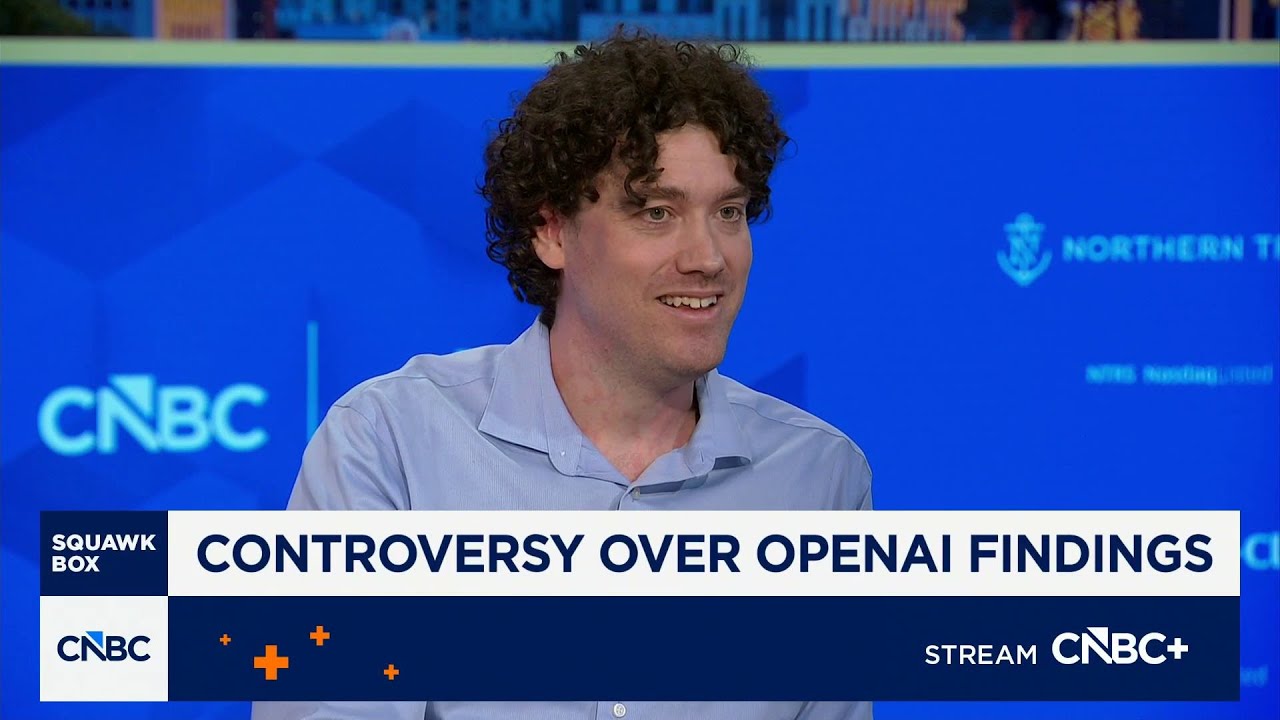
NYU mathematics professor Tristan Buckmaster told CNBC Television that OpenAI's claim to have solved the Navier-Stokes existence and smoothness problem followed directly from work he was developing with collaborator Levent on OpenAI's own Codex system.
The timeline is the entire case.
Buckmaster said that by the end of August he and Levent believed they were roughly a month away from a result on Navier-Stokes, one of the seven Millennium Prize problems for which the Clay Mathematics Institute offers $1 million. At that point a rumor spread from Anthropic to OpenAI that Anthropic researchers were close to solving two Millennium problems, Navier-Stokes and the Hodge conjecture. The rumor jumped to the tech world and then to X, spawned betting markets, and according to Buckmaster triggered an all-out compute push inside OpenAI, which saw a rival solving a Millennium Prize as an existential signal about model quality.
Buckmaster said he was using Codex to interpret and develop work coming from Levent, which meant drafts, prompts and intermediate calculations lived on OpenAI servers. He was on a paid personal account, not an enterprise account, and he discussed the toggle that controls whether OpenAI can train on user data. The default is on. He said he had turned it off on two accounts but had left one account with training on.
After the rumor intensified, he said he and Levent contacted an OpenAI mathematician to calm things, clarifying that they had not solved Navier-Stokes. They had solved the related Euler equation, a step below Navier-Stokes in the blow-up hierarchy, and wanted to avoid being cast as an Anthropic project because Levent works for Anthropic. OpenAI, he said, initially offered tokens and compute to avoid competing, with talk of millions of tokens to finish the project together.