Visual TL;DR
Multi-GPU BottleneckDriver
communication across multiple GPUs is a critical hurdle for AI performance
From the article 6 mentionsArora explained that while significant advancements have been made in optimizing single-GPU kernels and memory-efficient architectures, the bottleneck has shifted to multi-GPU communication.
Simran Arora's ResearchCore
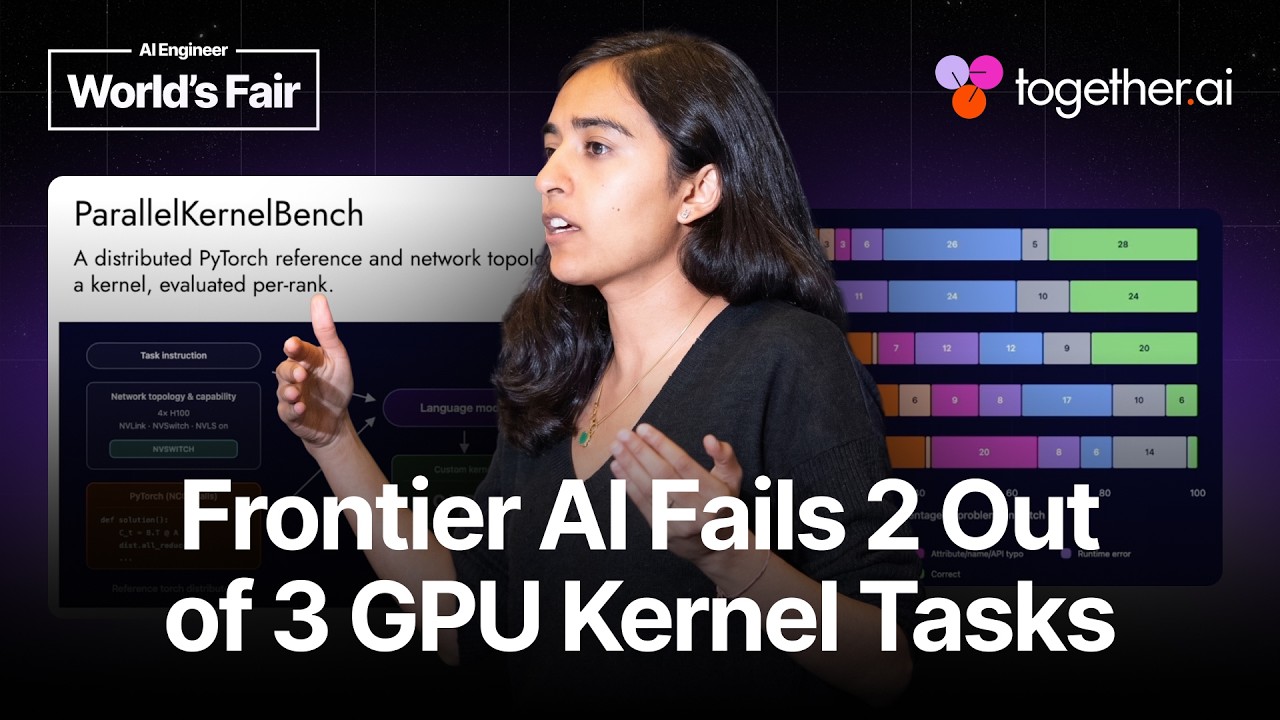
From the articleSimran Arora, a principal scientist at Together AI and an incoming professor at Caltech, recently shed light on the challenges and opportunities in developing efficient multi-GPU AI kernels during a presentation titled 'Can LLMs Write Fast Multi-GPU Kernels?'.
LLMs StruggleDriver
current LLMs fail to write fast multi-GPU kernels for optimization
From the article 4 mentionsArora highlighted that while LLMs can often generate compilable CUDA code, they struggle with the nuanced reasoning required for optimizing multi-GPU kernels.
Kernel Optimization GapOutcome
LLM limitations prevent efficient orchestration of multi-GPU communication
From the articleShe concluded by emphasizing the ongoing challenges and the potential for future research to unlock more sophisticated AI-driven kernel optimization.
AI Hardware UtilizationContext
From the article 3 mentionsIn the ever-evolving landscape of AI hardware, optimizing performance for large language models and other complex AI workloads is paramount.
Simran Arora's ResearchCore
From the articleSimran Arora, a principal scientist at Together AI and an incoming professor at Caltech, recently shed light on the challenges and opportunities in developing efficient multi-GPU AI kernels during a presentation titled 'Can LLMs Write Fast Multi-GPU Kernels?'.
Single-GPU ProgressEffect
advancements in single-GPU kernels and memory-efficient architectures
From the article 2 mentionsThe pace of innovation in GPU compute and memory has outstripped the progress in communication hardware.
Communication Hardware LagDriver
From the articleThe pace of innovation in GPU compute and memory has outstripped the progress in communication hardware.
Multi-GPU BottleneckDriver
communication across multiple GPUs is a critical hurdle for AI performance
From the article 6 mentionsArora explained that while significant advancements have been made in optimizing single-GPU kernels and memory-efficient architectures, the bottleneck has shifted to multi-GPU communication.
LLMs StruggleDriver
current LLMs fail to write fast multi-GPU kernels for optimization
From the article 4 mentionsArora highlighted that while LLMs can often generate compilable CUDA code, they struggle with the nuanced reasoning required for optimizing multi-GPU kernels.
Kernel Optimization GapOutcome
LLM limitations prevent efficient orchestration of multi-GPU communication
From the articleShe concluded by emphasizing the ongoing challenges and the potential for future research to unlock more sophisticated AI-driven kernel optimization.