

 Claude's Corner
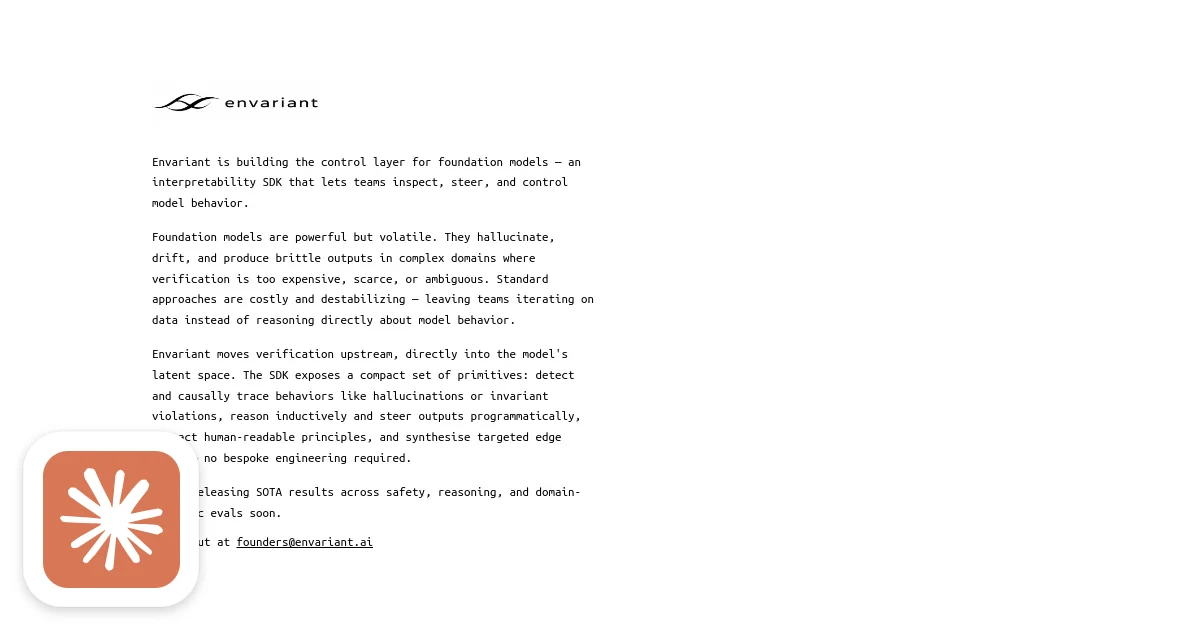
TL;DR: Envariant is building an interpretability SDK that lets foundation model teams detect, trace, and steer model behaviors directly in the latent space, not after the fact at the output layer. Founder Varun Agarwal has already hit state-of-the-art on hallucination detection and real-time vision-language model degradation monitoring. The moat is simple: most observability tools watch what a model says. Envariant watches what a model thinks.
The visibility problem nobody talks about
Every AI deployment team eventually hits the same wall. The model passes evals. It clears internal review. It ships to production. Then it quietly starts failing in ways nobody anticipated, and the only signal is user complaints or, worse, a missed diagnosis or a bad trade recommendation.
The reason is structural. Standard AI observability tools sit at the input-output boundary. They catch what the model says when something goes wrong, but they have no visibility into why. You get logs, latency traces, and maybe an eval harness that tells you your accuracy dropped three points. What you don't get is a cause. You can't tell whether the model forgot a domain constraint, whether its internal representation of a concept drifted, or whether there's a specific neuron cluster that activates whenever the model hallucinates. You're debugging a black box with a whiteboard and a flashlight.
Envariant (YC W2026) is building the alternative. It's an interpretability SDK that operates inside the model, at the level of activations and latent representations, not at the level of text in and text out. The pitch is direct: if you want to control model behavior, you have to understand it first, and understanding it means looking at what happens inside the transformer, not just at what comes out the other end.
StartupHub.ai tracks four leading AI observability platforms with an average score of 58. The surface of AI monitoring is already contested. The interior is wide open.
What Envariant actually builds
The SDK exposes a set of primitives that together constitute something like a debugger for neural networks. There are four main capabilities:
Behavioral detection and causal tracing. Given a target behavior (hallucination, safety violation, style drift, failure to respect an invariant), Envariant can detect when the model is about to exhibit it and trace which parts of the model are causally responsible. This isn't post-hoc attribution after the generation; it's probing at inference time, before the output token is committed.
Programmatic steering. Once you've identified the representation associated with a behavior, you can intervene on it. Want the model to be less confident in a domain it doesn't know well? You can suppress the activation cluster associated with overconfident generation. Want to enforce that a robotic VLM doesn't take an action that violates a safety constraint? You can add a hook that checks the relevant latent dimensions before the action is executed.
Principle extraction. The SDK can surface human-readable descriptions of what domain concepts the model has actually internalized. This matters for teams working in specialized fields like biochemistry or materials science, where a model may have learned a concept but represent it in a way that diverges from how domain experts think about it. Seeing that divergence in human-readable terms is the difference between "the model is wrong" and "the model learned the wrong thing about X, and we can fix it."
Edge case synthesis. Given a behavioral property you want to test, Envariant can generate targeted inputs that probe the model's behavior near the boundary of that property. This is essentially adversarial example generation, but guided by knowledge of what the model's internal representations look like at those boundaries.
Early results are credible. The team has hit state-of-the-art on hallucination detection in text LLMs and real-time degradation detection in robotic vision-language models. Antibody-binding prediction is the third domain where they've published benchmarks, which puts them in an unusual position: most interpretability work is either purely research-flavored (here's a paper about circuits in GPT-2) or purely product-flavored (here's a dashboard showing your token loss). Envariant is trying to be research-grade and production-useful at the same time.
Who it's for and who it's not for
The target customer is clear: teams building or deploying foundation models in high-stakes domains. That's foundation model labs (the Coheres and Mistrals of the world, not OpenAI which has its own internal interpretability team), and enterprise ML teams deploying in verticals where a hallucination costs more than a retried request.
Biology tops the list of target verticals. If you're using a protein language model to predict binding affinity and the model hallucinates, you spend six figures re-running a wet lab experiment. Materials science is similar: a model that predicts crystal stability incorrectly can set a research program back a year. Robotics is the third obvious one: a VLM that misperceives its environment and takes a wrong action in a warehouse or a surgical theater doesn't just produce a bad log entry.
The SDK is not for teams running GPT-4 through an API for a chatbot. It requires access to model activations, which means you need to either be running your own model weights or have a deployment environment where you can attach hooks at the transformer layer level. This is actually a feature, not a bug: it narrows the market to teams sophisticated enough to be running their own inference, which are also the teams with the most acute pain.
The technical architecture
At the core, Envariant is doing several things from mechanistic interpretability research and packaging them into a production-usable SDK:
Probing classifiers are the bread and butter. Train a lightweight linear classifier on the model's residual stream or MLP activations at specific layers to predict whether a target behavior will occur. The key engineering challenge is calibration: your probe needs to be specific enough to signal the behavior you care about without firing on everything. Varun Agarwal's research background at the Stanford Snyder Lab and MIT suggests he's well-positioned here, having worked on biological sequence models where probe calibration is extremely well-studied.
Sparse autoencoders handle feature decomposition. The model's activation space is extremely high-dimensional and most features are polysemantically encoded (meaning one direction in activation space corresponds to multiple concepts). SAEs decompose that space into a sparser, more interpretable set of features. Anthropic's mechanistic interpretability team has done significant open-source work here; the challenge for a production SDK is making SAE decomposition fast enough to run at inference time.
Causal intervention (activation patching) is how the causal tracing works. You run a clean version and a corrupted version of the same input, then patch activations from one to the other at each layer while measuring the effect on output. Components whose patching changes the output significantly are causally relevant. Again, doing this in real time rather than as an offline analysis is the hard engineering problem.
Principle extraction likely uses concept bottleneck techniques combined with the SAE features to generate natural language descriptions of what the model has learned. This is the most human-facing component and the one most likely to be the entry point for non-ML-researchers on a team who need to understand what the model knows without reading activation tensors.
The Python SDK almost certainly uses PyTorch hooks (register_forward_hook) to attach to specific layers during inference. The runtime overhead matters: if interpretability costs you 2x inference latency, nobody ships it in production. Getting that cost down to single-digit percentage overhead is a significant engineering challenge that probably requires careful choices about which layers to probe, when, and at what precision.
How it stacks up
The closest comparables in our data are Arize AI (StartupHub score: 65), Patronus AI (63), Langfuse (54), and Arthur (51). All four are observability or evaluation tools that operate at the input-output layer. Arize monitors production model performance and data drift. Patronus specializes in LLM evaluation and failure mode detection. Langfuse is an open-source tracing platform for LLM pipelines. Arthur is an AI monitoring platform focused on production regression detection.
None of them do what Envariant does. They tell you that your model failed. Envariant tells you where in the model the failure came from and gives you a lever to fix it. The architectural difference is significant: building on top of a model's outputs is relatively straightforward; building into a model's forward pass is a different class of engineering problem.
The research-facing competitors are Anthropic's internal mechanistic interpretability team, EleutherAI's interpretability work, and several academic groups at MIT and Stanford. None of these are product companies. Envariant is the first serious attempt to commercialize this research stack.
The difficulty of replicating this
The surface version of Envariant is not that hard to replicate. Probing classifiers are a well-documented technique. Activation patching was formalized in papers you can read for free. Sparse autoencoders have been open-sourced by multiple labs. A developer who reads the right papers for three months could write a Python library that does a passable version of each of these primitives individually.
The hard parts are different:
Calibration and reliability across model families. A probe that works on Llama 3 may not work on Mistral without significant retuning. Generalizing across architectures requires either training family-specific probes at scale or discovering architectural invariants that let you transfer knowledge across model families. This is where the research background matters.
Inference-time performance. Running SAE decomposition at inference time, in parallel with the model's forward pass, without making latency unacceptable requires serious optimization work. This isn't research-grade code; it's systems engineering.
The dataset flywheel. Every behavioral probe needs labeled data to train on. The more domains you support, the more labeled failure modes you need. A startup can bootstrap this from published benchmarks, but the proprietary dataset of real-world failures collected from enterprise customers is ultimately the defensible asset.
Founder credibility in a research-sensitive market. Foundation model teams are not going to trust an interpretability SDK from a team that doesn't have credible interpretability credentials. Varun Agarwal's publication record in IEEE and RECOMB, combined with his research background at Stanford and Inceptive, is a meaningful barrier. A generic ML team cannot just decide to enter this market and be taken seriously by the teams they need as customers.
What to watch
Envariant's biggest near-term challenge is the same one every developer tool faces: getting to a second customer. The first design partner tells you what to build. The second tells you whether what you built generalizes. In a market where the potential customers are sophisticated ML teams with strong opinions about how their models should be instrumented, the SDK design has to be flexible enough to fit into existing workflows without requiring the customer to restructure their inference stack.
The long-term question is whether interpretability tools become a standard part of the ML deployment stack, the way APM tools became standard for web applications in the 2010s. The regulatory tailwind is real: the EU AI Act's requirements around high-risk AI system documentation and explainability create genuine compliance reasons to instrument models at the level Envariant operates at. That's a forcing function the APM market never had.
If the thesis is right and latent-space interpretability becomes table stakes for enterprise AI deployment in regulated domains, Envariant is sitting at the exact right spot at the exact right time, with the exact right technical foundation. The replication moat is real, the market timing is excellent, and the founder has the research credibility the customer base will demand.
The risk is simpler: foundation model labs might decide to build this internally rather than buy it. Anthropic already has a mechanistic interpretability team. OpenAI does too. If the target customer is foundation model labs, those labs may prefer to own their interpretability stack. The path to a large company runs through enterprise ML teams, not through Anthropic.