

Google DeepMind Fuels European Robotics Startups

Google DeepMind's new accelerator program supports 15 European robotics startups, providing AI expertise and mentorship to build the future of physical AI.

Google DeepMind logo next to a graphic representing robotics and AI
Google DeepMind's new initiative aims to foster robotics innovation across Europe.· Deepmind
Visual TL;DR
Google DeepMind's GoalDriver
bridging AI research and real-world physical applications
From the article 3 mentionsGoogle DeepMind is betting big on the physical world.
Accelerator Program LaunchedCore
From the article 2 mentionsThe AI research giant has launched the Google DeepMind Accelerator: Robotics Europe, a three-month intensive program designed to supercharge 15 early-stage robotics startups from across the continent.
Supports 15 StartupsContext
early-stage robotics companies from across Europe
From the article 2 mentionsThe startups represent a diverse range of sectors, from healthcare and manufacturing to climate solutions and logistics, all leveraging AI to tackle complex challenges.
Provides AI ExpertiseCore
access to advanced AI infrastructure and Gemini models
From the articleMentors will provide hands-on guidance, helping founders navigate the intricate path from concept to scalable deployment.
Offers MentorshipContext
From the articleThe selected cohort, kicking off in London, will receive unparalleled access to Google's advanced AI infrastructure, including its proprietary Gemini robotics models, alongside deep technical mentorship from Google DeepMind and Google experts.
Fuels Embodied AIEffect
accelerating development of systems that act in physical environments
From the article 3 mentionsThis accelerator program is Google's latest move to foster innovation in embodied AI, systems that can perceive, reason, and act within the physical environment.
Diverse SectorsContext
From the articleThe startups represent a diverse range of sectors, from healthcare and manufacturing to climate solutions and logistics, all leveraging AI to tackle complex challenges.
Future of RoboticsOutcome
building the next generation of physical AI solutions
From the article 9+ mentionsThe program's focus is on transforming ambitious research into tangible robotic products.

Google DeepMind is betting big on the physical world. The AI research giant has launched the Google DeepMind Accelerator: Robotics Europe, a three-month intensive program designed to supercharge 15 early-stage robotics startups from across the continent. This initiative underscores a strategic push to bridge the gap between cutting-edge AI research and practical, real-world applications.

The selected cohort, kicking off in London, will receive unparalleled access to Google's advanced AI infrastructure, including its proprietary Gemini robotics models, alongside deep technical mentorship from Google DeepMind and Google experts.

Accelerating Embodied AI

This accelerator program is Google's latest move to foster innovation in embodied AI, systems that can perceive, reason, and act within the physical environment. The startups represent a diverse range of sectors, from healthcare and manufacturing to climate solutions and logistics, all leveraging AI to tackle complex challenges.

The program's focus is on transforming ambitious research into tangible robotic products. Mentors will provide hands-on guidance, helping founders navigate the intricate path from concept to scalable deployment. This hands-on approach is crucial for turning complex AI research into functional robotic applications that can operate safely and effectively in the real world.

Meet the Innovators

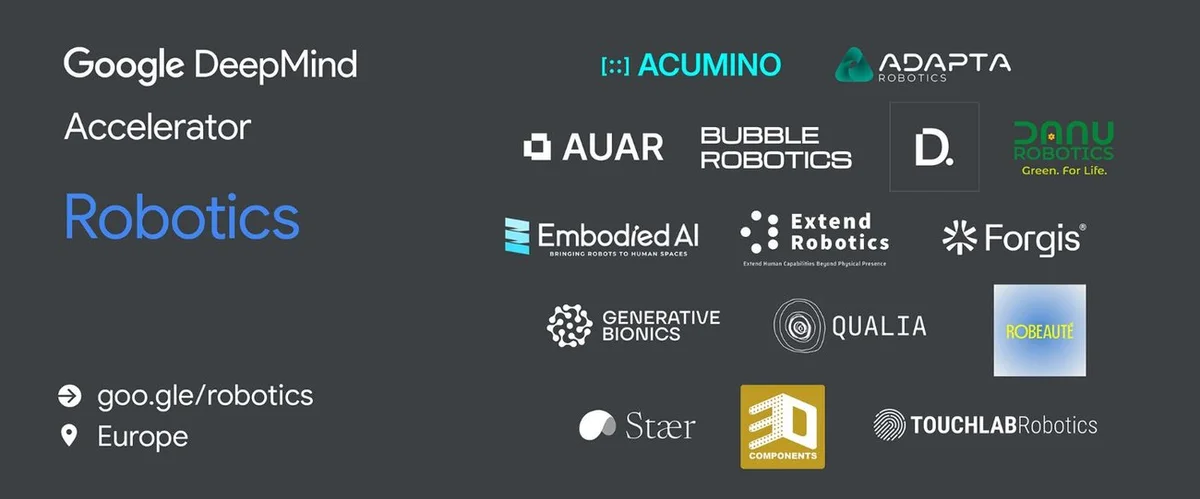
The 15 startups joining the program are:

  • 3D-Components AS (Norway): Automating robotic welding and metal 3D-printing parameter selection.
  • Acumino (Greece): Developing hardware-agnostic Physical AI for complex industrial tasks.
  • Adapta Robotics (Romania): Creating physical AI for automated QA in devices, supporting the circular economy.
  • AUAR (Automated Architecture) (United Kingdom): Deploying robotic MicroFactories for affordable homebuilding.
  • Bubble Robotics (France): Building autonomous underwater robot constellations for ocean monitoring.
  • Danu Robotics (United Kingdom): Automating complex waste sorting with embodied AI for material recovery.
  • Deltia GmbH (Germany): Digitizing production-line workflows to optimize manual processes.
  • Embodied AI (Switzerland): Utilizing teleoperated humanoids for data collection and AI training.
  • Extend Robotics (United Kingdom): Providing teleoperation software for training foundation models.
  • Forgis (Switzerland): Developing AI agents for predictive maintenance and operational optimization.
  • Generative Bionics (Italy): Building humanoid robots based on physical AI for global scaling.
  • Qualia (Denmark): Creating infrastructure to deploy robotic foundation models for automation.
  • ROBEAUTE (France): Developing microrobots for diagnosing and treating neuropathology.
  • Staer (Sweden): Using computer vision to build 3D spatial models for robot navigation.
  • Touchlab (United Kingdom): Creating an 'e-skin' for robots with high-resolution touch sensing.

These companies exemplify the growing momentum in robotics and intelligent systems across Europe. Each will receive strategic guidance to accelerate development and ensure responsible scaling.

© 2026 StartupHub.ai. All rights reserved. You may not republish this article in full without a license. Search engines and AI research tools may crawl and summarize for reference. Bulk reproduction or model training requires a license. See our terms.
Daniel Singer

Written by

Daniel Singer

Editor, StartupHub.ai

Daniel Singer is the editor of StartupHub.ai, a technology expert and thought leader on AI and its applications across sectors, from fintech and healthcare to developer tooling and consumer software. He writes and tests the tools covered here thoroughly and regularly, and built StartupHub.ai to give founders, operators and buyers a clearer read on what they are actually being sold.

More from Daniel Singer