

Alejandro Vidal on Rethinking LLM Evaluation with Psychometrics

Alejandro Vidal of Mindmakers advocates for integrating psychometrics into LLM evaluation to move beyond simplistic accuracy scores and gain deeper insights into model intelligence and benchmark quality.

11 min read
Alejandro Vidal discussing psychometrics and LLM evaluation on stage at World's Fair
Alejandro Vidal presents his insights on leveraging psychometrics for more effective LLM evaluation at World's Fair.· AI Engineer

Visual TL;DR. Flawed LLM Benchmarking due to Ignores Item Weight. Flawed LLM Benchmarking challenged by Alejandro Vidal. Alejandro Vidal proposes Introduce Psychometrics. Introduce Psychometrics e.g. Item Response Theory. Introduce Psychometrics enables Deeper Model Insights. Deeper Model Insights leads to Enhanced Benchmark Auditing. Deeper Model Insights also allows Shrink Benchmarks. Deeper Model Insights shapes Future LLM Evaluation.

  1. Flawed LLM Benchmarking: current methods reduce complex model intelligence to a single, simplistic accuracy score
  2. Ignores Item Weight: assumes every question in a benchmark carries equal importance, which is often false
  3. Alejandro Vidal: Mindmakers expert advocates for integrating psychometrics into LLM evaluation
  4. Introduce Psychometrics: apply methods traditionally used for measuring human intelligence to LLM assessment
  5. Item Response Theory: a specific psychometric model to evaluate item difficulty and model ability
  6. Deeper Model Insights: gain nuanced understanding of model intelligence beyond simple pass/fail scores
  7. Enhanced Benchmark Auditing: identify problematic or leaked items and improve overall benchmark quality
  8. Shrink Benchmarks: more efficient evaluation by identifying and removing redundant or low-value items
  9. Future LLM Evaluation: move beyond simplistic metrics for more robust and informative model assessment
Visual TL;DR
Visual TL;DR, startuphub.ai Flawed LLM Benchmarking challenged by Alejandro Vidal. Alejandro Vidal proposes Introduce Psychometrics. Introduce Psychometrics enables Deeper Model Insights. Deeper Model Insights shapes Future LLM Evaluation challenged by proposes enables shapes Flawed LLM Benchmarking Alejandro Vidal Introduce Psychometrics Deeper Model Insights Future LLM Evaluation From startuphub.ai · The publishers behind this format
Visual TL;DR, startuphub.ai Flawed LLM Benchmarking challenged by Alejandro Vidal. Alejandro Vidal proposes Introduce Psychometrics. Introduce Psychometrics enables Deeper Model Insights. Deeper Model Insights shapes Future LLM Evaluation challenged by proposes enables shapes Flawed LLMBenchmarking Alejandro Vidal IntroducePsychometrics Deeper ModelInsights Future LLMEvaluation From startuphub.ai · The publishers behind this format
Visual TL;DR, startuphub.ai Flawed LLM Benchmarking challenged by Alejandro Vidal. Alejandro Vidal proposes Introduce Psychometrics. Introduce Psychometrics enables Deeper Model Insights. Deeper Model Insights shapes Future LLM Evaluation challenged by proposes enables shapes Flawed LLM Benchmarking current methods reduce complex modelintelligence to a single, simplisticaccuracy score Alejandro Vidal Mindmakers expert advocates forintegrating psychometrics into LLMevaluation Introduce Psychometrics apply methods traditionally used formeasuring human intelligence to LLMassessment Deeper Model Insights gain nuanced understanding of modelintelligence beyond simple pass/failscores Future LLM Evaluation move beyond simplistic metrics for morerobust and informative model assessment From startuphub.ai · The publishers behind this format
Visual TL;DR, startuphub.ai Flawed LLM Benchmarking challenged by Alejandro Vidal. Alejandro Vidal proposes Introduce Psychometrics. Introduce Psychometrics enables Deeper Model Insights. Deeper Model Insights shapes Future LLM Evaluation challenged by proposes enables shapes Flawed LLMBenchmarking current methodsreduce complexmodel intelligence… Alejandro Vidal Mindmakers expertadvocates forintegrating… IntroducePsychometrics apply methodstraditionally usedfor measuring human… Deeper ModelInsights gain nuancedunderstanding ofmodel intelligence… Future LLMEvaluation move beyondsimplistic metricsfor more robust and… From startuphub.ai · The publishers behind this format
Visual TL;DR, startuphub.ai Flawed LLM Benchmarking due to Ignores Item Weight. Flawed LLM Benchmarking challenged by Alejandro Vidal. Alejandro Vidal proposes Introduce Psychometrics. Introduce Psychometrics e.g. Item Response Theory. Introduce Psychometrics enables Deeper Model Insights. Deeper Model Insights leads to Enhanced Benchmark Auditing. Deeper Model Insights also allows Shrink Benchmarks. Deeper Model Insights shapes Future LLM Evaluation due to challenged by proposes e.g. enables leads to also allows shapes Flawed LLM Benchmarking current methods reduce complex modelintelligence to a single, simplisticaccuracy score Ignores Item Weight assumes every question in a benchmarkcarries equal importance, which is oftenfalse Alejandro Vidal Mindmakers expert advocates forintegrating psychometrics into LLMevaluation Introduce Psychometrics apply methods traditionally used formeasuring human intelligence to LLMassessment Item Response Theory a specific psychometric model to evaluateitem difficulty and model ability Deeper Model Insights gain nuanced understanding of modelintelligence beyond simple pass/failscores Enhanced Benchmark Auditing identify problematic or leaked items andimprove overall benchmark quality Shrink Benchmarks more efficient evaluation by identifyingand removing redundant or low-value items Future LLM Evaluation move beyond simplistic metrics for morerobust and informative model assessment From startuphub.ai · The publishers behind this format
Visual TL;DR, startuphub.ai Flawed LLM Benchmarking due to Ignores Item Weight. Flawed LLM Benchmarking challenged by Alejandro Vidal. Alejandro Vidal proposes Introduce Psychometrics. Introduce Psychometrics e.g. Item Response Theory. Introduce Psychometrics enables Deeper Model Insights. Deeper Model Insights leads to Enhanced Benchmark Auditing. Deeper Model Insights also allows Shrink Benchmarks. Deeper Model Insights shapes Future LLM Evaluation due to challenged by proposes e.g. enables leads to also allows shapes Flawed LLMBenchmarking current methodsreduce complexmodel intelligence… Ignores ItemWeight assumes everyquestion in abenchmark carries… Alejandro Vidal Mindmakers expertadvocates forintegrating… IntroducePsychometrics apply methodstraditionally usedfor measuring human… Item ResponseTheory a specificpsychometric modelto evaluate item… Deeper ModelInsights gain nuancedunderstanding ofmodel intelligence… EnhancedBenchmark… identifyproblematic orleaked items and… Shrink Benchmarks more efficientevaluation byidentifying and… Future LLMEvaluation move beyondsimplistic metricsfor more robust and… From startuphub.ai · The publishers behind this format

In a recent presentation titled "Stop Evaluating Models Like It's the 50s," Alejandro Vidal of Mindmakers challenged the prevailing methods for assessing large language models (LLMs). Vidal argued that current benchmarking practices, which often boil down to a single accuracy score, are overly simplistic and fail to capture the intricate complexities of model intelligence. He proposed integrating modern psychometrics, a field traditionally used to measure human intelligence and traits, into LLM evaluation to achieve more nuanced and informative results.

Alejandro Vidal on Rethinking LLM Evaluation with Psychometrics - AI Engineer
Alejandro Vidal on Rethinking LLM Evaluation with Psychometrics — from AI Engineer

The Flaws of Traditional LLM Benchmarking

Vidal began by highlighting the fundamental flaw in current LLM evaluation: reducing a model's performance to a single number, typically an accuracy score. This approach, he explained, rests on a critical but often unstated assumption: every item or question in a benchmark carries equal weight. "That sum only holds under one assumption: all items weigh the same," Vidal stated. This assumption is problematic because individual items can be correlated, purely noisy, or disproportionately important, yet traditional methods treat them identically. Such an oversimplification obscures the true capabilities and weaknesses of LLMs.

Introducing Item Response Theory (IRT)

To overcome these limitations, Vidal advocated for the adoption of Item Response Theory (IRT), a psychometric modeling approach. IRT moves beyond simply summing correct answers by treating each item as a variable and modeling two key parameters:

  • Difficulty (b): This parameter quantifies how challenging an item is. It is defined as the ability level at which a model has a 50% probability of answering correctly. Very difficult questions require a high ability level to achieve even a 50% success rate, while easier questions are correctly answered by models with lower abilities.
  • Ability (theta): For each model, IRT estimates a theta value, representing its overall skill level on a shared scale with item difficulty. A model with a theta of zero is considered average for that distribution.

Vidal illustrated this with visual examples, showing how each item has a unique Item Response Function (IRF) curve, mapping model intelligence to the probability of a correct answer. He further introduced the concept of "discrimination (a)," which measures how steeply the IRF curve rises. Steeper curves are more informative as they better differentiate between models of varying abilities. Flat lines, conversely, indicate noise and offer little insight, while inverse curves suggest a flawed item that penalizes more capable models.

Enhanced Model and Benchmark Auditing

One of the most powerful applications of psychometrics in LLM evaluation, according to Vidal, is the ability to audit and improve benchmarks. By analyzing the 'discrimination' parameter (a) for each item, benchmark creators can identify problematic questions:

  • Informative Items: Items with high positive discrimination values are valuable, as they effectively differentiate between models.
  • Low Information Items: Flat-line items, with discrimination values close to zero, provide little insight and may be removed or revised to improve benchmark efficiency.
  • Broken Items: Critically, negative discrimination values flag items where stronger models perform worse than weaker ones. Vidal noted that this often points to mislabeled answers or factual errors within the benchmark data itself. He provided real-world examples where an LLM's unexpected answer revealed a flawed 'gold standard' answer in the dataset, leading to benchmark correction.

This auditing process ensures that benchmarks are robust, fair, and accurately reflect model capabilities, preventing misleading conclusions based on faulty evaluation data.

Shrinking Benchmarks and Detecting Leaks

Vidal also demonstrated how IRT can optimize benchmark size without sacrificing accuracy. By identifying the most informative items, a benchmark can be significantly reduced while maintaining a high correlation (e.g., 0.99) with the full benchmark's ranking. This is particularly useful for companies with private, task-specific benchmarks that need to be run repeatedly across different models or fine-tunings, saving computational resources and time.

Furthermore, IRT's residual analysis offers a powerful tool for detecting leaked items. By sorting items and models by difficulty and intelligence, Vidal showed how unexpected correct or incorrect answers (outliers) for certain models could signal a data leak. A large negative residual indicates a strong model failing an easy item, while a large positive residual suggests a weaker model succeeding on a hard item. These anomalies can be systematically tracked to identify items that might have been leaked to the internet, compromising the integrity of a benchmark.

Vidal extended this concept to adaptive testing, where a private bank of items can be used with a shared 'anchor set' for all organizations and unique 'fingerprint sets' for specific organizations. If a particular organization leaks data, its new models would perform unusually well on its unique fingerprint items, an anomaly detectable through residual loss analysis. This method offers a traceable mechanism to pinpoint the source of data leaks.

Understanding Model Relationships and Biases

Beyond individual item and model assessment, psychometrics can uncover deeper relationships between LLMs. By analyzing patterns in residual errors (how models deviate from expected performance), Vidal showed how one can detect if models share a common training history. Correlating these residual vectors can reveal clusters of models from the same family or identify instances where one model has been distilled from another. "This evidence actually is stronger than actually evidence from the answers," Vidal explained, suggesting that error patterns provide a more robust fingerprint of model lineage than raw performance scores.

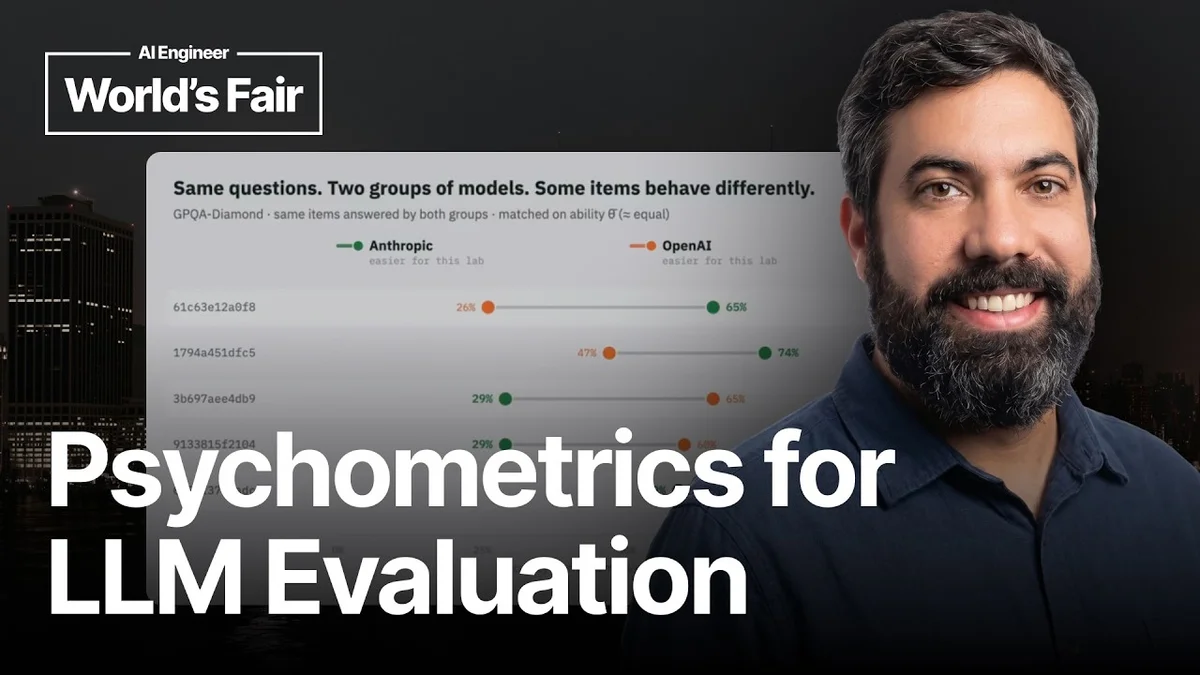
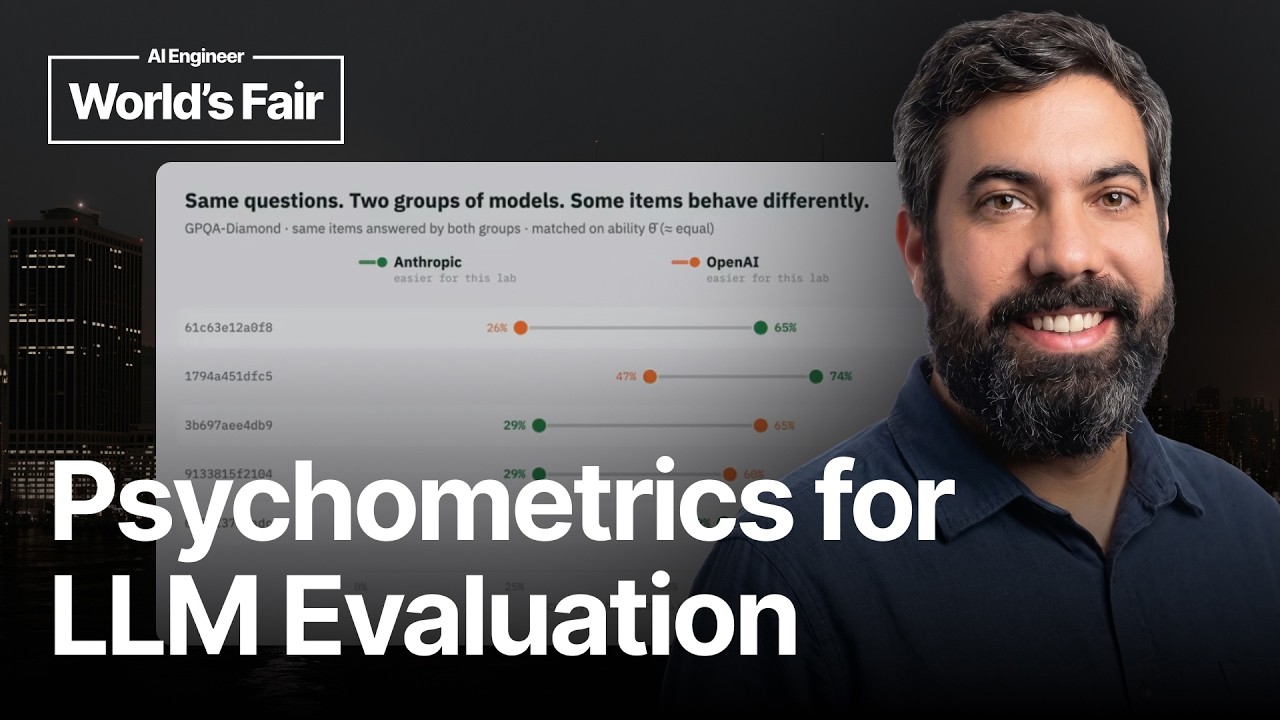
Vidal also touched upon Differential Item Functioning (DIF), a psychometric technique used to measure systematic differences in how different groups of models (e.g., Anthropic models versus OpenAI models) perform on the same items, even when matched for overall ability. This can reveal specific areas where one lab's models might excel or struggle compared to another's, offering insights into their underlying architectures or training data biases. This analysis aids in understanding model behavior across diverse tasks and their interrelationships in the market.

The Future of LLM Evaluation

Vidal concluded by emphasizing that this is just the beginning. Future directions include incorporating probabilities instead of binary correct/incorrect scores, per-expert evaluations, studying the impact of noise on measured ability, merging benchmarks for improved quality, utilizing secondary signals like tokens and latency, and exploring multidimensional IRT to capture the full skill geometry of models. He noted the striking similarity between the intelligence structures of LLMs and humans, suggesting a rich field for continued research and application in making LLM evaluations more robust and insightful.
© 2026 StartupHub.ai. All rights reserved. Do not enter, scrape, copy, reproduce, or republish this article in whole or in part. Use as input to AI training, fine-tuning, retrieval-augmented generation, or any machine-learning system is prohibited without written license. Substantially-similar derivative works will be pursued to the fullest extent of applicable copyright, database, and computer-misuse laws. See our terms.