AI Research

AI Benchmarking: Beyond 50s Metrics

Alejandro Vidal argues for adopting psychometric principles like IRT to move beyond outdated LLM benchmarking, enabling more nuanced and reliable model evaluation.

Daniel Singer

By Daniel Singer, Editor, StartupHub.ai

3 min read

Presentation slide with the title 'Stop evaluating models like it's the 50s.'
Credit: AI Engineer
Visual TL;DR
Outdated LLM BenchmarkingDriver
current methods from the 1950s count correct answers, too simplistic for LLMs
Classical Test TheoryContext
assumes every question carries equal weight, overlooking varying difficulty and informativeness
From the article 2 mentionsAlejandro Vidal, founder of Mind Makers, argues that this approach, known as classical test theory, is insufficient for accurately measuring LLM capabilities.
Alejandro VidalCore
Mind Makers founder advocates psychometric principles for robust LLM evaluation
From the article 7 mentionsAlejandro Vidal, founder of Mind Makers, argues that this approach, known as classical test theory, is insufficient for accurately measuring LLM capabilities.
Item Response Theory (IRT)Core
models item difficulty (B) and LLM ability (theta) on a shared scale
From the article 6 mentionsIn a recent presentation, Vidal advocated for adopting principles from psychometrics and measurement theory, particularly Item Response Theory (IRT), to create more robust and insightful LLM evaluations.
Nuanced LLM EvaluationEffect
enables granular understanding of model performance across different capability levels
From the article 2 mentionsVidal concluded by emphasizing the potential of IRT and related psychometric techniques for advancing LLM evaluation.
Beyond 50s MetricsOutcome
moving past simplistic correct answer counts for more reliable model assessment
Psychometric PrinciplesContext
From the article 2 mentionsIn a recent presentation, Vidal advocated for adopting principles from psychometrics and measurement theory, particularly Item Response Theory (IRT), to create more robust and insightful LLM evaluations.
Contents(4)

The current standard for evaluating Large Language Models (LLMs) is often too simplistic, relying on methods from the 1950s that focus on counting correct answers. Alejandro Vidal, founder of Mind Makers, argues that this approach, known as classical test theory, is insufficient for accurately measuring LLM capabilities. In a recent presentation, Vidal advocated for adopting principles from psychometrics and measurement theory, particularly Item Response Theory (IRT), to create more robust and insightful LLM evaluations.

AI Benchmarking: Beyond 50s Metrics - AI Engineer
AI Benchmarking: Beyond 50s Metrics, AI Engineer

The Limitations of Classical Benchmarking

Vidal highlighted that traditional benchmarking often assumes every question, or 'item,' in a test carries equal weight. This overlooks the reality that some questions are more difficult or informative than others. IRT, in contrast, models each item's difficulty (parameter 'B') and an LLM's ability (parameter 'theta') on a shared scale. This allows for a more granular understanding of how models perform across different levels of challenge.

As Vidal explained, "We are saying that every question is equally important. They should weigh the same, which is kind of insane if you think about that. We have better questions, more complicated questions that maybe we should pay more attention to."

Introducing Item Response Theory (IRT)

Vidal introduced IRT as the evolution of classical test theory. The core of IRT involves modeling the probability of a correct answer based on the LLM's ability and the item's difficulty. This relationship is often visualized as a curve, where the 'B' parameter signifies the difficulty level at which a model has a 50% chance of answering correctly. By estimating a 'theta' value for each model and a 'B' value for each item, researchers can gain a more accurate measure of both model intelligence and question difficulty.

He further elaborated on the parameters: "The B parameter is going to be the difficulty of each one of them, and we're going to create a function for each question. That function maps the LLM intelligence... to the probability of getting that answer right."

The daily brief

Get the free daily brief with the day's AI news, new AI startups and funding rounds every morning.

Join 64,000 other subscribers.

Key Applications of IRT in LLM Evaluation

Vidal outlined several practical applications of IRT for evaluating LLMs:

  • Benchmark Auditing: IRT allows for the identification and flagging of problematic items. Items with negative discrimination (where better models perform worse) or those that are mislabeled can be detected and either removed or improved.
  • Benchmark Shrinking: By understanding item discrimination, it's possible to create smaller, more efficient benchmarks that maintain high correlation with the original rankings, saving time and resources.
  • Outlier Detection: Residual analysis, a component of IRT, can help identify unexpected model behaviors, potential data leaks, or overfitting issues within benchmarks.
  • Consistency Analysis: IRT can reveal inconsistencies in model performance, which might indicate problems with the inference platform.
  • Leak Detection: A technique called adaptive testing, using an 'anchor set' and 'fingerprint sets,' can help protect benchmarks from leaks and unauthorized training.
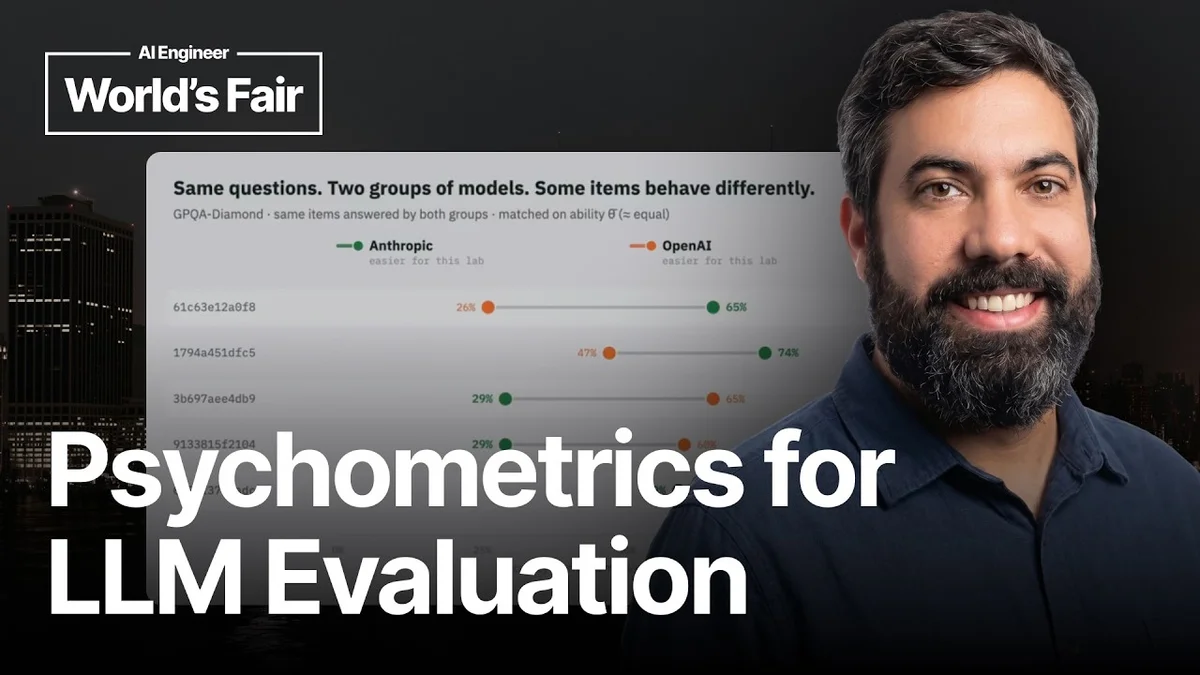
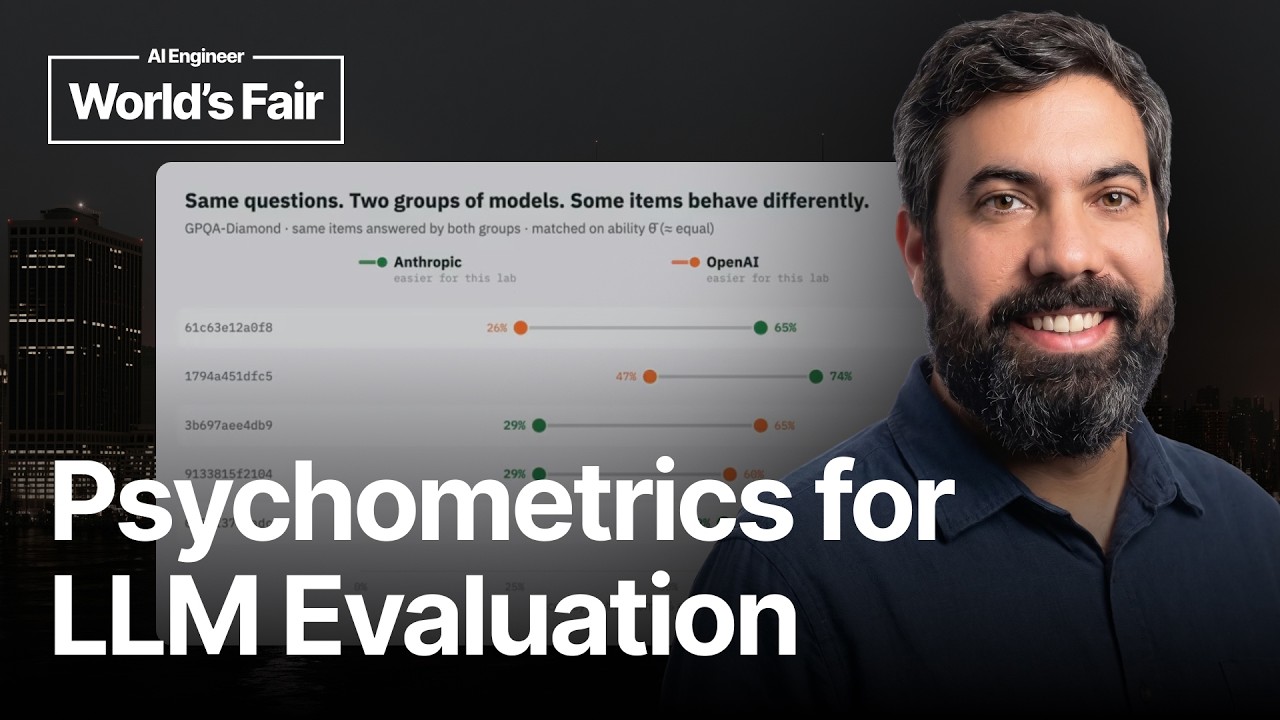
  • Bias Detection: By comparing item performance across different model groups (e.g., open-weight vs. closed-weight), IRT can help identify biased questions.
  • Model Relationship Analysis: Analyzing residual correlations can reveal similarities in how models fail, potentially indicating shared underlying architectures or training data.

The Future of LLM Benchmarking

Vidal concluded by emphasizing the potential of IRT and related psychometric techniques for advancing LLM evaluation. He suggested future research directions, including multidimensional models, merging benchmarks, incorporating secondary signals like latency, and applying IRT to measure model alignment and interpretability.

His call to action was clear: "I really hope that you find inspiring this talk. My goal here was to open the gates of psychometrical research for LLMs. I think we can improve a lot how we benchmark LLMs with very basic maths here."

Get the free daily brief every morning

Every morning the day's AI news, new AI startups and new funding rounds. Free and takes a few minutes to read, unsubscribe at any time.

Join 64,000 other subscribers.

TopicsAlejandro VidalMind MakersItem Response TheoryLLM BenchmarkingAI ResearchPsychometrics

Daniel Singer

Written by

Daniel Singer

Editor, StartupHub.ai

Daniel Singer is the editor of StartupHub.ai, a technology expert and thought leader on AI and its applications across sectors, from fintech and healthcare to developer tooling and consumer software. He writes and tests the tools covered here thoroughly and regularly, and built StartupHub.ai to give founders, operators and buyers a clearer read on what they are actually being sold.

Test your Agent Readiness now

Paste your website. How well ChatGPT, Claude and the other agents can read and use a site, in about a minute, free.

Watch

The videos behind the news, one flip at a time

The feed mixes the videos from our articles with startup demos and you flip through them like TV channels for free with no signup.

