


Today in AI: GigaPath-Flash Slashes Compute 50x

GigaPath-Flash distills a billion-parameter pathology model to 22M parameters, keeping 97% performance at 50x less compute for population-scale study.

3 min read
Whole-slide pathology image tiled for AI analysis with GigaPath-Flash efficient encoder
GigaPath-Flash distills a billion-parameter model to 22M for population-scale slide analysis· Microsoft Reesarch
Contents(3)

Microsoft Research just made pathology foundation models practical at population scale. GigaPath-Flash squeezes a billion-parameter whole-slide model into a 22M-parameter backbone that keeps 97% of the performance.

The goal isn't a leaderboard bump. It's to run the same model thousands of times across the kind of cohorts that hospitals actually generate.

How GigaPath-Flash stays accurate on a smaller backbone

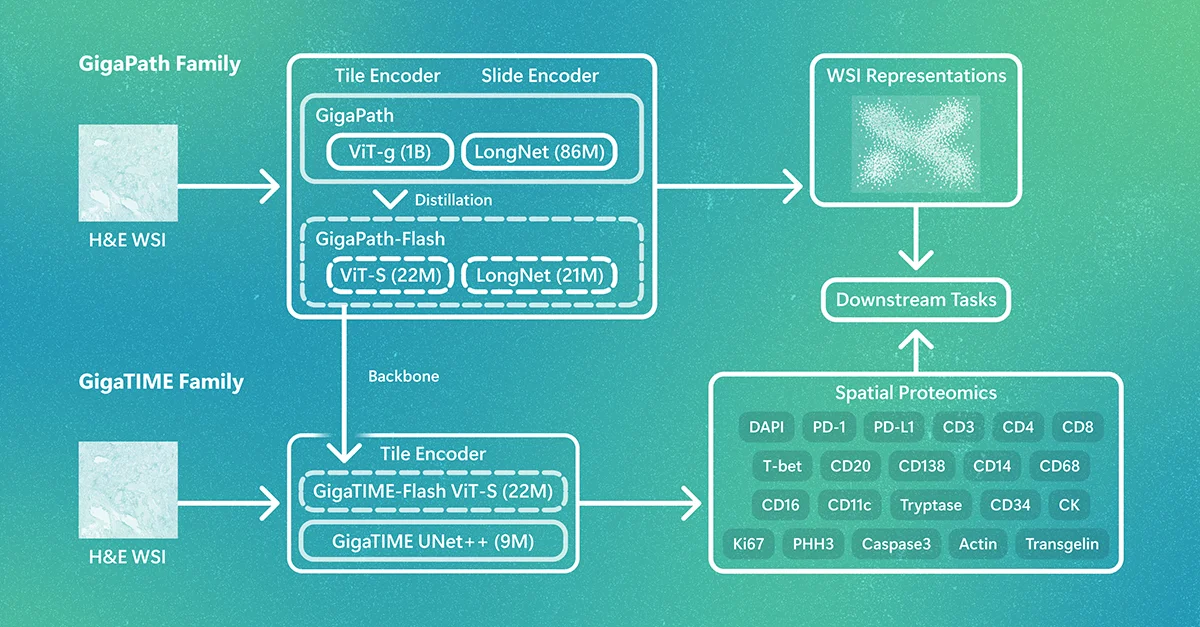
GigaPath-Flash pairs a distilled ViT-S tile encoder with a 21M-parameter LongNet slide encoder that uses dilated attention, so it scales linearly with tile count. The ViT-S is distilled from the original GigaPath ViT-g teacher, which was pretrained on Providence real-world slides.

On PANDA prostate grading and EBRAINS brain tumor subtyping, the smaller model lands within 3% of GigaPath at roughly 50 times less compute, the lowest inference cost among whole-slide pretrained models in Microsoft Research tests. This is the third efficiency push from Microsoft Research this summer, following Microsoft's Aurora 1.5 Boosts Weather AI, and the playbook is familiar: keep the representations, cut the backbone.

Why GigaTIME-Flash matters for tumor biology

GigaTIME-Flash reuses that ViT-S encoder for a different job, translating routine H&E stains into virtual spatial proteomics across 21 protein channels. The original GigaTIME was trained on 40 million cells with paired H&E and multiplex immunofluorescence, then applied to over 14,000 patients. It surfaced more than 1,200 associations between immune cell states and clinical biomarkers.

The Flash version swaps the CNN for the distilled ViT-S and a lightweight convolutional decoder fine-tuned with LoRA adapters. Across the GigaTIME test set and four out-of-distribution Prov-TMA cohorts in brain, breast, colon, and lung, it matches or improves mean windowed Pearson correlation. The biggest gains show up out-of-distribution.

That last point is the one builders should pay attention to. Better generalization on unseen tissue types is exactly what a multimodal AI translator needs if it will ever leave one health system behind.

What 50x cheaper inference actually unlocks

On a single A100 at 10,000 tiles per slide and batch size 128, Microsoft estimates virtual mIF for 1,000 slides drops from about 7 GPU-hours to roughly 2 hours. At 100,000 slides it falls from 30 GPU-days to 7, and at one million it drops from 300 days to 70.

Peak memory drops by about 8x, and throughput exceeds 1,600 tiles per second versus the original. Both models are open-weight on HuggingFace under Apache 2.0.

The limitation is stated outright: these are research models, not validated for diagnosis or treatment, and the evaluations remain narrow. For startups, the opening is population-scale hypothesis testing. The gap is prospective, multi-scanner validation before any clinical claim can stick.

© 2026 StartupHub.ai. All rights reserved. You may not republish this article in full without a license. Search engines and AI research tools may crawl and summarize for reference. Bulk reproduction or model training requires a license. See our terms.