


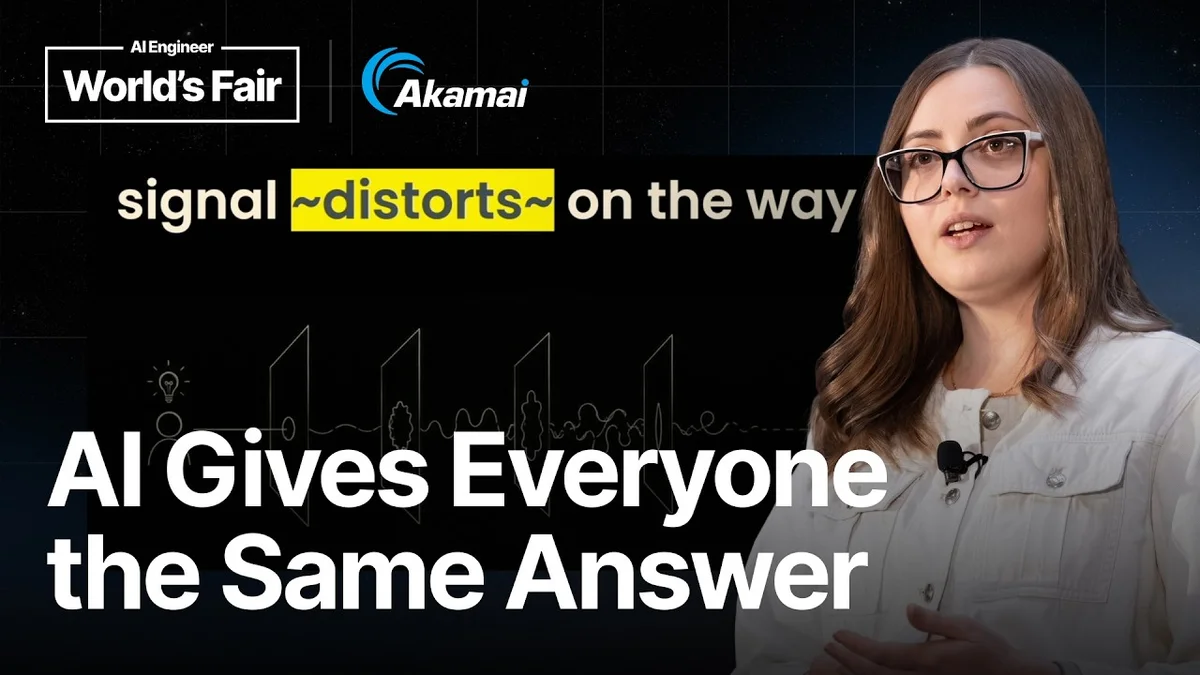
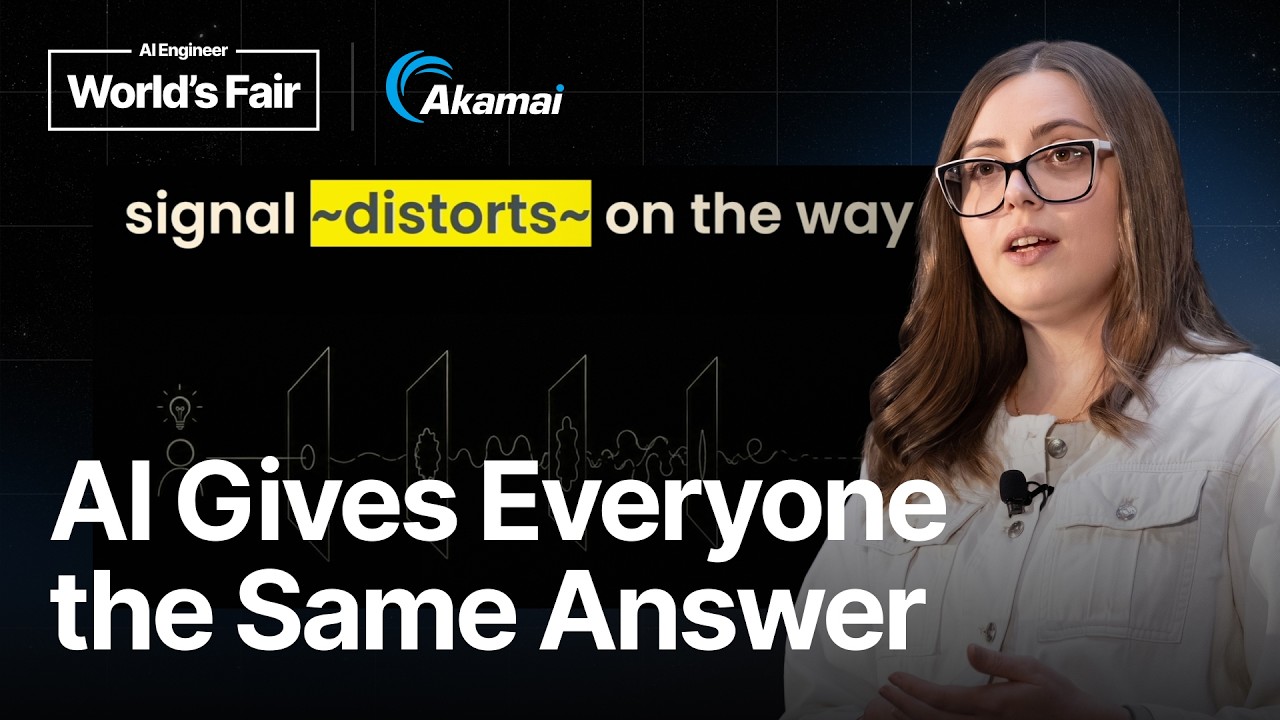
The Signal Layer Is the New Moat

When AI makes building free, Lena Hall says value moves from shipping speed to the signal layer: choosing what to build and emitting it without distortion.

7 min read
Lena Hall presenting The Signal Layer on stage at AI Engineer conference
Lena Hall, Akamai, on what to build when AI makes anything buildable.· AI Engineer
Visual TL;DR
Building got freeDriver
AI coding agents now score in high eighties on standard benchmarks
Differentiation brokeContext
When anyone can ship fast, what you point AI at matters most
Signal layer moatContext
Choosing what to build and emitting it without distortion creates advantage
From the article 2 mentionsThe signal layer is the new job when anything can be built, Lena Hall argued in AI Engineer.
GTM distorts signalDriver
Go-to-market effort introduces noise and distorts the true signal
Building got freeDriver
AI coding agents now score in high eighties on standard benchmarks
Measure then trainCore
Sarah Guos rule: anything measurable can be trained against automatically
From the articleHall borrows Sarah Guo's rule: anything you can measure you can train against.
Writing tripledEffect
AI writing capabilities grew dramatically in just two years
Shipping barely movedOutcome
Deployment speed improved only about one third despite AI gains
Code is most checkableCore
Software work automated first because test suites serve as free graders
From the articleCode automated first because it is the most checkable work we have.
Differentiation brokeContext
When anyone can ship fast, what you point AI at matters most
Signal layer moatContext
Choosing what to build and emitting it without distortion creates advantage
From the article 2 mentionsThe signal layer is the new job when anything can be built, Lena Hall argued in AI Engineer.
GTM distorts signalDriver
Go-to-market effort introduces noise and distorts the true signal
Contents(4)

The signal layer is the new job when anything can be built, Lena Hall argued in AI Engineer. When everyone can ship fast, deciding what to point AI at beats how fast you ship.

The Signal Layer Is the New Moat - AI Engineer
The Signal Layer Is the New Moat, from AI Engineer

Akamai (NASDAQ:AKAM) engineer Hall spoke at AI Engineer to a room that already runs hot. One attendee told her the opportunity cost of not working 9 a.m. to 9 p.m. six days a week feels too high right now.

Her friend ran 18 agents while riding his bike. She solved a production incident on a trail near a waterfall.

Abundance is the premise. Differentiation is the problem.

What broke when building got free?

Two years ago top coding agents solved a fraction of tasks on standard software benchmarks. Now the best agents score in the high eighties.

Writing nearly tripled. Shipping barely moved a third.

Hall borrows Sarah Guo's rule: anything you can measure you can train against. A compiler is a free grader. A test suite is a free grader.

Code automated first because it is the most checkable work we have. Implementation converges for free for everyone at once, but the most buildable thing and the most valuable thing are rarely the same.

Where does real differentiation survive?

AI is a convergence machine. Point it at "tell me what users want" or "make this viral" and it answers from common knowledge, competently and identically for you and your competitor.

Hall points to Paul Graham's old test: build what you and your friends need because surveys cannot see a market before it forms. Twitch sounded lame as a guy with a camera strapped to his head live streaming his life until it did not.

Weird and specific is necessary but not sufficient. A thousand similar ideas failed.

Broad taste will not save you either. Taste is preference under feedback, and anything demonstrated enough times with a better or worse signal, a model can imitate.

What resists training is narrower. Judgment about what has not happened yet, where no data exists. And judgment embedded in a relationship the model never observed, what this customer in this situation with this history actually needs.

Richard Hamming's filter applies here. Great scientists picked important problems where they had a reasonable attack. Time travel is consequential but not important because no one has an attack.

For decades the attack was rare. Hall says AI flipped that. Now everyone has an attack on everything, so knowing which problem is worth attacking is the scarce skill.

It comes from being close to a real domain with specific scars and unreasonable care. You do not need to be first. You need to be genuinely close where your insight lives in the delta between what AI was trained on and what should exist.

Why does go-to-market distort the signal?

Knowing your signal is half the job. Emitting it without distortion is the other half.

Hall breaks the loss into three failures. Source distortion is common in startups. Founders compress the signal past legibility, pitch architecture and cleverness, and delete customer pain. She cites a YC team that led with system design and heard noise back until they rewrote the opening around what the user hated. Pilots converted the next week.

Organization distortion hits big companies. Signal degrades at every handoff through management, legal, sales. It is not incompetence but investment. A founder sweats unaverageable details because the outcome is personal. A chain of ticket closers plus a convergence machine automates the signal out.

Machine distortion is the newest. One careful launch with claim, evidence and scope gets remixed by AI into tweets, decks and one-pagers. A narrow 94% eval becomes a blanket promise after enough repetition.

Hall's fix is a thin signal layer that validates and carries intent intact. Her example is a monitoring tool whose signal is quiet. Not intelligent AI-native observability platform, but stays quiet on anything it cannot tie to real user impact and shows everything it silenced so you can overrule it. Promise and limit are welded together.

Make the limit uneditable. In product, every suppressed alert stays visible. In messaging, 90% fewer pages lives next to every silence is visible and reversible. Test it by handing the README to an SRE who has never seen the project and asking them to describe it back. The gap is the distortion you were about to broadcast.

Why this matters for AI startups now

This maps to the vibe coding surge of the last six months. Cursor, Lovable and similar tools collapsed prototype time from weeks to hours, and the Expo Hall Hall walked now sounds the same for a reason.

When every feed fills with three bullet points and a bold takeaway that a model could write from a one-line prompt, readers skip it in half a second. You have automated your own irrelevance.

The alternative is to bring what the model cannot have, a specific point of view and a story you were in the room for, then let the machine do the converging work around that core.

The competitive set proves it. StartupHub.ai data shows Anything raised $15M in Seed funding in 2025, operating near players like Make, Dataminr, Exaforce, Cynomi, Mimecast and Mokn. In a crowded automation and security adjacent field, the pitch that sounds like everyone else is priced at zero by definition.

Hall closes where benchmarks stop. Trust has no grader, no reward signal, and cannot be fully automated because it is granted slowly and with consent. Doctors who open one tool every morning were not trained to do it.

Producing averageness is not free. You pay in tokens, infra and salaried hours, and every generic post teaches customers your name is not worth the click.

When you can build anything, build trust. Define the signal, protect it from distortion, and use AI aggressively for everything else.

© 2026 StartupHub.ai. All rights reserved. Do not enter, scrape, copy, reproduce, or republish this article in whole or in part. Use as input to AI training, fine-tuning, retrieval-augmented generation, or any machine-learning system is prohibited without written license. Substantially-similar derivative works will be pursued to the fullest extent of applicable copyright, database, and computer-misuse laws. See our terms.