Kimi K3 Sparks AI Investing Debate: A VC's View

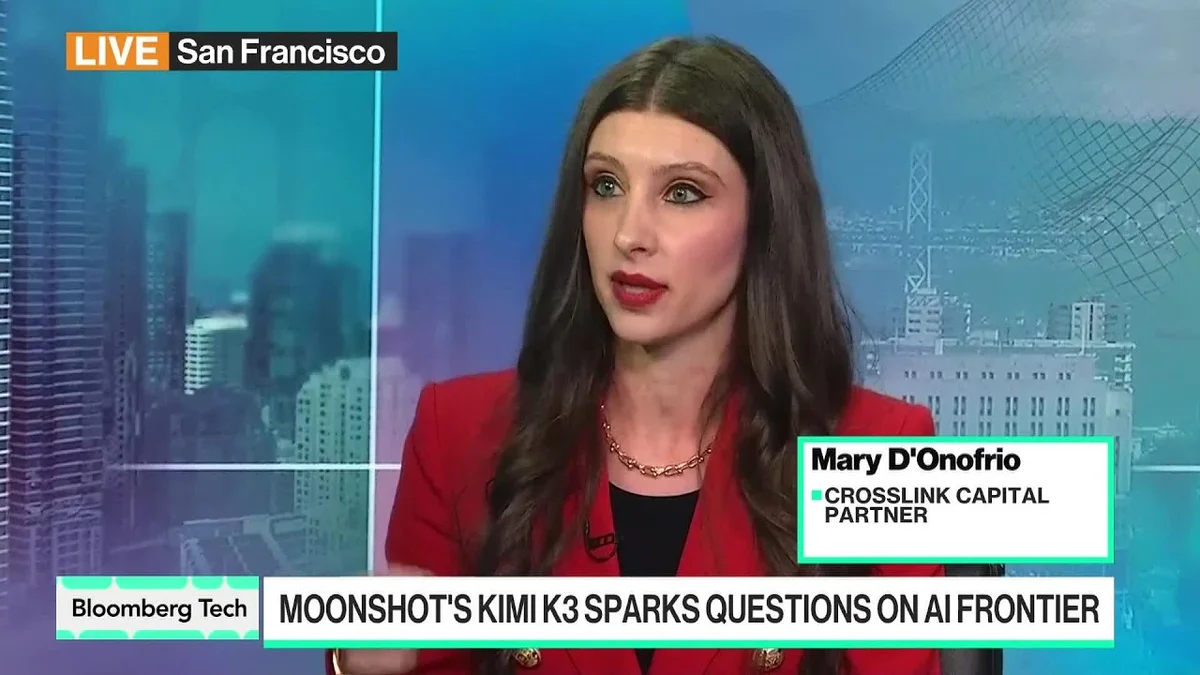
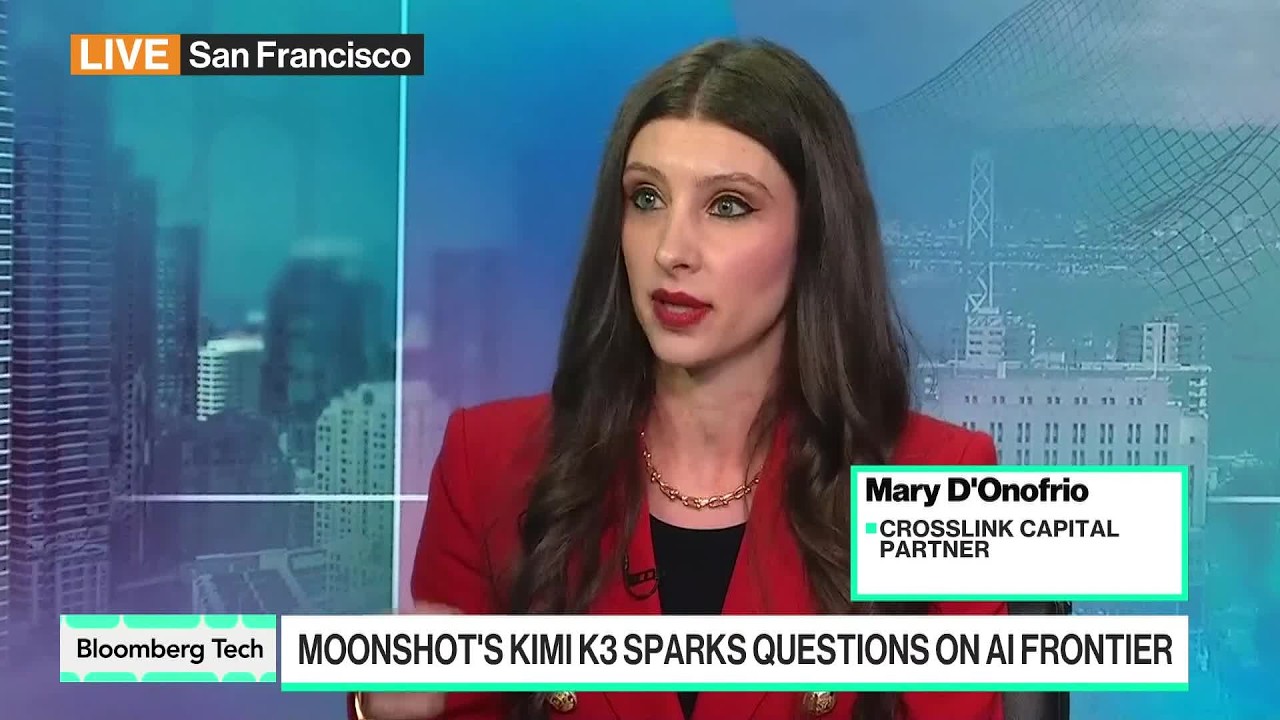
Crosslink Capital Partner Mary D'Onofrio discusses how Moonshot's Kimi K3 model impacts AI investing, the race for innovation, and market valuations.

Kimi K3 Sparks AI Investing Debate: A VC's View
Bloomberg Technology
Visual TL;DR
Kimi K3 Model ReleasedCore
Moonshot's 2.8 trillion parameter model sparks AI investing debate
From the article 6 mentionsKimi K3 is open-weight: the model weights are publicly downloadable, but training data and code are not released.
China's AI AdvanceEffect
From the article 2 mentionsThe 2.8 trillion parameter model positions China as a rapidly advancing player in the AI race, raising questions about the future of hardware demand and the ultimate value accrual in the AI sector.
AI Innovation RaceDriver
fierce competition among companies for superior AI models and capabilities
From the article 3 mentionsFailure to do so, she warned, risks being outpaced by the rapid innovations in both frontier and open-weight models.
VC Investment ViewCore
Mary D'Onofrio discusses implications for venture growth investments
From the article 5 mentionsHer view: strong model innovation is not necessarily bearish for the overall AI investment thesis, but it does mean value is shifting toward companies that can translate model capability into measurable productivity gains for businesses.
Hardware Demand QuestionsContext
uncertainty about future demand for AI infrastructure and chips
From the articleThe 2.8 trillion parameter model positions China as a rapidly advancing player in the AI race, raising questions about the future of hardware demand and the ultimate value accrual in the AI sector.
Value Accrual DebateContext
discussion on where ultimate value will settle in the AI sector
From the articleThe 2.8 trillion parameter model positions China as a rapidly advancing player in the AI race, raising questions about the future of hardware demand and the ultimate value accrual in the AI sector.
Market Valuations ShiftOutcome
rapid AI advancements reshaping public market valuations and investor sentiment
Contents(8)

The rapid advancements in artificial intelligence continue to reshape public markets, with the recent release of Moonshot's Kimi K3 model sparking significant debate. The 2.8 trillion parameter model positions China as a rapidly advancing player in the AI race, raising questions about the future of hardware demand and the ultimate value accrual in the AI sector. Mary D'Onofrio, a partner at Crosslink Capital specializing in venture growth investments across software, AI, and infrastructure, joined Bloomberg Tech to discuss the implications of Kimi K3 and the broader AI investment landscape.

StartupHub data

Companies working on this

Profiles of the companies named in this story, with funding and a one-liner from our database.

Teleport
$500M
Provides identity-based secure access to infrastructure for engineers and machines.
OpenAI
Private / $100B+ est
OpenAI is an AI research and deployment company dedicated to ensuring that artificial general intelligence benefits all of humanity.
Anthropic
Private / $100B+ est
Anthropic is an AI safety and research company building reliable, interpretable, and steerable AI systems, best known for the Claude family of models.
SpaceX
$800K
Designs, manufactures, and launches advanced rockets and spacecraft, aiming to make humanity multiplanetary.

Kimi K3 and the Shifting AI Frontier

D'Onofrio described the Kimi K3 model as "phenomenal," drawing parallels to the DeepSeek moment from the previous year. She noted that the model's performance, based on its own benchmarks, indicates that "China and open-weight models are closing the gap with frontier models." While acknowledging that the validity of benchmarks can be debated, D'Onofrio highlighted the "tremendous" productivity gains demonstrated by Kimi K3. She believes this development is a significant step towards the widespread adoption of open-weight models. In the context of increasing enterprise AI budgets, D'Onofrio posited that this trend could ultimately prove to be a "boon for AI ubiquity over time."

The full discussion can be found on Bloomberg Technology's YouTube channel.

How Kimi K3 Is Reshaping AI Investing - Bloomberg Technology
How Kimi K3 Is Reshaping AI Investing, from Bloomberg Technology

The Race for Innovation in AI

When asked about the impact of Kimi K3 on Crosslink's existing portfolio, D'Onofrio explained that while it might not fundamentally alter the AI "cake" itself, it serves as a clear signal that models are constantly leapfrogging each other. This necessitates that companies "out-innovate" by building defensible moats through data, performance, or customer resonance. Failure to do so, she warned, risks being outpaced by the rapid innovations in both frontier and open-weight models.

AI Infrastructure and Agent Technologies

D'Onofrio detailed her investment focus at Crosslink Capital, emphasizing her significant time spent in vertical AI and AI infrastructure. She defines AI infrastructure as the physical and software systems required to build, train, and run AI models. The initial wave, she explained, focused on building scalable models. The current wave, however, is shifting towards deploying these models "quickly, fastly, cheaply." Agents, she noted, are a key component of this efficiency, acting as the reasoning layer that connects models with external tools, data, and memory to produce outcomes. Agent infrastructure, including agent harnesses and identity layers, has become a significant area of focus for her, with Teleport being a notable portfolio company in this space.

Valuations and Market Signals

The conversation turned to the economic implications of Kimi K3's release, particularly regarding AI company valuations. D'Onofrio acknowledged the sentiment that if a Chinese startup can achieve such advanced model capabilities with certain economics, it raises questions about the trillion-dollar valuations of companies like OpenAI and Anthropic. However, she cautioned against drawing premature conclusions, noting that OpenAI and Anthropic are generating billions in revenue through diverse business streams beyond their core models. She also pointed out that while Moonshot's API is open, many open-weight models are not yet available, and crucially, "open weight doesn't mean it's free to run," a dynamic that is often underestimated.

Public Markets and AI Enthusiasm

Discussing recent IPOs like SpaceX and SK Hynix, D'Onofrio observed that these events signal a strong investor appetite for anything related to the AI build-out. She also noted that while the IPO window may be reopening, it appears to be doing so for established, revenue-generating businesses, suggesting that investors, while keen on AI, remain risk-averse and are looking for "relatively secure" investments.

August 2026 Update: Where Kimi K3 Sits Now

Since D'Onofrio's Bloomberg interview in July 2026, Kimi K3 has continued to gain traction. The model now ranks third on the Artificial Analysis Intelligence Index, a position broadly consistent with the VC view that it occupies "an intermediate space" between mid-range and frontier models. However, the cost-efficiency story has strengthened: at approximately $0.94 per benchmark task, Kimi K3 costs roughly half what Claude Opus 4.8 costs per completed task ($1.80), which is shifting enterprise procurement conversations. StartupHub.ai rates Moonshot AI at 70 out of 100 overall, and across the AI model providers we track, cost-per-task gap of this magnitude between open-weight and closed models is the largest we have recorded this year.

Frequently Asked Questions

Why does Kimi K3 matter for AI investors?

Kimi K3 demonstrated that frontier-class model capability is achievable with an open-weight approach at materially lower per-task cost than leading closed models. For investors, this compresses the moat of closed-model incumbents and raises questions about where pricing power and value will accrue in the AI stack, whether at the model layer, infrastructure, or application layer.

What did VC Mary D'Onofrio say about Kimi K3 and valuations?

D'Onofrio, a partner at Crosslink Capital, cautioned against drawing premature conclusions about trillion-dollar valuations from Kimi K3's release. She argued that AI model competition drives down inference costs, which benefits the application layer. Her view: strong model innovation is not necessarily bearish for the overall AI investment thesis, but it does mean value is shifting toward companies that can translate model capability into measurable productivity gains for businesses.

Is Kimi K3 open source?

Kimi K3 is open-weight: the model weights are publicly downloadable, but training data and code are not released. This means enterprises can self-host the model for cost control or regulatory compliance, but it is not a fully open-source project in the traditional sense.

How does Kimi K3 compare to GPT-5.5 and Claude Opus 4.8 on benchmarks?

Kimi K3 ranks third on the Artificial Analysis Intelligence Index, behind GPT-5.5 and Claude Opus 4.8. Capability gaps have narrowed considerably. The primary remaining differentiators for the closed models are enterprise SLA guarantees, safety tooling, and fine-tuning support.

Last updated: August 2026

© 2026 StartupHub.ai. All rights reserved. You may not republish this article in full without a license. Search engines and AI research tools may crawl and summarize for reference. Bulk reproduction or model training requires a license. See our terms.
Daniel Singer

Written by

Daniel Singer

Editor, StartupHub.ai

Daniel Singer is the editor of StartupHub.ai, a technology expert and thought leader on AI and its applications across sectors, from fintech and healthcare to developer tooling and consumer software. He writes and tests the tools covered here thoroughly and regularly, and built StartupHub.ai to give founders, operators and buyers a clearer read on what they are actually being sold.

More from Daniel Singer

