


Tchir: AI and Everything Else - Two Economies Driving Markets

Peter Tchir of Academy Securities outlines a market divided into two economies: the AI-driven compute sector and everything else, warning of potential risks if AI spending slows.

8 min read
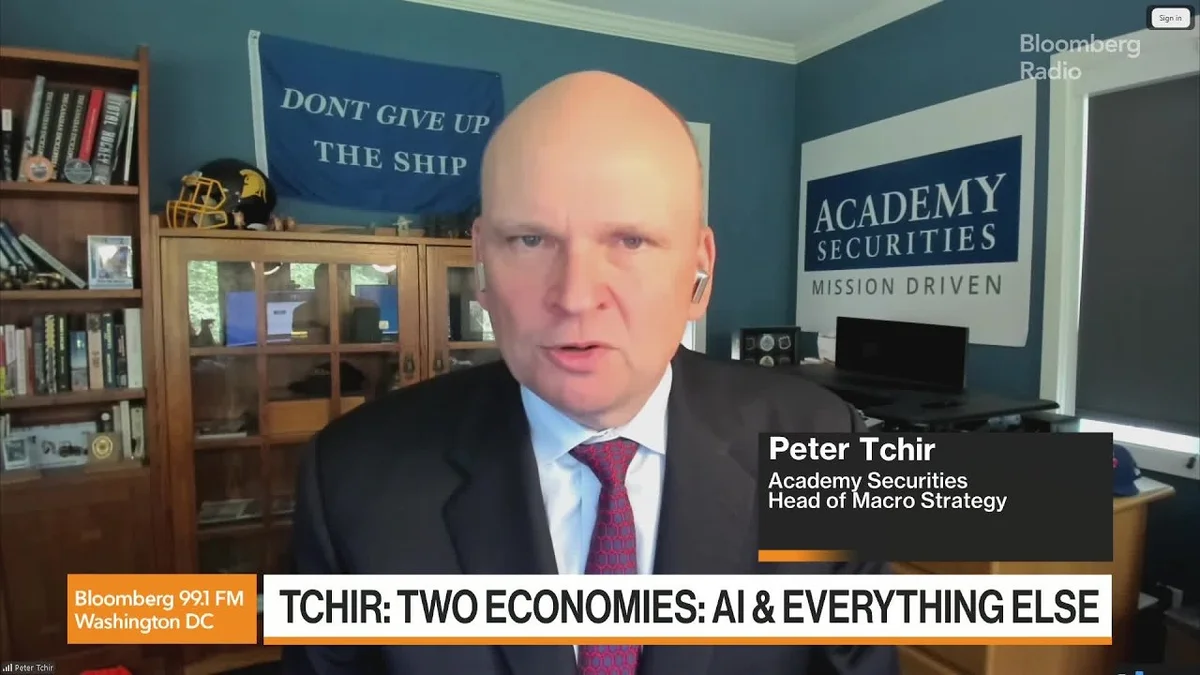
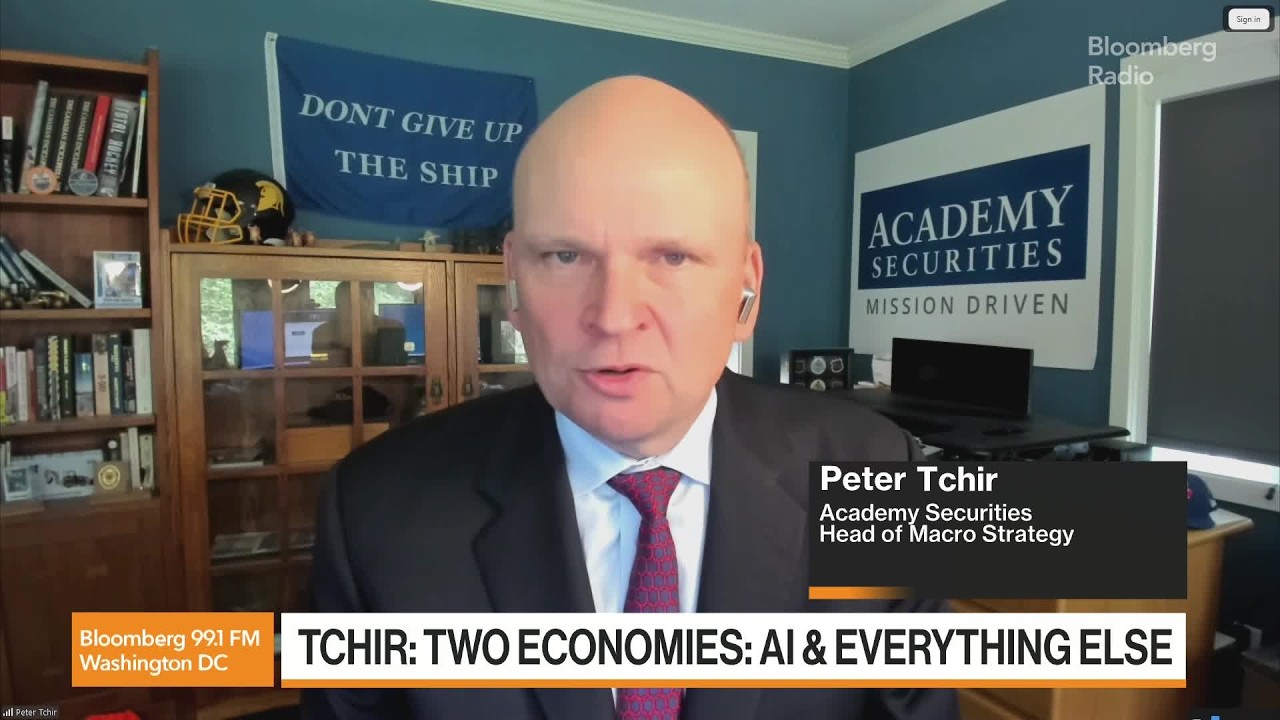
Peter Tchir, Head of Macro Strategy at Academy Securities, discusses the AI-driven economy on Bloomberg Radio.
Peter Tchir explains his view on the current economic landscape, divided by AI compute.· Bloomberg Podcast

Visual TL;DR. Two Economies driven by AI Compute Boom. AI Compute Boom fuels Market Strength. Early Cracks signals Future Outlook. Market Strength impacts Future Outlook. Hyperscaler Spending contributes to AI Compute Boom. Inflation & Fed influences Future Outlook.

  1. Two Economies: AI compute sector vs. everything else driving market dynamics
  2. AI Compute Boom: data centers built at unprecedented pace, robust demand for resources
  3. Market Strength: significant driver of overall market performance and economic growth
  4. Early Cracks: Meta's Zuckerberg hints at potential slowdown in AI spending
  5. Hyperscaler Spending: large tech companies investing heavily in AI infrastructure
  6. Future Outlook: potential risks if AI infrastructure spending decelerates
  7. Inflation & Fed: broader economic factors influencing market stability beyond AI
Visual TL;DR
Visual TL;DR, startuphub.ai Two Economies driven by AI Compute Boom. AI Compute Boom fuels Market Strength. Market Strength impacts Future Outlook driven by fuels impacts Two Economies AI Compute Boom Market Strength Future Outlook From startuphub.ai · The publishers behind this format
Visual TL;DR, startuphub.ai Two Economies driven by AI Compute Boom. AI Compute Boom fuels Market Strength. Market Strength impacts Future Outlook driven by fuels impacts Two Economies AI compute sector vs. everything elsedriving market dynamics AI Compute Boom data centers built at unprecedented pace,robust demand for resources Market Strength significant driver of overall marketperformance and economic growth Future Outlook potential risks if AI infrastructurespending decelerates From startuphub.ai · The publishers behind this format
Visual TL;DR, startuphub.ai Two Economies driven by AI Compute Boom. AI Compute Boom fuels Market Strength. Market Strength impacts Future Outlook driven by fuels impacts Two Economies AI compute sectorvs. everything elsedriving market… AI Compute Boom data centers builtat unprecedentedpace, robust demand… Market Strength significant driverof overall marketperformance and… Future Outlook potential risks ifAI infrastructurespending… From startuphub.ai · The publishers behind this format
Visual TL;DR, startuphub.ai Two Economies driven by AI Compute Boom. AI Compute Boom fuels Market Strength. Early Cracks signals Future Outlook. Market Strength impacts Future Outlook. Hyperscaler Spending contributes to AI Compute Boom. Inflation & Fed influences Future Outlook driven by fuels signals impacts contributes to influences Two Economies AI compute sector vs. everything elsedriving market dynamics AI Compute Boom data centers built at unprecedented pace,robust demand for resources Market Strength significant driver of overall marketperformance and economic growth Early Cracks Meta's Zuckerberg hints at potentialslowdown in AI spending Hyperscaler Spending large tech companies investing heavily inAI infrastructure Future Outlook potential risks if AI infrastructurespending decelerates Inflation & Fed broader economic factors influencingmarket stability beyond AI From startuphub.ai · The publishers behind this format
Visual TL;DR, startuphub.ai Two Economies driven by AI Compute Boom. AI Compute Boom fuels Market Strength. Early Cracks signals Future Outlook. Market Strength impacts Future Outlook. Hyperscaler Spending contributes to AI Compute Boom. Inflation & Fed influences Future Outlook driven by fuels signals impacts contributes to influences Two Economies AI compute sectorvs. everything elsedriving market… AI Compute Boom data centers builtat unprecedentedpace, robust demand… Market Strength significant driverof overall marketperformance and… Early Cracks Meta's Zuckerberghints at potentialslowdown in AI… HyperscalerSpending large techcompanies investingheavily in AI… Future Outlook potential risks ifAI infrastructurespending… Inflation & Fed broader economicfactors influencingmarket stability… From startuphub.ai · The publishers behind this format

In a recent discussion, Peter Tchir, Head of Macro Strategy at Academy Securities (NASDAQ:ACAD), presented a compelling framework for understanding the current market dynamics, positing the existence of "two economies: the AI driven data center, a compute build, the our economy and the rest of the economy." This bifurcation highlights the outsized influence of artificial intelligence infrastructure on overall economic performance, a trend that has been accelerating.

The AI Compute Boom and Early Cracks

Tchir noted that the AI-driven compute economy has been performing exceptionally well. Data centers are being built at an unprecedented pace, and companies are readily accepting rising prices for compute resources. This robust demand has been a significant driver of market strength. However, Tchir pointed to a recent development that could signal a shift: "We saw some of the first cracks last Thursday when, you know, for the first time, Zuckerberg said, Meta (NASDAQ:META) might actually sell some excess compute."

This statement from Meta Platforms CEO Mark Zuckerberg is particularly noteworthy because it deviates from a prior market sentiment where the only perceived mistake was not having enough compute. The possibility of a major hyperscaler selling excess capacity suggests a potential softening of demand or an oversupply in the near future. Tchir emphasized this as "the real question here is, yeah, we're no the next six months you're all looking good on this, but well, people start questioning where they want to be two years from now. That to me is the biggest risk to the market is some change in compute."

The full discussion can be found on Bloomberg Podcast's YouTube channel.

There are Two Types of Economies, AI and Everything Else, says Tchir - Bloomberg Podcast
There are Two Types of Economies, AI and Everything Else, says Tchir, from Bloomberg Podcast

While some compute-related companies have already experienced significant sell-offs, indicating that some of this risk is being priced in, Tchir believes there is still greater risk ahead. He expressed concern that if compute spending begins to fade, it would severely impact the broader economy, given its current role as a massive driver.

Earnings Season and Future Outlook

Looking ahead to the upcoming earnings season for the second quarter, Tchir reflected on the first quarter's strong performance, which largely fueled the market's gains throughout the year. However, he cautioned that these earnings were disproportionately driven by a handful of companies. "If you look at the index level earnings they're awesome. But strip away those companies. The rest did not look as good."

This concentration of success makes the earnings game harder to win in the future. Investors, facing record valuations, are demanding more than just a good quarter. Tchir highlighted a recent announcement from Micron Technology (NASDAQ:MU), which indicated locked-in orders for years to come, as the kind of long-term visibility the market now requires. "It's not just this quarter earnings. It's really going to be what have you sold next year. What are you selling two years from now? And how certain are you those that those sales are coming through." This forward-looking perspective, he reiterated, will be heavily driven by compute demand.
Hyperscaler Spending and Market Structure

The Federal Reserve's decision and the earnings reports from major tech companies and hyperscalers, all scheduled for the same week, will be critical. Tchir expects that the market has already priced in continued strong AI spending and CapEx from these giants. Any deviation or hint of a slowdown in compute demand could have a disproportionate effect on the market.

Tchir also pointed to the role of market structure, specifically highly leveraged ETFs like SOXL (the triple-leveraged semiconductor ETF), which has amplified market moves in both directions. With over $20 billion in assets, such instruments exacerbate volatility. "I think it's amplifies them mostly on the way up. But it will amplify on the way down if we get any cracks." He noted that news that would typically cause a 0.5% to 1% market move now often results in a 2% to 3% swing, largely due to this amplified market structure. This makes the market more susceptible to downside risk, even if it has helped on the upside.

Inflation and the Fed's Stance

Beyond AI and earnings, Tchir anticipates a shift in the inflation narrative. He believes that the market is currently mispricing the Federal Reserve's stance, viewing it as hawkish and expecting further rate hikes. Tchir, however, suggests the Fed is still dovish but needs an excuse to act accordingly. "I think Warsh is going to be able to say hey inflation's coming down under me. I think he did a phenomenal job addressing inflation. I really think we're going to see deflation, you know, inflation decline."

He expects the Fed to start considering alternative inflation metrics, such as Zillow rents, that do not indicate inflation is above 2%. This re-evaluation of data, Tchir argues, will provide the necessary justification for the Fed to adopt a more dovish stance, likely soon, though perhaps not at the immediate upcoming meeting.

© 2026 StartupHub.ai. All rights reserved. Do not enter, scrape, copy, reproduce, or republish this article in whole or in part. Use as input to AI training, fine-tuning, retrieval-augmented generation, or any machine-learning system is prohibited without written license. Substantially-similar derivative works will be pursued to the fullest extent of applicable copyright, database, and computer-misuse laws. See our terms.