


Startup School: Max Kolysh on Landing First 10 Customers

Max Kolysh of Y Combinator shares essential strategies for startups to land their first 10 customers, emphasizing personal networks, understanding customer behavior, and targeted outreach.

4 min read
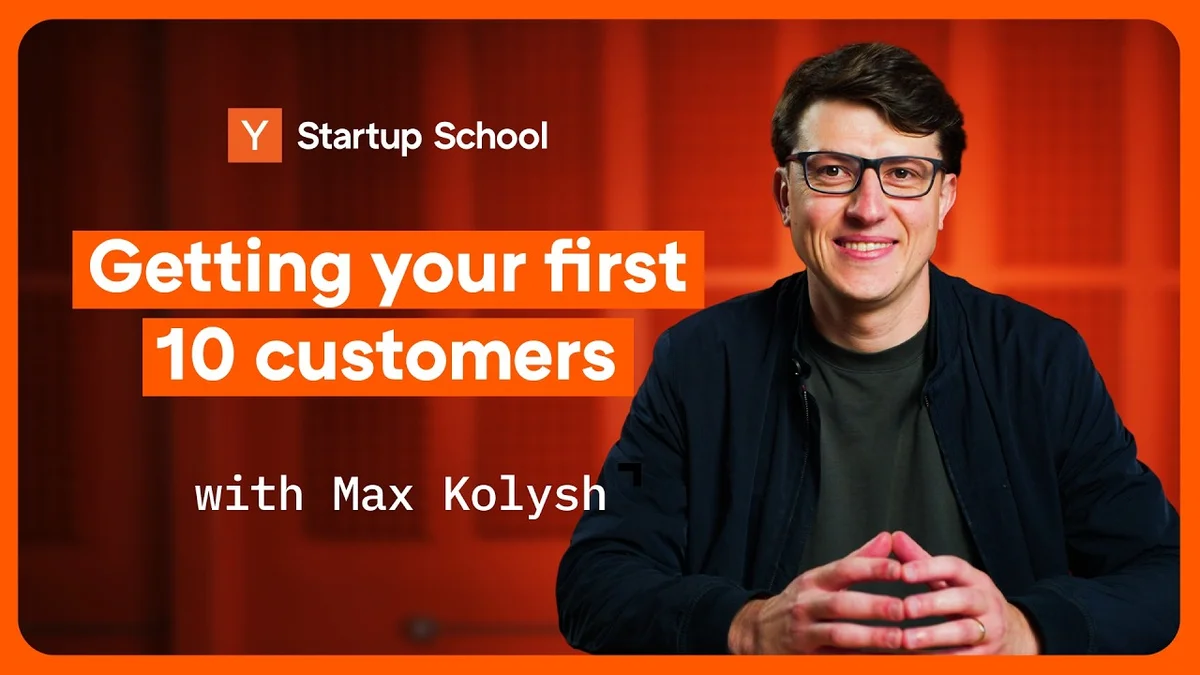
Max Kolysh speaking at a table for Startup School video.
Max Kolysh, Visiting Partner at Y Combinator, discusses strategies for acquiring initial customers.· YC

Securing the first ten customers is a critical milestone for any startup, often requiring a more hands-on and personal approach than later growth stages. In this video from Startup School, Max Kolysh, a Visiting Partner at Y Combinator, shares insights gathered from numerous founders on the most effective strategies for this crucial initial phase.

Understanding Your Customer's Day

Kolysh emphasizes that before diving into any outreach or choosing a sales channel, founders must deeply understand their target customer. This involves answering fundamental questions like: What does their average day look like? How often do they check their email? Where do they congregate online (e.g., Reddit, LinkedIn, specific forums)? Do they attend conferences, and if so, which ones? Where do they seek recommendations for new software or services? Understanding these details helps founders identify the most effective places to connect with potential buyers.
Related startups

The full discussion can be found on YC's YouTube channel.

How to Get Your First 10 Customers - YC
How to Get Your First 10 Customers, from YC

Leveraging Your Warm Network First

One of the most consistently successful strategies Kolysh highlights is the importance of exhausting one's warm network first. These are the people who already have a degree of trust in you as a founder. This includes friends in the industry, former colleagues, classmates, and even people you know through a single introduction. These individuals are more likely to take a chance on a new product from an unknown company simply because they trust the person behind it, not solely based on the product's features.

AI Tools and Manual Outreach

While AI-powered tools like Apollo.io and Clay can be invaluable for prospecting and data enrichment, Kolysh cautions against relying on them exclusively for the very first customers. These tools become significantly more effective once a startup has validated its product and has a clearer understanding of its customer base, ideally after acquiring 10-20 high-quality customers. For the initial phase, manual outreach and leveraging personal connections are often more fruitful.

The Power of In-Person Interaction and Micro-Events

Kolysh shares anecdotes of founders who achieved significant early success by being present and engaging in person. One founder, after struggling with low response rates from cold emails, attended industry-specific trade shows and directly engaged with potential customers. This hands-on approach led to more meaningful conversations and ultimately closed more deals in days than previous months of digital outreach. Another strategy involves hosting small, targeted micro-events like founder dinners or happy hours for a select group of ideal customers. These intimate gatherings foster deeper connections and provide valuable feedback.

Finding Pain in Public

A key tactic for identifying potential customers is to find where the pain points your product solves are being expressed publicly. For consumer products, this might be on social media platforms like Facebook groups or Reddit. For B2B products, relevant communities might include industry-specific forums or trade association message boards. By actively participating in these spaces, founders can identify unmet needs and engage with potential customers who are already vocalizing their problems.

Crafting Effective Outreach

When it comes to writing outreach emails or messages, Kolysh stresses the importance of brevity and clarity. Emails should ideally be under 75 words, with a clear call to action. Founders should also consider the framing of their outreach: is it a sales pitch or an offer of advice and mentorship? Offering value, such as a quick vulnerability scan for a security startup or a product feedback session, can be more effective than a direct sales approach, especially in the early stages.

The Early vs. Scaling Approach

Kolysh differentiates the strategy for the first 10 customers from the strategy for the next 100. The initial customers are often acquired through highly manual, personalized efforts. As a startup grows, the focus shifts to scaling these efforts, often by leveraging more automated tools and processes. However, the core principle of understanding and engaging with the customer remains paramount throughout the journey.

© 2026 StartupHub.ai. All rights reserved. Do not enter, scrape, copy, reproduce, or republish this article in whole or in part. Use as input to AI training, fine-tuning, retrieval-augmented generation, or any machine-learning system is prohibited without written license. Substantially-similar derivative works will be pursued to the fullest extent of applicable copyright, database, and computer-misuse laws. See our terms.