

Sara Hooker: AI Frontier Discovery Needs Broader Access

AI researcher Sara Hooker discusses how compute barriers and narrow career paths have limited AI discovery, and how new tools like AutoScientist are democratizing frontier AI development.

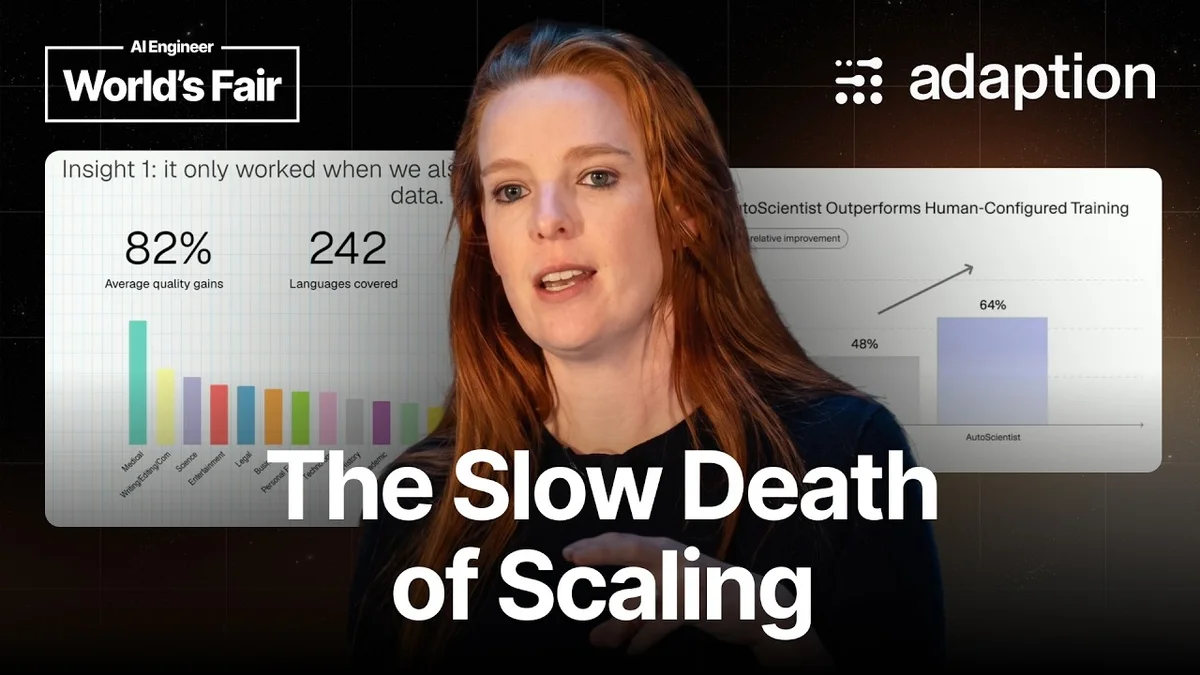
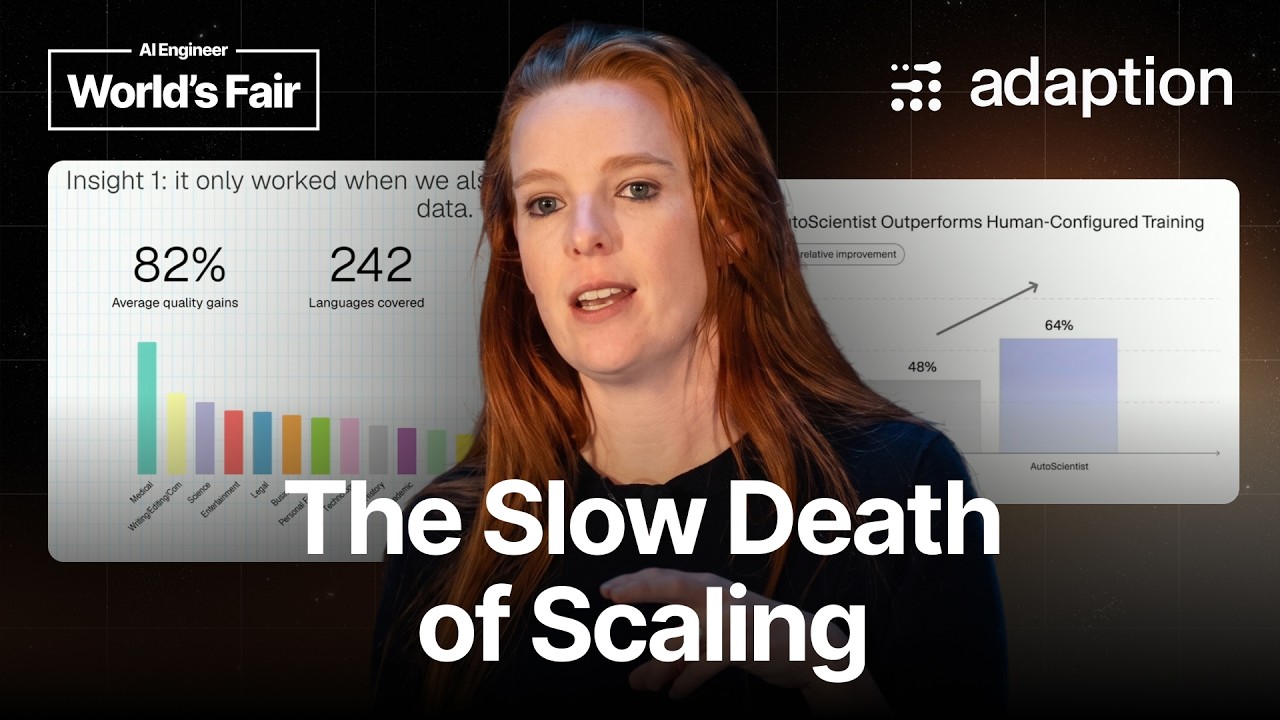
Sara Hooker presenting on AI frontier discovery and democratization.
AI Engineer
Visual TL;DR
Narrow AI PathDriver
compute barriers and specific career trajectories limit broader participation in AI discovery
From the articleIn a compelling presentation at the AI Engineer World's Fair, Sara Hooker, an AI researcher, argued that the path to frontier AI discovery has been bottlenecked by an "unreasonably narrow path" and the prohibitive cost of compute.
Elite Labs DominateDriver
power concentrated within a few leading labs, hindering diverse innovation and access
From the articleShe highlighted that in modern AI research, a specific, highly filtered career trajectory is often required: a top PhD program, followed by stints at elite industry labs, and then the pursuit of impactful research.
AutoScientist ToolCore
new tools like AutoScientist democratize frontier AI development by lowering barriers
From the article 5 mentionsHooker expressed optimism for a revolution in who gets to shape AI, proposing that it's possible to "allow anyone to build the same frontier intelligence as that in labs." She introduced AutoScientist, a tool developed by Adaption Labs, which automates the model training process.
Exclusion from FrontierDriver
individuals not fitting the mold or 'right problem' excluded from cutting-edge contributions
From the article 2 mentionsHooker expressed optimism for a revolution in who gets to shape AI, proposing that it's possible to "allow anyone to build the same frontier intelligence as that in labs." She introduced AutoScientist, a tool developed by Adaption Labs, which automates the model training process.
Democratize DiscoveryEffect
enabling broader access to AI research, moving beyond the 'unreasonably narrow path'
From the article 2 mentionsHooker traced the evolution of scientific discovery, from the era of "gentleman scientists" to the professionalization of academia and, more recently, the dominance of industry labs.
Adaptive IntelligenceContext
the future of AI belongs to adaptive systems, overcoming the 'slow death of scaling'
From the article 3 mentionsThis shift, she believes, means the future of machine intelligence is adaptive.
Broader AI AccessOutcome
new tools and approaches foster wider participation in AI frontier discovery
From the article 3 mentionsHooker pointed to the concept of "GPU poor versus GPU rich" as a stark illustration of how access to compute has dictated participation in AI breakthroughs.
Contents(4)

In a compelling presentation at the AI Engineer World's Fair, Sara Hooker, an AI researcher, argued that the path to frontier AI discovery has been bottlenecked by an "unreasonably narrow path" and the prohibitive cost of compute. This has historically concentrated power within a few leading labs, limiting broader participation and innovation.

Sara Hooker: AI Frontier Discovery Needs Broader Access - AI Engineer
Sara Hooker: AI Frontier Discovery Needs Broader Access, AI Engineer

The "Unreasonably Narrow Path" in AI Research

Hooker traced the evolution of scientific discovery, from the era of "gentleman scientists" to the professionalization of academia and, more recently, the dominance of industry labs. She highlighted that in modern AI research, a specific, highly filtered career trajectory is often required: a top PhD program, followed by stints at elite industry labs, and then the pursuit of impactful research. This "aggressively filtered system" meant that individuals who didn't fit this mold or weren't focused on the "right problem at the right time" were excluded from contributing to the cutting edge.

The need for significant computational resources further compounded these barriers. Hooker pointed to the concept of "GPU poor versus GPU rich" as a stark illustration of how access to compute has dictated participation in AI breakthroughs. A map of significant machine learning system breakthroughs, she noted, showed vast regions of the world completely left out.

Democratizing Discovery with AutoScientist

Hooker expressed optimism for a revolution in who gets to shape AI, proposing that it's possible to "allow anyone to build the same frontier intelligence as that in labs." She introduced AutoScientist, a tool developed by Adaption Labs, which automates the model training process. AutoScientist co-optimizes the entire loop, from data to alignment, and self-evolves based on domain and data types. Notably, it has shown to outperform human research staff in model training decisions.

A key insight from AutoScientist's development is the critical role of co-optimizing data alongside the model. Hooker emphasized that "most returns for performance are now on a broader action space," and that controlling data quality is paramount. She explained that AutoScientist combines domain knowledge, dataset adaptation, and self-improvement capabilities to achieve these results.

The "Slow Death of Scaling" and Adaptive Intelligence

Hooker also touched upon the concept of the "slow death of scaling," noting that pre-training size is no longer the sole determinant of performance. Empirically, she stated, "pre-training scale isn't going to dominate performance," which fundamentally alters who can create the best innovation recipes. Instead, she argued, the focus is shifting towards areas where barriers to entry are more "nimble," such as optimizing in the data space and learning from interaction.

This shift, she believes, means the future of machine intelligence is adaptive. "It will be shaped by whoever makes adaptation as efficient as possible," Hooker stated. She highlighted that the most important intelligence is a model that interacts efficiently and learns continuously from its environment. This leads to a new era where models should adapt in real-time, and the ability to update behavior continuously is the last-mile advantage.

The Future Belongs to the Adaptive

Hooker concluded by reiterating that the current trends indicate a ripe moment for a revolution in AI participation. The automation of complex training processes and the diminishing returns of sheer scale are lowering the barriers to entry. She encouraged the audience to consider how they can contribute to this more democratized future of AI, emphasizing that the focus is shifting from mastering tools to answering critical questions.

© 2026 StartupHub.ai. All rights reserved. You may not republish this article in full without a license. Search engines and AI research tools may crawl and summarize for reference. Bulk reproduction or model training requires a license. See our terms.
Daniel Singer

Written by

Daniel Singer

Editor, StartupHub.ai

Daniel Singer is the editor of StartupHub.ai, a technology expert and thought leader on AI and its applications across sectors, from fintech and healthcare to developer tooling and consumer software. He writes and tests the tools covered here thoroughly and regularly, and built StartupHub.ai to give founders, operators and buyers a clearer read on what they are actually being sold.