


RLM Models: A New Approach to Large Codebases

Shashi Jagtap of Superagentic AI explores Recursive Language Models (RLMs) and their application for coding agents tackling large codebases, showcasing their RLM Code implementation.

8 min read
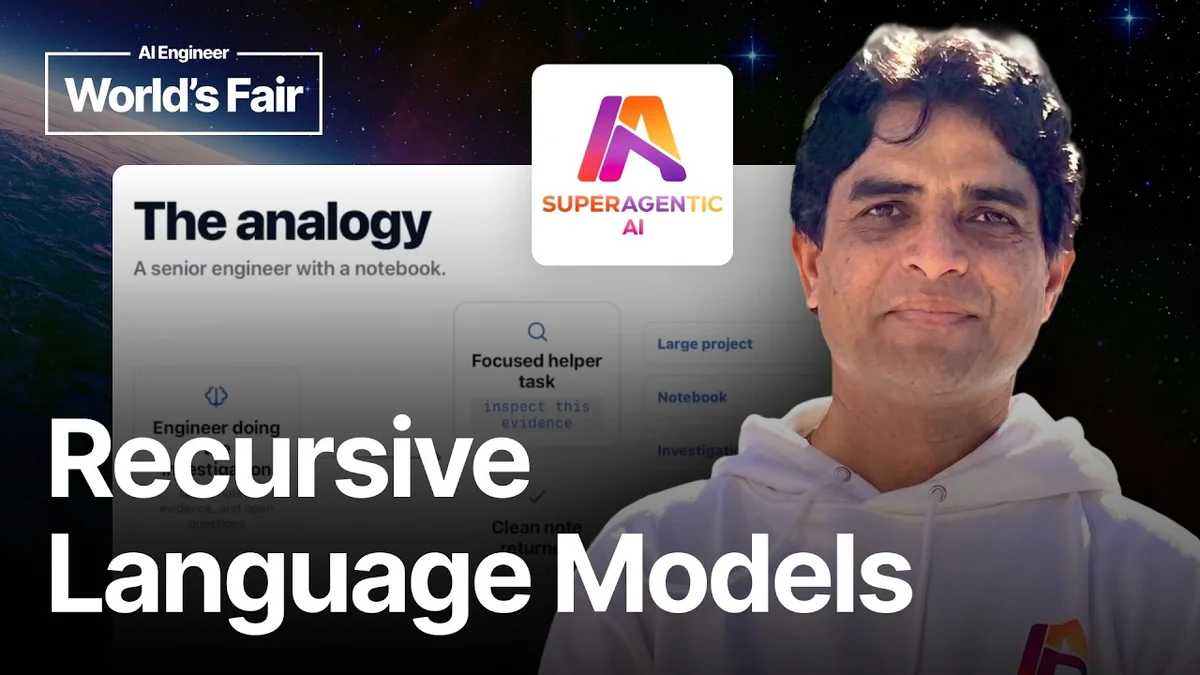
Shashi Jagtap presenting RLM: Recursive Language Models for Large Codebases
AI Engineer

Visual TL;DR. Large Codebases causes Context Window Limits. Context Window Limits solved by RLM Solution. Large Codebases addressed by RLM Solution. RLM Solution uses Externalized Context. Externalized Context demonstrated in RLM Code Demo. RLM Solution shown via RLM Code Demo. RLM Code Demo leads to Improved Agent Performance. Improved Agent Performance integrates with Broader Ecosystem.

  1. Large Codebases: coding agents struggle with complexity of multi-file projects and monolithic repositories
  2. Context Window Limits: traditional methods like grep or summarization degrade performance as context grows
  3. RLM Solution: Recursive Language Models (RLMs) address large context challenges for coding agents
  4. Externalized Context: RLMs manage context outside the main model, improving efficiency and scalability
  5. RLM Code Demo: Superagentic AI's Shashi Jagtap showcased practical implementation for coding agents
  6. Improved Agent Performance: RLMs enable coding agents to effectively tackle large, complex codebases
  7. Broader Ecosystem: RLMs integrate with existing tools, enhancing overall AI engineering workflows
Visual TL;DR
Visual TL;DR, startuphub.ai Large Codebases addressed by RLM Solution. RLM Solution shown via RLM Code Demo. RLM Code Demo leads to Improved Agent Performance addressed by shown via leads to Large Codebases RLM Solution RLM Code Demo Improved Agent Performance From startuphub.ai · The publishers behind this format
Visual TL;DR, startuphub.ai Large Codebases addressed by RLM Solution. RLM Solution shown via RLM Code Demo. RLM Code Demo leads to Improved Agent Performance addressed by shown via leads to Large Codebases RLM Solution RLM Code Demo Improved AgentPerformance From startuphub.ai · The publishers behind this format
Visual TL;DR, startuphub.ai Large Codebases addressed by RLM Solution. RLM Solution shown via RLM Code Demo. RLM Code Demo leads to Improved Agent Performance addressed by shown via leads to Large Codebases coding agents struggle with complexity ofmulti-file projects and monolithicrepositories RLM Solution Recursive Language Models (RLMs) addresslarge context challenges for coding agents RLM Code Demo Superagentic AI's Shashi Jagtap showcasedpractical implementation for coding agents Improved Agent Performance RLMs enable coding agents to effectivelytackle large, complex codebases From startuphub.ai · The publishers behind this format
Visual TL;DR, startuphub.ai Large Codebases addressed by RLM Solution. RLM Solution shown via RLM Code Demo. RLM Code Demo leads to Improved Agent Performance addressed by shown via leads to Large Codebases coding agentsstruggle withcomplexity of… RLM Solution Recursive LanguageModels (RLMs)address large… RLM Code Demo Superagentic AI'sShashi Jagtapshowcased practical… Improved AgentPerformance RLMs enable codingagents toeffectively tackle… From startuphub.ai · The publishers behind this format
Visual TL;DR, startuphub.ai Large Codebases causes Context Window Limits. Context Window Limits solved by RLM Solution. Large Codebases addressed by RLM Solution. RLM Solution uses Externalized Context. Externalized Context demonstrated in RLM Code Demo. RLM Solution shown via RLM Code Demo. RLM Code Demo leads to Improved Agent Performance. Improved Agent Performance integrates with Broader Ecosystem causes solved by addressed by uses demonstrated in shown via leads to integrates with Large Codebases coding agents struggle with complexity ofmulti-file projects and monolithicrepositories Context Window Limits traditional methods like grep orsummarization degrade performance ascontext grows RLM Solution Recursive Language Models (RLMs) addresslarge context challenges for coding agents Externalized Context RLMs manage context outside the mainmodel, improving efficiency andscalability RLM Code Demo Superagentic AI's Shashi Jagtap showcasedpractical implementation for coding agents Improved Agent Performance RLMs enable coding agents to effectivelytackle large, complex codebases Broader Ecosystem RLMs integrate with existing tools,enhancing overall AI engineering workflows From startuphub.ai · The publishers behind this format
Visual TL;DR, startuphub.ai Large Codebases causes Context Window Limits. Context Window Limits solved by RLM Solution. Large Codebases addressed by RLM Solution. RLM Solution uses Externalized Context. Externalized Context demonstrated in RLM Code Demo. RLM Solution shown via RLM Code Demo. RLM Code Demo leads to Improved Agent Performance. Improved Agent Performance integrates with Broader Ecosystem causes solved by addressed by uses demonstrated in shown via leads to integrates with Large Codebases coding agentsstruggle withcomplexity of… Context WindowLimits traditional methodslike grep orsummarization… RLM Solution Recursive LanguageModels (RLMs)address large… ExternalizedContext RLMs manage contextoutside the mainmodel, improving… RLM Code Demo Superagentic AI'sShashi Jagtapshowcased practical… Improved AgentPerformance RLMs enable codingagents toeffectively tackle… Broader Ecosystem RLMs integrate withexisting tools,enhancing overall… From startuphub.ai · The publishers behind this format

Shashi Jagtap, founder of Superagentic AI, presented a compelling vision for tackling the challenges of large codebases with AI agents during the AI Engineer World Fair 2026. His talk, titled "RLM: Recursive Language Models for Large Codebases," introduced Recursive Language Models (RLMs) as a solution to a persistent problem: the degradation of performance in coding agents as context windows grow, particularly with monolithic repositories.

RLM Models: A New Approach to Large Codebases - AI Engineer
RLM Models: A New Approach to Large Codebases — from AI Engineer

The Problem with Large Contexts

Jagtap highlighted that while coding agents excel with smaller code repositories or single files, their effectiveness diminishes significantly when faced with the complexity of large, multi-file projects. Traditional approaches like using tools such as 'grep' for searching, semantic search, or context compression using summarization have limitations. These methods often struggle with the inherent structure of codebases, which include directories, dependencies, tests, and configurations, making them more than just plain text.

The RLM Solution: Externalized Context Management

The core thesis of RLMs, as presented, is to move context management into a programmable execution environment. Instead of feeding the entire codebase into the model's context window, RLMs treat the repository as structured data. The model can then write code to inspect, slice, and compute relevant chunks of this data, which are then fed into the main context window. This recursive approach allows the model to effectively navigate and reason over complex code structures.

Jagtap drew an analogy to a senior software engineer tackling a large codebase. Such an engineer wouldn't read line by line but would inspect the structure, dependencies, and perhaps consult with colleagues. Similarly, an RLM can interact with its 'programmable ripple' (a coding agent or script) to explore the codebase, make notes, and recursively query other models or systems for answers, ultimately returning a synthesized result.

Introducing RLM Code by Superagentic AI

To demonstrate these concepts, Jagtap introduced RLM Code, an open-source project from Superagentic AI. This is described as a research playground and an independent, experimental reference implementation for building, running, evaluating, and comparing LLM-based coding agents. RLM Code supports various agent paradigms, including pure RLM, CodeAct, and traditional approaches, within a unified platform that emphasizes safety, observability, and reproducibility.

Jagtap emphasized that RLM itself is a pattern, and RLM Code is a reference implementation that adheres strictly to the RLM paper's ideas, including recursive calls and ripple execution. The flexibility of RLM Code allows it to be run with local or cloud-based models and integrated with various observability frameworks and other tools like Pydantic or Google Ad.

Live Demo and Practical Applications

The presentation included a live demo showcasing RLM Code in action. Jagtap demonstrated how the system operates within a Docker sandbox, showing the loop of context loading, REPL code execution for extracting relevant snippets, recursive LLM queries for synthesis, and the finalization of results. The output traces, available in JSONL format, can be exported to any observability platform of choice.

Potential use cases for AI engineers were highlighted, including root cause analysis for incidents, mapping unfamiliar repositories, performing security audits, and assisting with code refactoring and onboarding. The ability to design custom harnesses based on specific needs was also emphasized, capturing the full trajectory from planning to final output.

RLM in the Broader Ecosystem

Jagtap noted that RLM concepts are already being integrated into proprietary systems, such as managed agents and dynamic workflows. He cited examples like the Codex harness writing Python code within a REPL to curate context, and the underlying principles being used in managed agent systems from major cloud providers. He also mentioned that some engineers from Anthropic have acknowledged using RLM concepts.

The talk concluded by reiterating the power of RLM for handling large-context repository work, urging developers to try the concept on their own projects and to experiment with its customizable harness design. The core message was clear: RLM offers a structured and effective way to manage complex codebases, moving beyond simple text processing to a more intelligent, stateful interaction.

© 2026 StartupHub.ai. All rights reserved. Do not enter, scrape, copy, reproduce, or republish this article in whole or in part. Use as input to AI training, fine-tuning, retrieval-augmented generation, or any machine-learning system is prohibited without written license. Substantially-similar derivative works will be pursued to the fullest extent of applicable copyright, database, and computer-misuse laws. See our terms.