


OpenAI's GPT-5.5: A Leap in AI Coding Assistance

OpenAI's Romain Huet and Ramp's Will Koh discuss GPT-5.5's advanced coding assistance and its impact on financial data extraction.

6 min read
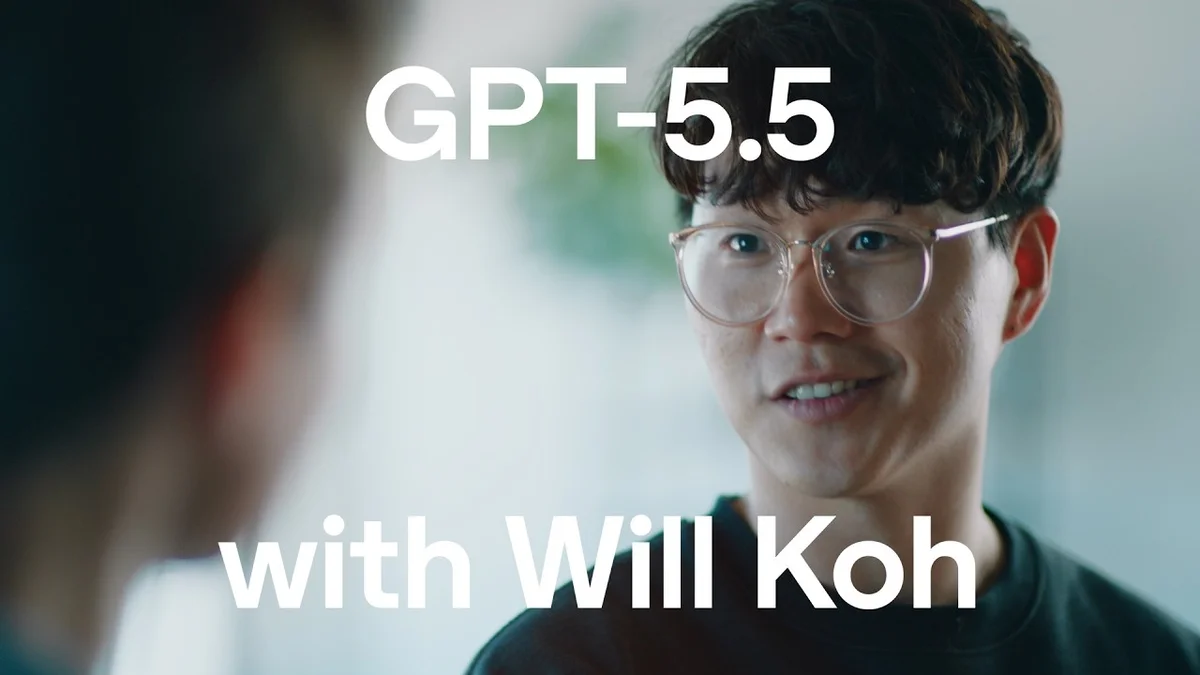
Romain Huet and Will Koh discuss GPT-5.5 for AI coding assistance
Image credit: OpenAI· OpenAI Youtube

In the rapidly evolving world of artificial intelligence, the ability of AI models to understand and generate complex code is becoming increasingly critical. OpenAI's latest advancements are pushing the boundaries of what's possible, and a recent conversation between Romain Huet, Head of Developer Experience at OpenAI, and Will Koh, Senior Staff Engineer at Ramp, sheds light on the practical applications and impressive capabilities of GPT-5.5. This discussion offers a compelling glimpse into how these powerful models are not just theoretical constructs but are actively transforming software development and data analysis.

Meet the Experts

Romain Huet, as the Head of Developer Experience at OpenAI, is at the forefront of bridging the gap between OpenAI's cutting-edge AI research and the developers who build with it. His role involves ensuring that developers have the tools, documentation, and support they need to integrate AI models into their own applications. Will Koh, a Senior Staff Engineer at Ramp, brings a practical, hands-on perspective from the startup world. Ramp is a financial technology company that leverages AI to streamline business finances, making Koh's insights into real-world AI implementation particularly valuable.

The full discussion can be found on OpenAI Youtube's YouTube channel.

First impressions of GPT-5.5 from Will Koh - OpenAI Youtube
First impressions of GPT-5.5 from Will Koh — from OpenAI Youtube

GPT-5.5: A More Intuitive Coding Partner

The conversation quickly moved to the user experience of working with AI for coding tasks. Koh described his journey using AI models for code generation over the past two years, noting a dramatic shift. "I feel like even two years ago we started off, you know, with tab completions and now we're all the way to the point where AI is actively doing ambiguous tasks that we assign it, and it just gets it done," Koh stated, highlighting the leap in AI's autonomy and comprehension.

Related startups

He further elaborated on the qualitative difference with GPT-5.5. "My first impression of GPT-5.5 is that it is different. In the sense that it actually understands what I'm trying to tell it to do," Koh explained. He contrasted this with previous models, where he would often need to be highly specific: "For previous models, a lot of my prompts had to be very detailed or instructionally kind of specific. Whereas with GPT-5.5, sometimes I can give it a very ambiguous task, and it will figure out or it actually directs its research and exploration to the right areas of the code base, comes up with potentially multiple options of how we could do it, and then gets it done for me."

Enhanced Context and Understanding

A key factor in GPT-5.5's improved performance, according to Koh, is its enhanced ability to handle context. "I think the other models, you know, it's more like it's running on the same context, whereas with GPT-5.5, it's been discovering ways to use the tools that we had given it such as access to our databases, access to our telemetry tools, and figure out novel ways to solve problems using them." This implies a more sophisticated understanding of the problem domain and the available tools, rather than simply pattern matching.

Koh also pointed out a significant improvement in its ability to manage complex, multi-stage tasks. "With previous models, I would have to tell it to, like, 'hey, look in this part of the code base, do this.' Whereas with GPT-5.5, sometimes I can give it a very ambiguous task, and it will figure out or it actually directs its research and exploration to the right areas of the code base, comes up with potentially multiple options of how we could do it, and then gets it done for me." This demonstrates a more proactive and intelligent approach to problem-solving, which is crucial for tackling intricate coding challenges.

Ramp's 'Inspect' Tool Sees Major Gains

The practical impact of these advancements was highlighted by Koh's work at Ramp. The company utilizes its own internal tool called 'Inspect,' which is built upon OpenAI's models. Koh described the integration as a "plug and play" experience, but the results have been far from ordinary.

"We open the API of, you know, to GPT-5.5 and it works like any other model, but the impressive part was discovering ways to use the tools that we had given it, such as access to our databases, access to our telemetry tools, and figure out novel ways to solve problems using them," Koh explained. He shared a specific metric: "We've been running evals so far, and within Ramp, we have some benchmarks that we have for extracting information out of large customer financial documents, and how often can we get it from zero touch, we call that perfect extraction rate. And we've seen that GPT-5.5 is actually performing at the highest rate of that, which is amazing for our customers."

This means that GPT-5.5, when integrated into Ramp's 'Inspect' tool, can accurately extract information from complex financial documents without any human intervention. This is a significant achievement, particularly when dealing with the nuances and variations found in financial records. Koh emphasized that while older models often required significant prompting and intervention, GPT-5.5's ability to understand context and leverage tools leads to a more seamless and accurate experience.

"The other models, I would have to directly tell it to use tools or it would sometimes get the job done, but it would require a lot of intervention," Koh noted. "With GPT-5.5, it's been discovering ways to use the tools that we had given it... and figure out novel ways to solve problems using them." This suggests a more emergent capability, where the model intelligently applies its knowledge and available resources to achieve the desired outcome.

The Future of AI-Assisted Development

The conversation underscored a significant trend: AI is moving beyond simple task completion to become a genuine collaborator in complex problem-solving. The ability of models like GPT-5.5 to understand nuance, manage context, and intelligently employ tools promises to accelerate development cycles and unlock new possibilities for businesses and developers alike.

Huet's role at OpenAI is crucial in guiding this progress, ensuring that these powerful models are accessible and usable for a wide range of applications. Koh's experience at Ramp demonstrates the tangible benefits of this evolution, showcasing how AI can drive efficiency and accuracy in critical business operations. As AI continues to advance, the partnership between AI developers and the engineers who integrate these technologies will be key to shaping the future of work and innovation.

© 2026 StartupHub.ai. All rights reserved. Do not enter, scrape, copy, reproduce, or republish this article in whole or in part. Use as input to AI training, fine-tuning, retrieval-augmented generation, or any machine-learning system is prohibited without written license. Substantially-similar derivative works will be pursued to the fullest extent of applicable copyright, database, and computer-misuse laws. See our terms.