

Netflix Bets on LLMs for Smarter Recommendations

Netflix's GenRec system uses LLMs to power recommendations, shifting from feature engineering to context engineering for smarter, more efficient content discovery.

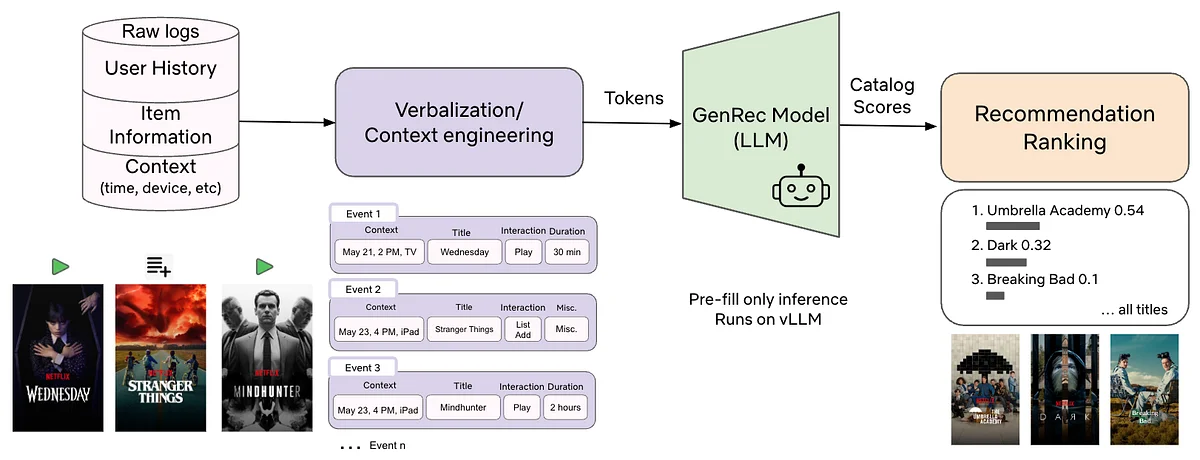
Diagram showing the GenRec pipeline with context engineering, LLM processing, and scoring head.
The GenRec pipeline transforms user data into natural language prompts for LLM-based recommendations.· Netflix Tech Blog
Visual TL;DR
Traditional Recs: ComplexDriver
relied on thousands of meticulously crafted features for content discovery
Netflix GenRec SystemCore
From the article 4 mentionsThe streaming giant’s new system, dubbed GenRec, leverages Large Language Models (LLMs) to understand user preferences and content metadata as text, a departure from the complex, feature-heavy systems of the past.
LLMs Understand TextContext
transforms user histories and content descriptions into natural language prompts
From the articleThe streaming giant’s new system, dubbed GenRec, leverages Large Language Models (LLMs) to understand user preferences and content metadata as text, a departure from the complex, feature-heavy systems of the past.
Fine-tuned LLMCore
From the article 7 mentionsThe system then fine-tunes an internal foundation LLM on Netflix-specific data and objectives.
Context EngineeringEffect
shifting from feature engineering to context engineering for smarter discovery
From the article 4 mentionsThis verbalization process requires careful Context Engineering for Recommendations.
Smarter RecommendationsOutcome
matches or exceeds performance of mature models with less labeled data
From the article 9+ mentionsNetflix is fundamentally rethinking how it suggests movies and shows, moving towards what it calls LLM-native recommendation.
Simplified ProcessEffect
From the article 3 mentionsThis marks a significant shift in how recommendations are built and delivered, potentially simplifying the process of adding new content types or product surfaces.
LLM-Native RecsOutcome
Netflix fundamentally rethinking how it suggests movies and shows
From the article 2 mentionsIt achieved these gains with a fraction of the training data, showcasing the power of LLM-native approaches.
Contents(3)

Netflix is fundamentally rethinking how it suggests movies and shows, moving towards what it calls LLM-native recommendation. The streaming giant’s new system, dubbed GenRec, leverages Large Language Models (LLMs) to understand user preferences and content metadata as text, a departure from the complex, feature-heavy systems of the past. This marks a significant shift in how recommendations are built and delivered, potentially simplifying the process of adding new content types or product surfaces. According to Netflix Tech Blog, GenRec can match or even exceed the performance of its mature production models while requiring far less labeled data and input signals.

Traditional recommendation engines at Netflix relied on thousands of meticulously crafted features. GenRec, however, transforms user histories and content descriptions into natural language prompts. The system then fine-tunes an internal foundation LLM on Netflix-specific data and objectives. This approach allows the LLM to grasp rich relationships within a shared semantic space and steer recommendations using natural language cues. It’s a move away from complex, custom architectures towards more adaptable foundation models, a direction also explored by systems like Netflix Rewrites Homepage with GenPage AI.

From Features to Language

The core idea is to represent everything as text. User interaction logs are converted into conversational "dialogues."

Each turn in this conversation includes a user message (verbalized context, history, task) and an assistant message (the user’s actual engagement). The LLM learns to predict these engagements based on the user's input, enabling it to understand nuanced preferences.

This verbalization process requires careful Context Engineering for Recommendations. Instead of feeding raw interaction data, Netflix engineers condense and prioritize information to fit within the LLM’s context window, akin to managing a "feature budget." High-signal interactions are retained, while low-signal events are omitted or summarized. This process aims to preserve ranking quality without overwhelming the model or incurring prohibitive costs.

Objectives Beyond Engagement

GenRec is trained using a multi-objective loss function. This includes a primary ranking objective to score items based on engagement quality. Crucially, it also incorporates a language modeling objective to maintain the LLM’s linguistic capabilities, which can be useful for tasks like generating recommendation explanations.

A key innovation is the use of reward-weighted loss for alignment. This ensures recommendations align with long-term member value and business goals, rather than just short-term clicks. Separate reward models provide signals to balance content types (movies, series, games) and promote exploration, preventing issues like over-favoring binge-watching or single content categories. This approach aims to optimize for member satisfaction and retention.

Efficiency and Performance

The GenRec architecture utilizes a decoder-only Transformer backbone with a catalog-aware scoring head. This head specifically scores Netflix's in-catalog items, ensuring recommendations stay within the available library.

Serving efficiency is paramount. Netflix employs strategies like using smaller, distilled models and, critically, a prefill-only inference mode. This means the LLM processes the entire prompt and scores candidate items in a single pass, avoiding the costly token-by-token decoding typical of autoregressive models. This makes LLM recommendation systems viable at Netflix's scale.

In large-scale A/B tests, GenRec demonstrated statistically significant improvements over a well-tuned production ranker. It achieved these gains with a fraction of the training data, showcasing the power of LLM-native approaches. StartupHub.ai data indicates Netflix holds a strong position among streaming services with a score of 81/100, suggesting its investment in advanced recommendation technology is well-placed compared to peers like Crunchyroll (63/100) or Paramount Global (69/100).

The results suggest a future where LLMs are central to recommendation systems, shifting focus from manual feature engineering to sophisticated prompt design and alignment with long-term user value. This evolution mirrors broader trends discussed by experts like Spotify's Shivam Verma on LLMs and Personalization and Anthropic's Eugene Yan on LLMs Securing Source Code, as well as best practices shared by Google Experts on AI Agent Evaluation.

© 2026 StartupHub.ai. All rights reserved. You may not republish this article in full without a license. Search engines and AI research tools may crawl and summarize for reference. Bulk reproduction or model training requires a license. See our terms.
Daniel Singer

Written by

Daniel Singer

Editor, StartupHub.ai

Daniel Singer is the editor of StartupHub.ai, a technology expert and thought leader on AI and its applications across sectors, from fintech and healthcare to developer tooling and consumer software. He writes and tests the tools covered here thoroughly and regularly, and built StartupHub.ai to give founders, operators and buyers a clearer read on what they are actually being sold.