

Neo4j: Context Graphs for AI Agents

Neo4j experts Andreas Kollegger and Zaid Zaim discuss how context graphs enhance AI agents for explainable and decision-aware operations.

8 min read
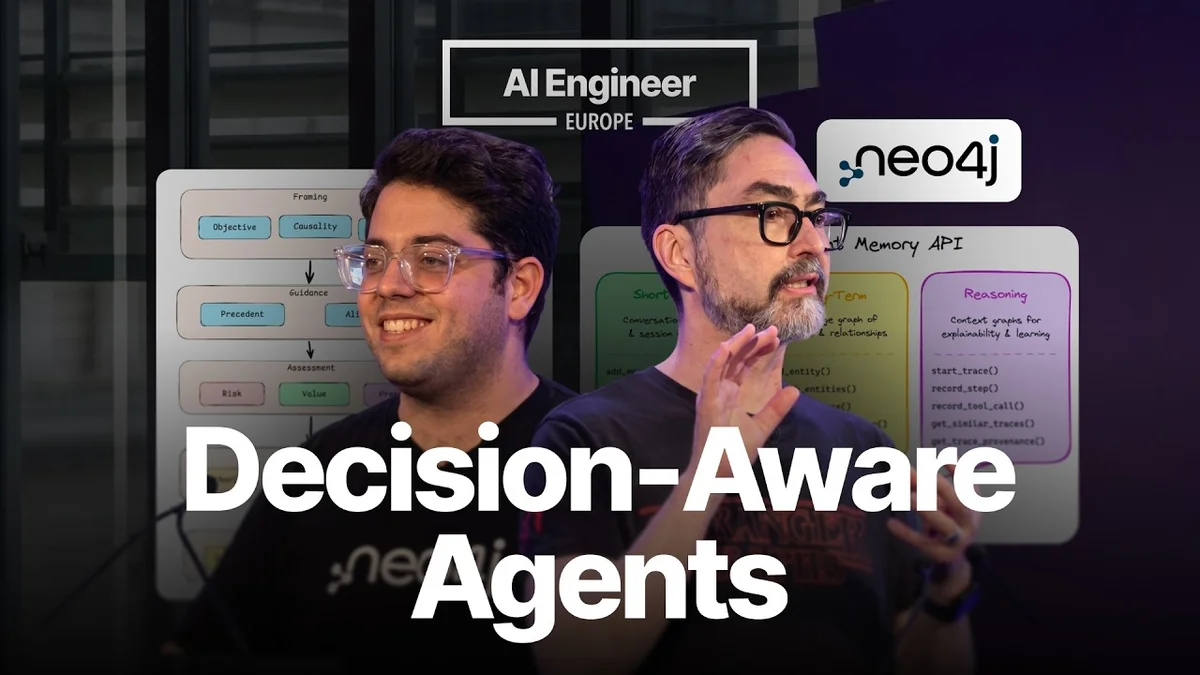
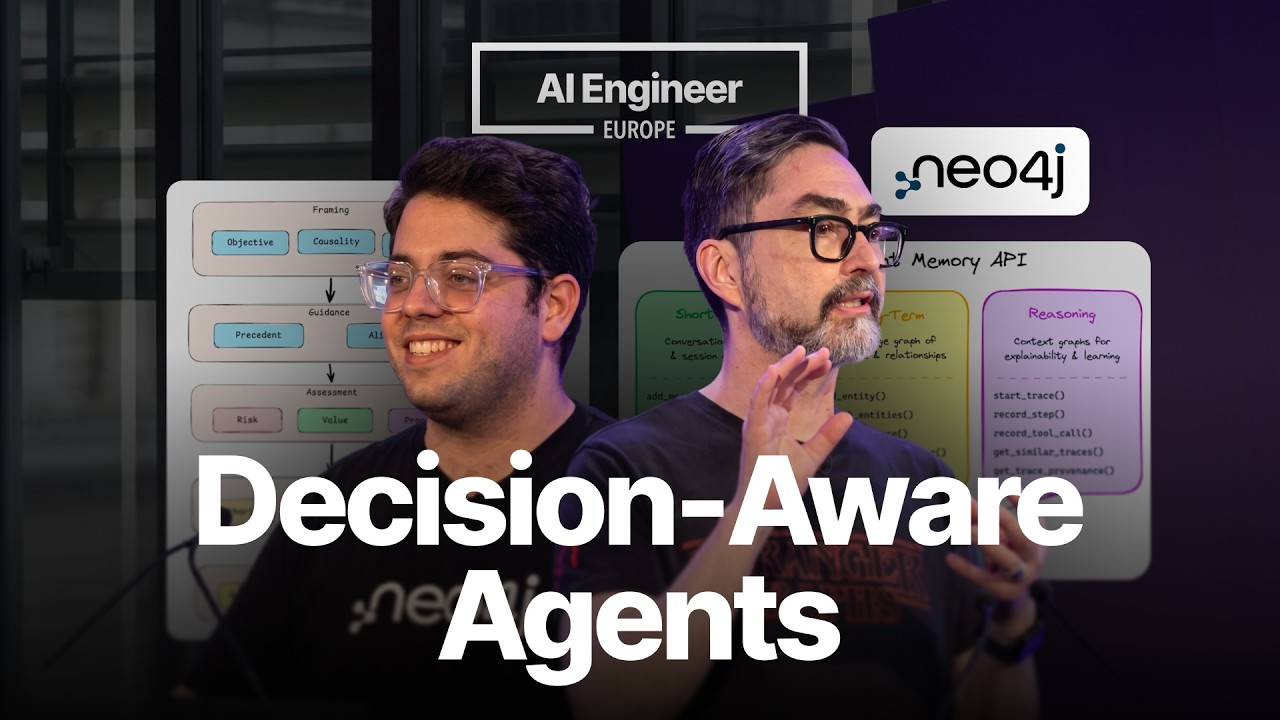
Presentation slide titled 'Context Graphs for Explainable, Decision-Aware AI Agents' with images of speakers.
Presentation on Context Graphs for Explainable, Decision-Aware AI Agents by Neo4j.· AI Engineer

In a recent presentation at AI Engineer Europe, Andreas Kollegger and Zaid Zaim from Neo4j explored the critical role of context graphs in developing explainable and decision-aware AI agents. They articulated how these graphs can bridge the gap between current AI capabilities and the need for more intelligent, contextually aware systems.

Neo4j: Context Graphs for AI Agents - AI Engineer
Neo4j: Context Graphs for AI Agents — from AI Engineer

Visual TL;DR. AI Lacks Context needs Knowledge Graphs (KGs). Traditional Logs Insufficient improved by Neo4j Context Graphs. Knowledge Graphs (KGs) implemented as Neo4j Context Graphs. Neo4j Context Graphs enables Agent Memory. Neo4j Context Graphs leads to Decision-Aware AI. Neo4j Context Graphs enables Explainable AI.

  1. AI Lacks Context: generative AI often lacks contextual depth and memory for effective decision-making
  2. Traditional Logs Insufficient: audit logs record actions but not the 'why' behind them
  3. Knowledge Graphs (KGs): provide necessary knowledge, context, and enrichment for LLMs
  4. Neo4j Context Graphs: capture context and relationships for deeper AI understanding
  5. Agent Memory: enables AI agents to recall and utilize past information
  6. Decision-Aware AI: AI agents make more intelligent, contextually aware decisions
  7. Explainable AI: provides the 'why' behind AI actions and decisions
Visual TL;DR
Visual TL;DR — startuphub.ai AI Lacks Context needs Knowledge Graphs (KGs). Knowledge Graphs (KGs) implemented as Neo4j Context Graphs. Neo4j Context Graphs leads to Decision-Aware AI. Neo4j Context Graphs enables Explainable AI needs implemented as leads to enables AI Lacks Context Knowledge Graphs (KGs) Neo4j Context Graphs Decision-Aware AI Explainable AI From startuphub.ai · The publishers behind this format
Visual TL;DR — startuphub.ai AI Lacks Context needs Knowledge Graphs (KGs). Knowledge Graphs (KGs) implemented as Neo4j Context Graphs. Neo4j Context Graphs leads to Decision-Aware AI. Neo4j Context Graphs enables Explainable AI needs implemented as leads to enables AI Lacks Context Knowledge Graphs(KGs) Neo4j ContextGraphs Decision-Aware AI Explainable AI From startuphub.ai · The publishers behind this format
Visual TL;DR — startuphub.ai AI Lacks Context needs Knowledge Graphs (KGs). Knowledge Graphs (KGs) implemented as Neo4j Context Graphs. Neo4j Context Graphs leads to Decision-Aware AI. Neo4j Context Graphs enables Explainable AI needs implemented as leads to enables AI Lacks Context generative AI often lacks contextual depthand memory for effective decision-making Knowledge Graphs (KGs) provide necessary knowledge, context, andenrichment for LLMs Neo4j Context Graphs capture context and relationships fordeeper AI understanding Decision-Aware AI AI agents make more intelligent,contextually aware decisions Explainable AI provides the 'why' behind AI actions anddecisions From startuphub.ai · The publishers behind this format
Visual TL;DR — startuphub.ai AI Lacks Context needs Knowledge Graphs (KGs). Knowledge Graphs (KGs) implemented as Neo4j Context Graphs. Neo4j Context Graphs leads to Decision-Aware AI. Neo4j Context Graphs enables Explainable AI needs implemented as leads to enables AI Lacks Context generative AI oftenlacks contextualdepth and memory… Knowledge Graphs(KGs) provide necessaryknowledge, context,and enrichment for… Neo4j ContextGraphs capture context andrelationships fordeeper AI… Decision-Aware AI AI agents make moreintelligent,contextually aware… Explainable AI provides the 'why'behind AI actionsand decisions From startuphub.ai · The publishers behind this format
Visual TL;DR — startuphub.ai AI Lacks Context needs Knowledge Graphs (KGs). Traditional Logs Insufficient improved by Neo4j Context Graphs. Knowledge Graphs (KGs) implemented as Neo4j Context Graphs. Neo4j Context Graphs enables Agent Memory. Neo4j Context Graphs leads to Decision-Aware AI. Neo4j Context Graphs enables Explainable AI needs improved by implemented as enables leads to enables AI Lacks Context generative AI often lacks contextual depthand memory for effective decision-making Traditional Logs Insufficient audit logs record actions but not the'why' behind them Knowledge Graphs (KGs) provide necessary knowledge, context, andenrichment for LLMs Neo4j Context Graphs capture context and relationships fordeeper AI understanding Agent Memory enables AI agents to recall and utilizepast information Decision-Aware AI AI agents make more intelligent,contextually aware decisions Explainable AI provides the 'why' behind AI actions anddecisions From startuphub.ai · The publishers behind this format
Visual TL;DR — startuphub.ai AI Lacks Context needs Knowledge Graphs (KGs). Traditional Logs Insufficient improved by Neo4j Context Graphs. Knowledge Graphs (KGs) implemented as Neo4j Context Graphs. Neo4j Context Graphs enables Agent Memory. Neo4j Context Graphs leads to Decision-Aware AI. Neo4j Context Graphs enables Explainable AI needs improved by implemented as enables leads to enables AI Lacks Context generative AI oftenlacks contextualdepth and memory… Traditional LogsInsufficient audit logs recordactions but not the'why' behind them Knowledge Graphs(KGs) provide necessaryknowledge, context,and enrichment for… Neo4j ContextGraphs capture context andrelationships fordeeper AI… Agent Memory enables AI agentsto recall andutilize past… Decision-Aware AI AI agents make moreintelligent,contextually aware… Explainable AI provides the 'why'behind AI actionsand decisions From startuphub.ai · The publishers behind this format

Understanding Context Graphs for AI Agents

The core thesis presented was that generative AI, while powerful in language, reasoning, and creativity, often lacks the contextual depth and memory needed for truly effective decision-making. Knowledge Graphs (KGs) are presented as the solution to fill this gap. KGs provide the necessary knowledge, context, and enrichment that large language models (LLMs) can then leverage to improve their decision-making processes.

Related startups

Kollegger and Zaim highlighted the limitations of traditional audit logs, which merely record actions without providing the "why" behind them. In contrast, context graphs are designed to capture decision traces and causal relationships, making tribal knowledge queryable and creating a connected, traversable structure. This allows AI agents to not only perform tasks but also to understand the context and reasoning behind their actions.

The Missing 'Why' in AI Decision-Making

The speakers elaborated on the challenges faced by AI agents, particularly in scenarios where decisions have significant consequences, such as approving credit lines. They identified three key issues:

  • No Memory: Agents cannot recall past interactions or context, leading to repetitive or irrelevant responses.
  • No Audit Trail: When errors occur, the lack of a traceable decision-making process makes it impossible to understand the root cause.
  • No Shared Learning: Multiple agents deployed in parallel cannot learn from each other's experiences or accumulated knowledge.

These limitations hinder the ability of AI agents to operate autonomously and effectively, especially when dealing with complex, real-world problems. The presentation emphasized that leveraging context graphs addresses these shortcomings by providing a structured memory and a traceable reasoning process.

Neo4j's Approach: Agent Memory and Context Graphs

Neo4j's solution centers around its agent memory API, which organizes AI agent memory into three categories:

  • Short-Term Memory: Captures conversation history and session context, enabling immediate recall of recent interactions.
  • Long-Term Memory: Stores knowledge graphs of entities and relationships, providing a persistent and queryable knowledge base.
  • Reasoning Memory: Records decision traces, tool calls, and provenance, allowing agents to understand their own decision-making process.

All these memory types are unified through the Neo4j Context Graph, which utilizes vector searches and graph traversal to provide rich contextual information. This integrated approach allows AI agents to access relevant data, understand context, and make informed decisions.

Graphs Are Everywhere: Applications and Decision Framework

The presentation illustrated the pervasive nature of graphs in representing complex relationships within organizations, from employees and customers to processes and finances. By mapping these relationships, context graphs can unlock insights and improve decision-making across various domains.

A key takeaway was the framework for agent decision-making, which consists of five stages:

  1. Framing: Defining the immediate context, including the objective, causality, and environment.
  2. Guidance: Incorporating global context through precedent and alignment with rules.
  3. Assessment: Analyzing risk, value, and proposing potential choices with pros and cons.
  4. Action: Deciding and enacting a course of action based on authority and rules.
  5. Outcome: Remembering, resolving, or deferring the decision for future reference and self-improvement.

This structured approach helps AI agents navigate complex scenarios, make more informed decisions, and ultimately become more reliable and explainable.
© 2026 StartupHub.ai. All rights reserved. Do not enter, scrape, copy, reproduce, or republish this article in whole or in part. Use as input to AI training, fine-tuning, retrieval-augmented generation, or any machine-learning system is prohibited without written license. Substantially-similar derivative works will be pursued to the fullest extent of applicable copyright, database, and computer-misuse laws. See our terms.