

Machinecraft's Rushabh Doshi on Building a 36-Agent AI

Rushabh Doshi of Machinecraft details how his 100-person factory built a 36-agent AI system, Ira, to manage its go-to-market strategy without extensive ML resources.

9 min read
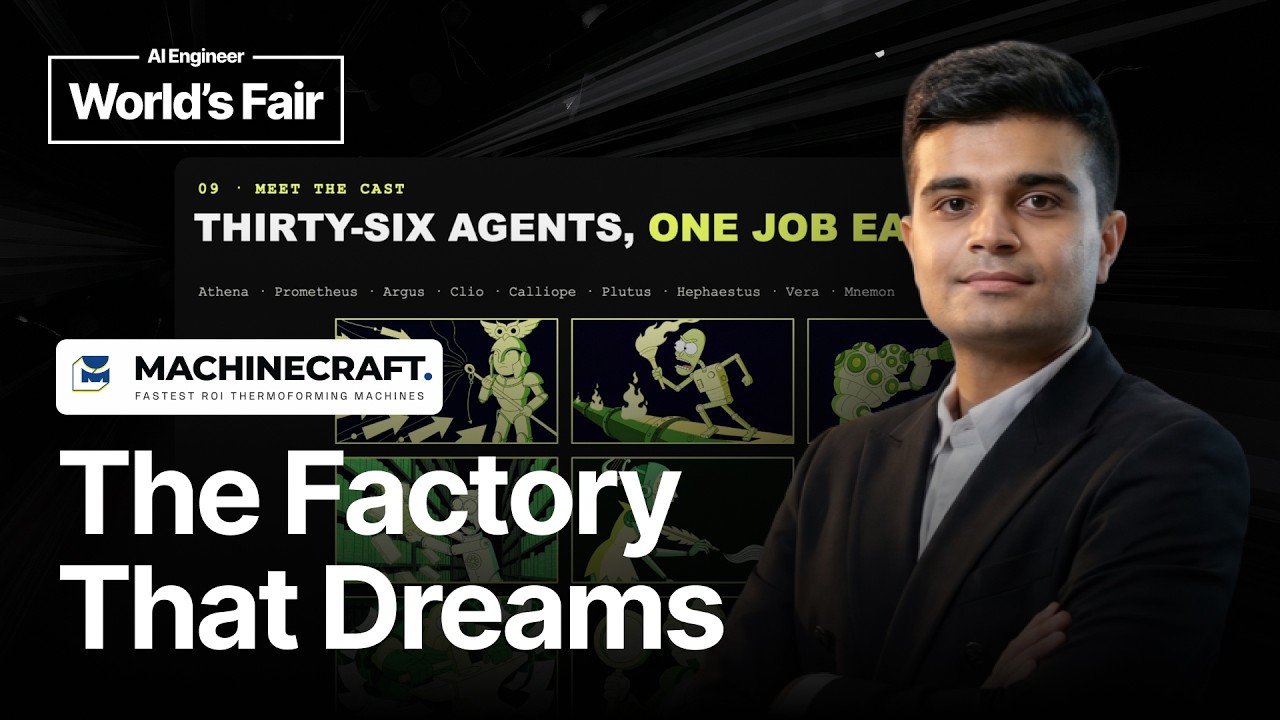
Rushabh Doshi of Machinecraft presenting his 36-agent AI system, Ira, with animated graphics depicting the AI's architecture and functions.
Rushabh Doshi introduces Ira, Machinecraft's 36-agent AI system, built for efficiency and cost-effectiveness.· AI Engineer

Visual TL;DR. Fleeting Knowledge Problem faced by Machinecraft Factory. Machinecraft Factory built Ira: 36-Agent AI. Ira: 36-Agent AI featured No Model Training. Ira: 36-Agent AI used Biology-Inspired Design. Ira: 36-Agent AI enables Autonomous GTM Strategy. Autonomous GTM Strategy leading to Cost-Effective AI.

  1. Fleeting Knowledge Problem: critical business knowledge resided in few brains, lost with employee turnover
  2. Machinecraft Factory: 100-person factory in India, needed to manage go-to-market strategy
  3. Ira: 36-Agent AI: sophisticated AI system built without dedicated data science or ML budget
  4. No Model Training: architecture required no extensive machine learning model training or data scientists
  5. Biology-Inspired Design: system architecture drew inspiration from biological systems for robustness
  6. Autonomous GTM Strategy: Ira now autonomously manages the entire go-to-market strategy for the factory
  7. Cost-Effective AI: practical, cost-effective approach to AI adoption challenging conventional wisdom
Visual TL;DR
Visual TL;DR, startuphub.ai Ira: 36-Agent AI enables Autonomous GTM Strategy. Autonomous GTM Strategy leading to Cost-Effective AI enables leading to Fleeting Knowledge Problem Ira: 36-Agent AI Autonomous GTM Strategy Cost-Effective AI From startuphub.ai · The publishers behind this format
Visual TL;DR, startuphub.ai Ira: 36-Agent AI enables Autonomous GTM Strategy. Autonomous GTM Strategy leading to Cost-Effective AI enables leading to FleetingKnowledge Problem Ira: 36-Agent AI Autonomous GTMStrategy Cost-Effective AI From startuphub.ai · The publishers behind this format
Visual TL;DR, startuphub.ai Ira: 36-Agent AI enables Autonomous GTM Strategy. Autonomous GTM Strategy leading to Cost-Effective AI enables leading to Fleeting Knowledge Problem critical business knowledge resided in fewbrains, lost with employee turnover Ira: 36-Agent AI sophisticated AI system built withoutdedicated data science or ML budget Autonomous GTM Strategy Ira now autonomously manages the entirego-to-market strategy for the factory Cost-Effective AI practical, cost-effective approach to AIadoption challenging conventional wisdom From startuphub.ai · The publishers behind this format
Visual TL;DR, startuphub.ai Ira: 36-Agent AI enables Autonomous GTM Strategy. Autonomous GTM Strategy leading to Cost-Effective AI enables leading to FleetingKnowledge Problem critical businessknowledge residedin few brains, lost… Ira: 36-Agent AI sophisticated AIsystem builtwithout dedicated… Autonomous GTMStrategy Ira nowautonomouslymanages the entire… Cost-Effective AI practical,cost-effectiveapproach to AI… From startuphub.ai · The publishers behind this format
Visual TL;DR, startuphub.ai Fleeting Knowledge Problem faced by Machinecraft Factory. Machinecraft Factory built Ira: 36-Agent AI. Ira: 36-Agent AI featured No Model Training. Ira: 36-Agent AI used Biology-Inspired Design. Ira: 36-Agent AI enables Autonomous GTM Strategy. Autonomous GTM Strategy leading to Cost-Effective AI faced by built featured used enables leading to Fleeting Knowledge Problem critical business knowledge resided in fewbrains, lost with employee turnover Machinecraft Factory 100-person factory in India, needed tomanage go-to-market strategy Ira: 36-Agent AI sophisticated AI system built withoutdedicated data science or ML budget No Model Training architecture required no extensive machinelearning model training or data scientists Biology-Inspired Design system architecture drew inspiration frombiological systems for robustness Autonomous GTM Strategy Ira now autonomously manages the entirego-to-market strategy for the factory Cost-Effective AI practical, cost-effective approach to AIadoption challenging conventional wisdom From startuphub.ai · The publishers behind this format
Visual TL;DR, startuphub.ai Fleeting Knowledge Problem faced by Machinecraft Factory. Machinecraft Factory built Ira: 36-Agent AI. Ira: 36-Agent AI featured No Model Training. Ira: 36-Agent AI used Biology-Inspired Design. Ira: 36-Agent AI enables Autonomous GTM Strategy. Autonomous GTM Strategy leading to Cost-Effective AI faced by built featured used enables leading to FleetingKnowledge Problem critical businessknowledge residedin few brains, lost… MachinecraftFactory 100-person factoryin India, needed tomanage go-to-market… Ira: 36-Agent AI sophisticated AIsystem builtwithout dedicated… No Model Training architecturerequired noextensive machine… Biology-InspiredDesign system architecturedrew inspirationfrom biological… Autonomous GTMStrategy Ira nowautonomouslymanages the entire… Cost-Effective AI practical,cost-effectiveapproach to AI… From startuphub.ai · The publishers behind this format

In a compelling presentation, Rushabh Doshi, who leads Machinecraft, a 100-person factory in India, detailed how his company developed a sophisticated 36-agent AI system named Ira. This system now autonomously manages Machinecraft's entire go-to-market strategy, all without the need for a dedicated data science team or a substantial machine learning budget. Doshi's story highlights a practical, cost-effective approach to AI adoption that challenges conventional wisdom in the startup and AI sectors.


Machinecraft's Rushabh Doshi on Building a 36-Agent AI - AI Engineer
Machinecraft's Rushabh Doshi on Building a 36-Agent AI — from AI Engineer

The Problem of Fleeting Knowledge

Doshi began by explaining the core challenge Machinecraft faced: the critical knowledge needed to run their thermoforming machine business resided in just a few brains across three generations. This knowledge encompassed customer specifics, past quotations, machine customizations, and more. The constant turnover of employees meant a continuous loss of institutional memory, creating a precarious situation for the company's long-term stability. "We weren't scared of the competitors, we were scared of forgetting," Doshi stated, emphasizing the existential threat posed by this knowledge drain.

Growing a Company's Brain

Instead of relying on documentation that often goes unread, Doshi conceived a radical idea: to "grow a brain that just held it." This was not a chatbot, but a comprehensive digital twin of the company. The first step was simple yet monumental: feeding Ira everything. This included years of quotes, drawings, payment schedules, timelines, and email threads, amounting to hundreds of gigabytes of proprietary historical data. Crucially, this was Machinecraft's internal data, not information from the public internet.

A Plot Twist: No Model Training Required

One of the most surprising revelations Doshi shared was that Machinecraft never trained a model. "No GPUs humming in the basement, no fine-tuning," he clarified. Instead, they leveraged off-the-shelf models to read their chopped-up historical data, extracting facts and storing their meaning as vectors in Qdrant and relationships in Neo4j. Ira's intelligence, Doshi explained, doesn't come from a smarter model but from a "really, really well-organized memory."

Biology-Inspired Architecture

Machinecraft adopted a unique, biology-inspired architecture for Ira. They began to think of Ira not as software, but as something they were nurturing. The system was given a 'body' with 'senses' to understand who it was interacting with, a 'gut' to digest documents into facts, a 'memory,' a 'dream cycle,' and an 'immune system' to filter out bad information. This biological metaphor, Doshi noted, was adopted because "evolution already spent a billion years solving how do you stay coherent over time? We just copied the homework."

The Pantheon of Agents: Why 36 Specialists?

A key design decision was to create 36 specialized AI agents rather than a single, all-encompassing prompt. Doshi argued that a single prompt attempting to do everything often performs poorly. Ira, therefore, operates as a "pantheon" of specialists, each with a distinct role. For example, Athena manages overall operations, Prometheus handles sales, Plutus oversees pricing, Hephaestus knows machine specifications, Vera fact-checks, and Memnon guards corrections to ensure fixes are permanent. These agents even hold internal 'meetings,' arguing to arrive at a single, coherent answer, much like a boardroom that never sleeps or gets tired.

Ira's Daily Operations and Technical Stack

Ira now manages Machinecraft's entire front business, from initial contact with a stranger to converting them into a customer. This includes nine concrete daily tasks: outbound emails, account briefs, quotations, outreach, reviving dead leads, inbound replies, and lead qualification. All of this is accessible through a single cursor tab, where users can type commands and Ira executes complex tasks: searching the knowledge base, reading inboxes, drafting emails, and building code. The underlying technical stack is robust, featuring databases for vectors and graph relationships, a CRM, three different model providers optimized for specific tasks, and tools for data ingestion, communication, and monitoring. The golden rule, however, remains: "Ira drafts, human sends."

Engineered Memory and the Dream Cycle

Doshi highlighted a critical flaw in many AI systems: their lack of persistent memory. "A raw language model is basically a goldfish," he explained, forgetting interactions once a tab is closed. Machinecraft engineered Ira's memory in layers: working memory for recent interactions, pinned facts, episodic memory for conversations, and relationship memory that evolves from stranger to trusted. A 'salience gate' ensures only relevant information is retained. Most fascinating is Ira's nightly 'dream cycle,' where it replays the day, consolidates useful information, prunes stale data, hunts for contradictions, and converts experiences into reusable skills. Doshi receives a 'dream report' each morning, detailing what Ira learned overnight.

A Conscience, Not Just a Filter

Beyond functionality, Ira incorporates a 'conscience' derived from the principles of Machinecraft's three-generation Jain family business. This is not merely a 'be helpful, be harmless' filter but a soul file embodying five core engineering rules: no single source has the whole truth (cross-check everything), never speak in absolutes (cite sources), do your own job (not someone else's), report the truth even if it's ugly, and nobody works alone. These ancient philosophies serve as crucial guardrails in production.

Cost-Effective Innovation and Brain OS

Doshi underscored the financial implications of their approach. There was "no training bill, zero." The real cost was teaching the company to remember itself. An agency quoted $230,000 to build Ira, but Machinecraft developed it for around $30,000, and it runs for a few thousand dollars a month. Recognizing the transformative potential, Machinecraft has open-sourced Ira's architecture as Brain OS, an 'empty nervous system' comprising agents, memory, the dream cycle, and the soul file. The goal is not to sell their brain but to empower other companies to build their own, asserting that "only you can build your company's brain."

© 2026 StartupHub.ai. All rights reserved. Do not enter, scrape, copy, reproduce, or republish this article in whole or in part. Use as input to AI training, fine-tuning, retrieval-augmented generation, or any machine-learning system is prohibited without written license. Substantially-similar derivative works will be pursued to the fullest extent of applicable copyright, database, and computer-misuse laws. See our terms.