

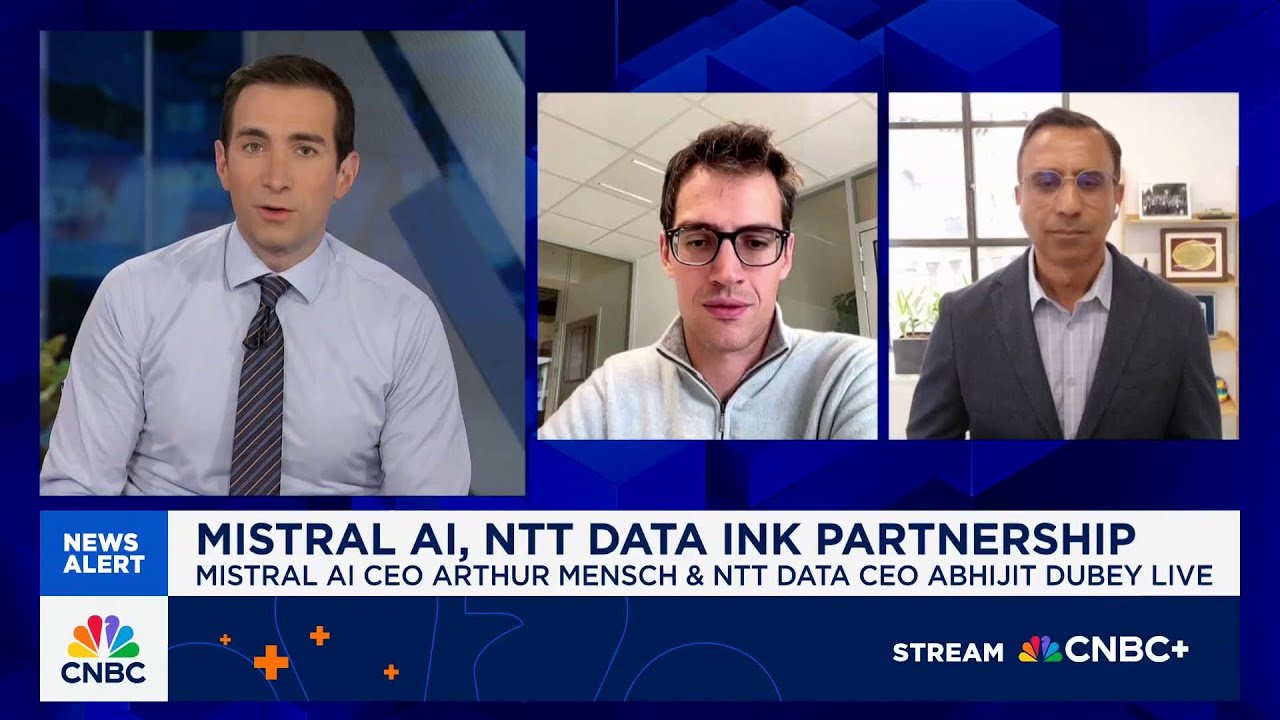
French AI powerhouse Mistral AI and global IT services leader NTT Data have announced a strategic partnership aimed at accelerating the secure and impactful deployment of generative AI solutions across enterprises. This collaboration signals a pivotal moment for AI adoption, emphasizing practical application over mere experimentation.
During an exclusive interview on CNBC's 'Squawk Box', Mistral co-founder and CEO Arthur Mensch and NTT Data CEO Abhijit Dubey detailed the facets of their new alliance, including its implications for enterprise customers and broader market expansion. The discussion underscored a growing demand among large organizations to move beyond proofs-of-concept and realize tangible financial returns from their AI investments.
Abhijit Dubey highlighted this shift, stating, "What we have found over the last, I would say, three to six months is a real inflection point in large enterprise customers wanting to move from mass experimentation, mass POCs... and really want to deploy enterprise at scale." This reflects a critical need for AI solutions that are not only powerful but also tailored to specific industry needs and capable of being integrated into existing private infrastructures, ensuring data ownership and security.
The synergy between Mistral's cutting-edge large language models and NTT Data's extensive domain expertise and global delivery capabilities forms a potent combination. Arthur Mensch emphasized that Mistral's models consistently rank "within the top tier" for performance, particularly in areas like transcription, optical character recognition, and local deployment on devices. He added, "What differentiates us from typical model provider is this full stack approach to actually deploying AI and changing processes in enterprises so that we can deliver on the value."
This strategic alignment addresses the enterprise imperative for fine-tuned, domain-specific AI models that can operate on private infrastructure. Such an approach is particularly crucial for heavily regulated sectors like public service, defense, utilities, and financial institutions, where data sovereignty and stringent security protocols are paramount.