


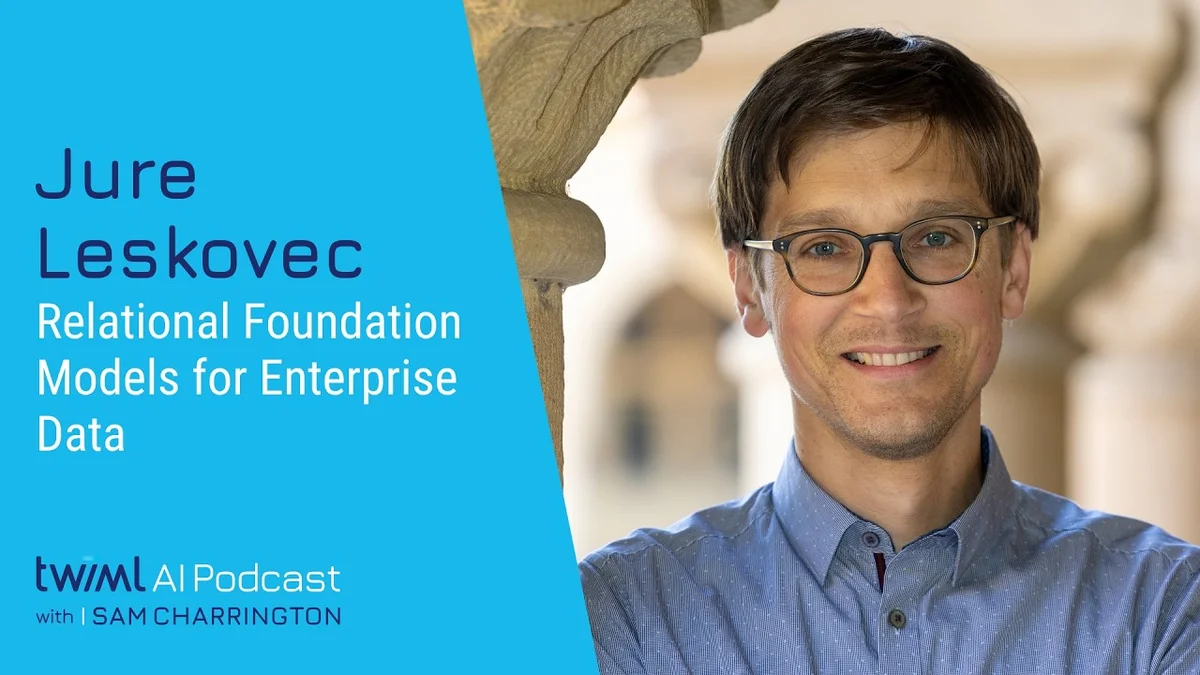
Jure Leskovec on Relational Foundation Models

Jure Leskovec, AI researcher and Stanford professor, discusses Relational Foundation Models, a new AI approach for understanding complex enterprise data and its applications.

7 min read
Jure Leskovec speaking on a panel about AI models.
Jure Leskovec, Professor at Stanford University and Co-Founder/Chief Scientist at Kumo.· TWIML

In a recent AI Podcast episode, Jure Leskovec, co-founder and chief scientist at Kumo, and professor at Stanford University, discussed the transformative potential of Relational Foundation Models for enterprise data. These models represent a significant advancement in applying deep learning to structured, relational data, moving beyond the typical unstructured text or image domains that have dominated recent AI breakthroughs.

Visual TL;DR. Jure Leskovec develops Relational Foundation Models. Enterprise Data Challenges addressed by Relational Foundation Models. Relational Foundation Models enables Transformative Potential. Graph Neural Networks builds on Relational Foundation Models. Relational Foundation Models has Key Capabilities. Key Capabilities leads to Transformative Potential. Transformative Potential involves Future Applications.

  1. Jure Leskovec: AI researcher, Stanford professor, Kumo co-founder
  2. Enterprise Data Challenges: Complex structured data beyond text/images
  3. Relational Foundation Models: New AI for structured relational data
  4. Graph Neural Networks: Leskovec's expertise in large-scale data analysis
  5. Key Capabilities: Understanding complex relationships in data
  6. Transformative Potential: Revolutionizing enterprise data understanding and applications
  7. Future Applications: Road ahead for advanced enterprise AI
Visual TL;DR
Visual TL;DR — startuphub.ai Jure Leskovec develops Relational Foundation Models. Enterprise Data Challenges addressed by Relational Foundation Models. Relational Foundation Models enables Transformative Potential develops addressed by enables Jure Leskovec Enterprise Data Challenges Relational Foundation Models Transformative Potential From startuphub.ai · The publishers behind this format
Visual TL;DR — startuphub.ai Jure Leskovec develops Relational Foundation Models. Enterprise Data Challenges addressed by Relational Foundation Models. Relational Foundation Models enables Transformative Potential develops addressed by enables Jure Leskovec Enterprise DataChallenges RelationalFoundation Models TransformativePotential From startuphub.ai · The publishers behind this format
Visual TL;DR — startuphub.ai Jure Leskovec develops Relational Foundation Models. Enterprise Data Challenges addressed by Relational Foundation Models. Relational Foundation Models enables Transformative Potential develops addressed by enables Jure Leskovec AI researcher, Stanford professor, Kumoco-founder Enterprise Data Challenges Complex structured data beyond text/images Relational Foundation Models New AI for structured relational data Transformative Potential Revolutionizing enterprise dataunderstanding and applications From startuphub.ai · The publishers behind this format
Visual TL;DR — startuphub.ai Jure Leskovec develops Relational Foundation Models. Enterprise Data Challenges addressed by Relational Foundation Models. Relational Foundation Models enables Transformative Potential develops addressed by enables Jure Leskovec AI researcher,Stanford professor,Kumo co-founder Enterprise DataChallenges Complex structureddata beyondtext/images RelationalFoundation Models New AI forstructuredrelational data TransformativePotential Revolutionizingenterprise dataunderstanding and… From startuphub.ai · The publishers behind this format
Visual TL;DR — startuphub.ai Jure Leskovec develops Relational Foundation Models. Enterprise Data Challenges addressed by Relational Foundation Models. Relational Foundation Models enables Transformative Potential. Graph Neural Networks builds on Relational Foundation Models. Relational Foundation Models has Key Capabilities. Key Capabilities leads to Transformative Potential. Transformative Potential involves Future Applications develops addressed by enables builds on has leads to involves Jure Leskovec AI researcher, Stanford professor, Kumoco-founder Enterprise Data Challenges Complex structured data beyond text/images Relational Foundation Models New AI for structured relational data Graph Neural Networks Leskovec's expertise in large-scale dataanalysis Key Capabilities Understanding complex relationships indata Transformative Potential Revolutionizing enterprise dataunderstanding and applications Future Applications Road ahead for advanced enterprise AI From startuphub.ai · The publishers behind this format
Visual TL;DR — startuphub.ai Jure Leskovec develops Relational Foundation Models. Enterprise Data Challenges addressed by Relational Foundation Models. Relational Foundation Models enables Transformative Potential. Graph Neural Networks builds on Relational Foundation Models. Relational Foundation Models has Key Capabilities. Key Capabilities leads to Transformative Potential. Transformative Potential involves Future Applications develops addressed by enables builds on has leads to involves Jure Leskovec AI researcher,Stanford professor,Kumo co-founder Enterprise DataChallenges Complex structureddata beyondtext/images RelationalFoundation Models New AI forstructuredrelational data Graph NeuralNetworks Leskovec'sexpertise inlarge-scale data… Key Capabilities Understandingcomplexrelationships in… TransformativePotential Revolutionizingenterprise dataunderstanding and… FutureApplications Road ahead foradvanced enterpriseAI From startuphub.ai · The publishers behind this format

Who Is Jure Leskovec?

Jure Leskovec is a distinguished researcher in the field of machine learning and artificial intelligence. His work at Stanford University and as a co-founder of Kumo focuses on developing novel AI models and applying them to complex, real-world problems. Leskovec is particularly known for his contributions to graph neural networks, recommender systems, and the analysis of large-scale data, including social networks and, more recently, enterprise data.

Related startups

The full discussion can be found on TWIML's YouTube channel.

Relational Foundation Models for Enterprise Data [Jure Leskovec] - 768 - TWIML
Relational Foundation Models for Enterprise Data [Jure Leskovec] - 768 — from TWIML

Relational Foundation Models for Enterprise Data

Leskovec introduced Relational Foundation Models as a new class of models designed to understand and reason over the inherently structured and relational nature of enterprise data. Unlike traditional machine learning models that might require extensive feature engineering or task-specific training, these foundation models aim to learn general representations of entities and their relationships directly from raw data. This approach allows them to be applied to a wide array of downstream tasks without significant adaptation.

The core idea behind these models is to treat enterprise data as a massive, interconnected graph. Entities, such as customers, products, or transactions, are represented as nodes, and the relationships between them—like purchases, interactions, or dependencies—are represented as edges. Leskovec explained that the models are trained using a self-supervised learning objective, akin to masked language modeling in natural language processing. Specifically, the models learn to predict masked entities or relationships within the data graph, allowing them to capture the underlying structure and semantics of the enterprise data.

Key Capabilities and Applications

Leskovec highlighted several key capabilities of Relational Foundation Models:

  • Understanding Complex Relationships: The models can capture intricate, multi-hop relationships within the data, which are crucial for understanding complex business processes and customer behaviors.
  • Generalizability: By learning general representations, these models can be fine-tuned for various downstream tasks, such as fraud detection, customer churn prediction, recommendation systems, and even scientific discovery in fields like drug development.
  • Scalability: While challenging, the research aims to scale these models to handle the vast quantities of relational data present in large enterprises.

He elaborated on how these models can be applied to real-world scenarios, such as identifying fraudulent transactions by understanding complex webs of suspicious relationships between entities, or predicting customer behavior by analyzing their interactions and relationships with products and services.

The Road Ahead

Leskovec emphasized that while the potential is immense, scaling these models to the complexity and volume of enterprise data remains a significant research and engineering challenge. However, the ability of Relational Foundation Models to learn from raw, structured data and generalize across diverse tasks represents a promising direction for unlocking the value hidden within enterprise information.

© 2026 StartupHub.ai. All rights reserved. Do not enter, scrape, copy, reproduce, or republish this article in whole or in part. Use as input to AI training, fine-tuning, retrieval-augmented generation, or any machine-learning system is prohibited without written license. Substantially-similar derivative works will be pursued to the fullest extent of applicable copyright, database, and computer-misuse laws. See our terms.