


Inside the Uber Software Factory Scale Play

Uber runs 70% of pull requests via agents and cut cost per session 52% by capping context, tuning cache TTL and routing subagents to cheaper models.

8 min read
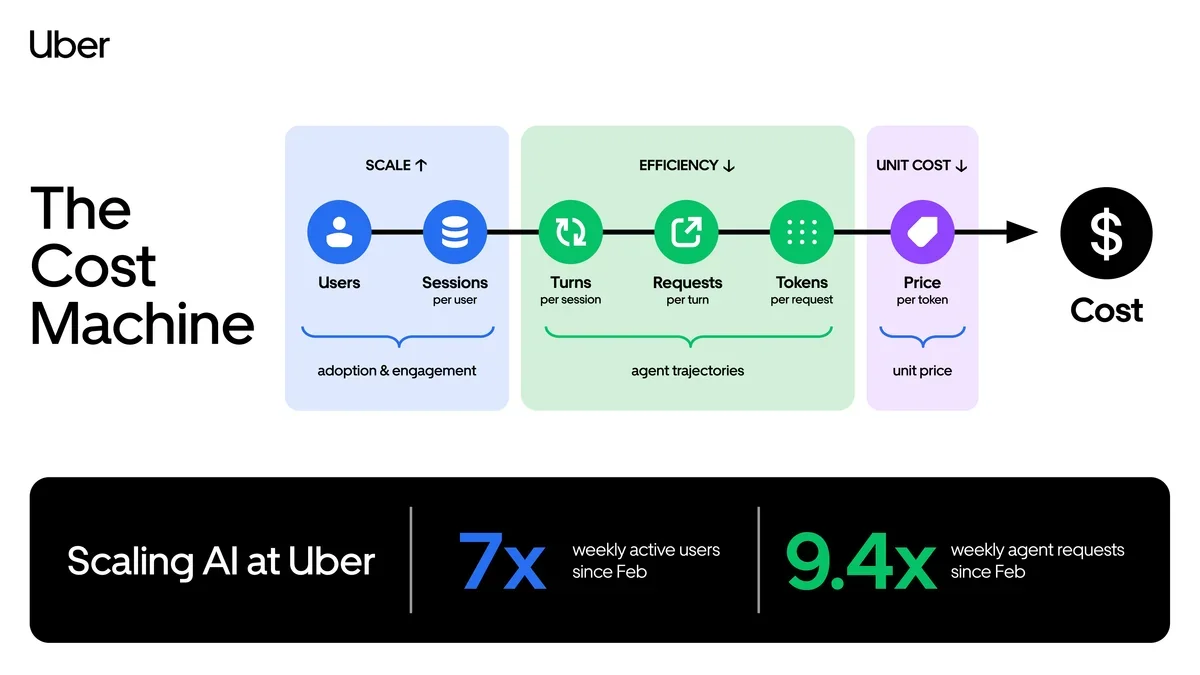
Diagram of Uber Software Factory layers and cost equation with agent metrics
Uber's Software Factory layers and cost decomposition that drove 34% lower cost per 1K requests.· Uber Engineering
Visual TL;DR
Uber AI factoryCore
Engineers built over 3,600 agent skills for engineers across the company
From the article 9+ mentionsThe Uber Software Factory now handles more than 70% of pull requests via agents, according to Uber Engineering.
Cost per 1K dropsOutcome
Cost per 1,000 requests fell 34% from peak during optimization window
From the article 6 mentionsCost per 1,000 requests fell almost 34% from its peak.
Agents handle PRsCore
From the articleThe Uber Software Factory now handles more than 70% of pull requests via agents, according to Uber Engineering.
AI spend flatOutcome
Total AI spend stabilized since April despite 9.4x growth in requests
From the article 2 mentionsThe middle three are where Uber spends its effort.
Cap context windowDriver
Trimming context length cut cost per session 52% from June peak
From the articleUber's lesson is portable: benchmark real work, pick Pareto winners, cap context, fix TTL to human idle time, and hide tool schemas until needed.
Uber AI factoryCore
Engineers built over 3,600 agent skills for engineers across the company
From the article 9+ mentionsThe Uber Software Factory now handles more than 70% of pull requests via agents, according to Uber Engineering.
Agents handle PRsCore
From the articleThe Uber Software Factory now handles more than 70% of pull requests via agents, according to Uber Engineering.
Fix model for benchmarkContext
Holding one model constant from February to July isolated real optimization gains
From the article 3 mentionsUber builds benchmarks from real work, runs every model behind one harness, and moves to whatever is cheapest at equal quality.
Cap context windowDriver
Trimming context length cut cost per session 52% from June peak
From the articleUber's lesson is portable: benchmark real work, pick Pareto winners, cap context, fix TTL to human idle time, and hide tool schemas until needed.
Weekly users 7xOutcome
From the article 3 mentionsWeekly active users across agentic offerings grew 7x from February to mid-August.
Tune cache TTLDriver
Aggressive cache time-to-live settings reused tokens across requests
Route subagentsDriver
Cheaper models handle subagent tasks while flagship models lead reasoning
From the article 5 mentionsUber now routes 1,000+ MCP servers through a gateway and exposes them as CLI commands that resolve at call time, plus tool search that loads only needed tools.
Cost per 1K dropsOutcome
Cost per 1,000 requests fell 34% from peak during optimization window
From the article 6 mentionsCost per 1,000 requests fell almost 34% from its peak.
AI spend flatOutcome
Total AI spend stabilized since April despite 9.4x growth in requests
From the article 2 mentionsThe middle three are where Uber spends its effort.
Contents(3)

The Uber Software Factory now handles more than 70% of pull requests via agents, according to Uber Engineering.

Uber (NYSE:UBER) detailed the system on August 27, 2026, led by Distinguished Engineer Uday Kiran Medisetty at AI Engineer 2026. Engineers built over 3,600 agent skills, and the fleet executes more than 30K skill runs per day.

Weekly active users across agentic offerings grew 7x from February to mid-August. Weekly agentic requests grew 9.4x in the same window.

Spend did not follow. Total AI spend stabilized since April.

The factory math Uber actually tracks

Holding one model fixed from February to July isolates optimization from model churn. Cost per 1,000 requests fell almost 34% from its peak. Cost per session fell 52% from its June peak.

Uber organizes usage into four layers, from specialized managed agents to general interactive sessions. Higher layers give Uber more control over cost, quality and model choice.

The cost equation is six terms multiplied: users x requests per user x input tokens per request x output tokens per request x price per token x turns. The middle three are where Uber spends its effort.

That framing is rare in public. Most enterprises track total spend and token price. Uber tracks cost per 1 million tokens, cost per 1,000 sessions, prompt cache hit rate, and outcome-denominated cost like cost per merged PR or cost per alert triaged.

How Uber cuts tokens without cutting quality

Price per token is set by vendors. Uber attacks the other terms.

Model selection is benchmark-driven and Pareto-optimal. Uber builds benchmarks from real work, runs every model behind one harness, and moves to whatever is cheapest at equal quality. The frontier shifts every few weeks, so routing is continuous.

The proof is uReview, which reviews every pull request. Tested on thousands of real PRs with graded bugs, switches moved F1 up while cost per review dropped sharply. Configurations below the Pareto frontier were discarded. Uber also maintains an internal Uber SWE Benchmark across frontier and open-weight models for monorepo tasks.

For interactive sessions, the biggest lever is the subagent default. The primary model plans and evaluates, subagents do scoped work on a cheaper model. That matters more as subagent use rises with better orchestration.

Tokens per request is where compounding happens. Uber caps auto-compaction at 400K tokens even for 1M context models. Reasoning effort defaults to Medium, which cuts billed output tokens that cost multiples of input.

Prompt caching is tuned to economics, not defaults. Cached reads cost 0.1x input, but writes cost 1.25x for 5-minute TTL and 2x for 1-hour TTL from Anthropic. Engineers idle past five minutes often, so interactive sessions moved to 1-hour TTL while short-lived subagents stay at 5 minutes.

Tool overhead was the silent killer. Loading all MCP Gateway schemas added 50K to 70K tokens to the first prompt with 100+ tools installed, then resent every turn. Uber now routes 1,000+ MCP servers through a gateway and exposes them as CLI commands that resolve at call time, plus tool search that loads only needed tools.

Code-mode finishes the job. Instead of one model turn per polling step for a SQL query, a Python loop runs in a subprocess and returns only the summary. Claude Code measurements show savings of 55% for SELECT 1, 58% for COUNT(*), 71% for GROUP BY LIMIT 20, 59% for SHOW COLUMNS, and near 100% for a wide SELECT * returning 50 rows. Uber ships more than 25 code-mode skills for top MCP servers to make the cheap path the default.

Why this matters beyond Uber

Everyone is buying agents. Almost no one has instrumented the unit economics this way.

Competitors are pushing the opposite lever: more context, more reasoning, more autonomy. Microsoft (NASDAQ:MSFT) and GitHub Copilot, Alphabet Inc. (NASDAQ:GOOGL) with Gemini Code Assist, and Anthropic with Claude Code all default to larger windows and higher reasoning. Uber shows cost discipline comes from constraining those defaults and routing work to weaker models where F1 holds.

The gap in Uber's post is reliability and latency. There is no word on revert rate shifts after model swaps, timeout budgets, or how visual validation for E2E PRs scores. Those are the numbers that turn cost per PR into cost per correct PR.

There is also a parallel on the physical side. Tesla (NASDAQ:TSLA) and humanoid builders chase factory automation in metal. StartupHub.ai data shows Figure at 57/100, trailing The Bot Company at 64/100 and Apptronik at 59/100, with Agility Robotics at 56/100 and Sunday and Atoms around 55 to 56/100. Figure has VERIFIED financials of $1B raised in its Series B in 2025. The software factory is where that automation logic is already paying in dollars per task.

Uber's lesson is portable: benchmark real work, pick Pareto winners, cap context, fix TTL to human idle time, and hide tool schemas until needed. Your mileage varies by codebase and team size, but the method travels.

© 2026 StartupHub.ai. All rights reserved. Do not enter, scrape, copy, reproduce, or republish this article in whole or in part. Use as input to AI training, fine-tuning, retrieval-augmented generation, or any machine-learning system is prohibited without written license. Substantially-similar derivative works will be pursued to the fullest extent of applicable copyright, database, and computer-misuse laws. See our terms.