

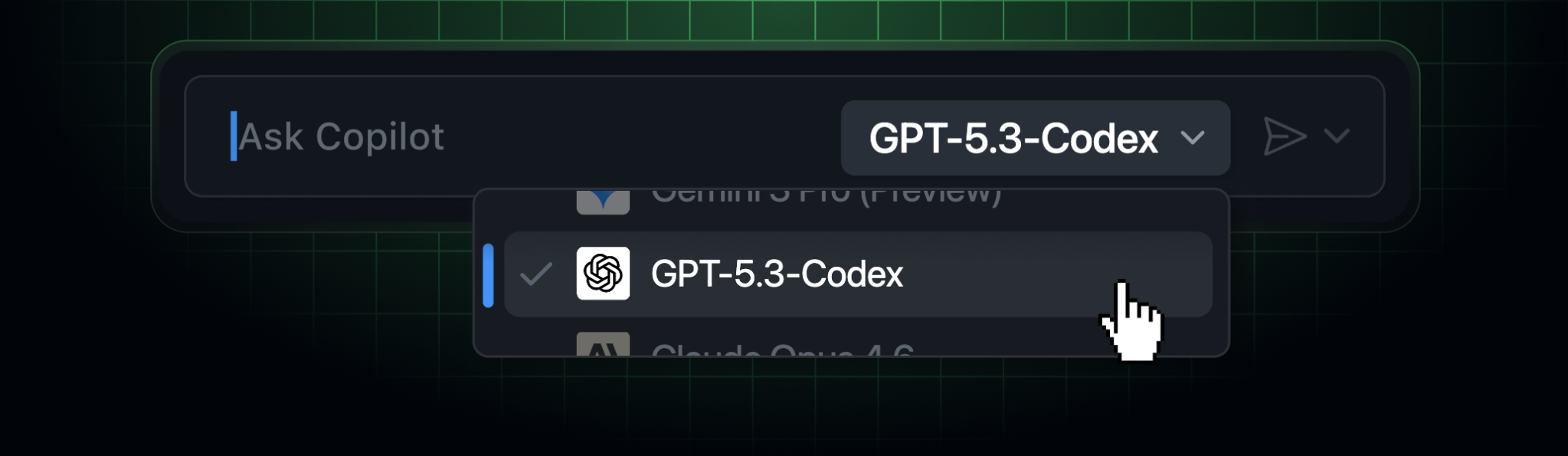
OpenAI's latest agentic coding model, GPT-5.3 Codex, is rolling out to GitHub Copilot and Cursor. The upgrade promises enhanced performance on coding, agentic, and real-world capability benchmarks.
Early tests indicate GPT-5.3 Codex delivers up to 25% faster execution on complex, tool-driven workflows compared to its predecessor, GPT-5.2 Codex. This advancement allows for more sophisticated reasoning and execution in long-running tasks.
Wider Availability and Access
GPT-5.3 Codex will be accessible to Copilot Pro, Pro+, Business, and Enterprise users. It can be selected directly within Visual Studio Code, on github.com, GitHub Mobile, and the GitHub CLI.
For Copilot Business and Enterprise administrators, enabling GPT-5.3 Codex requires activation through the Copilot settings policy.
Advancing Agentic Capabilities
GPT-5.3 Codex represents a significant leap in agentic coding model capabilities. It integrates advancements from GPT-5.2 Codex in frontier coding performance with GPT-5.2's enhanced reasoning and professional knowledge.
The model demonstrates state-of-the-art performance on benchmarks like SWE-Bench Pro and Terminal-Bench 2.0. Notably, it achieves these results using fewer tokens, improving efficiency.
OpenAI also highlighted GPT-5.3 Codex's ability to autonomously build complex applications, such as functional games, over extended periods. The model exhibited improved intent understanding for everyday website creation, generating more complete and production-ready designs by default.
Beyond Code Generation
The capabilities of GPT-5.3 Codex extend beyond traditional code writing. It is designed to support a wider range of professional tasks, including debugging, deployment, monitoring, writing product requirement documents, editing copy, and conducting user research.
The model also shows strong performance on professional knowledge work, as measured by GDPval, matching GPT-5.2's results. It can generate diverse professional outputs, from financial advice presentations to NPV analysis spreadsheets.
In the OSWorld benchmark, which tests agentic computer-use capabilities, GPT-5.3 Codex demonstrated substantially stronger performance than previous GPT models, nearing human-level accuracy.
Self-Improvement and Collaboration
GPT-5.3 Codex is notable for being one of the first models instrumental in its own creation. OpenAI utilized early versions for debugging training processes, managing deployments, and analyzing evaluation results, significantly accelerating its development.
The model is designed to be an interactive collaborator. It provides frequent updates on its progress and decisions, allowing users to steer its work in real-time without losing context. This interactive approach facilitates a more dynamic and controlled development process.
Cybersecurity Focus
GPT-5.3 Codex is the first model classified as High capability for cybersecurity tasks under OpenAI's Preparedness Framework. It has been trained to identify software vulnerabilities.
OpenAI is implementing a comprehensive cybersecurity safety stack, including safety training and automated monitoring, to support defensive use and mitigate potential misuse. A pilot program, Trusted Access for Cyber, is launching to accelerate cyber defense research.
The company is also investing in ecosystem safeguards, including security research agents and partnerships with open-source maintainers. A $10 million grant program offering API credits is available for organizations engaged in cyber defense research.
Availability and Future Prospects
GPT-5.3 Codex is available with paid ChatGPT plans across its various interfaces. API access is expected soon. The model is currently running 25% faster due to infrastructure optimizations.
OpenAI sees GPT-5.3 Codex as a foundational step towards a general-purpose AI collaborator capable of operating computers and completing complex work end-to-end, expanding the possibilities for both developers and professionals.


