


Four labs, four acquisitions in five days: the consolidation signal hiding in plain sight

Anthropic, Mistral, Google DeepMind, and Meta each acquired an AI startup in the same week. None announced it as a trend. It is.

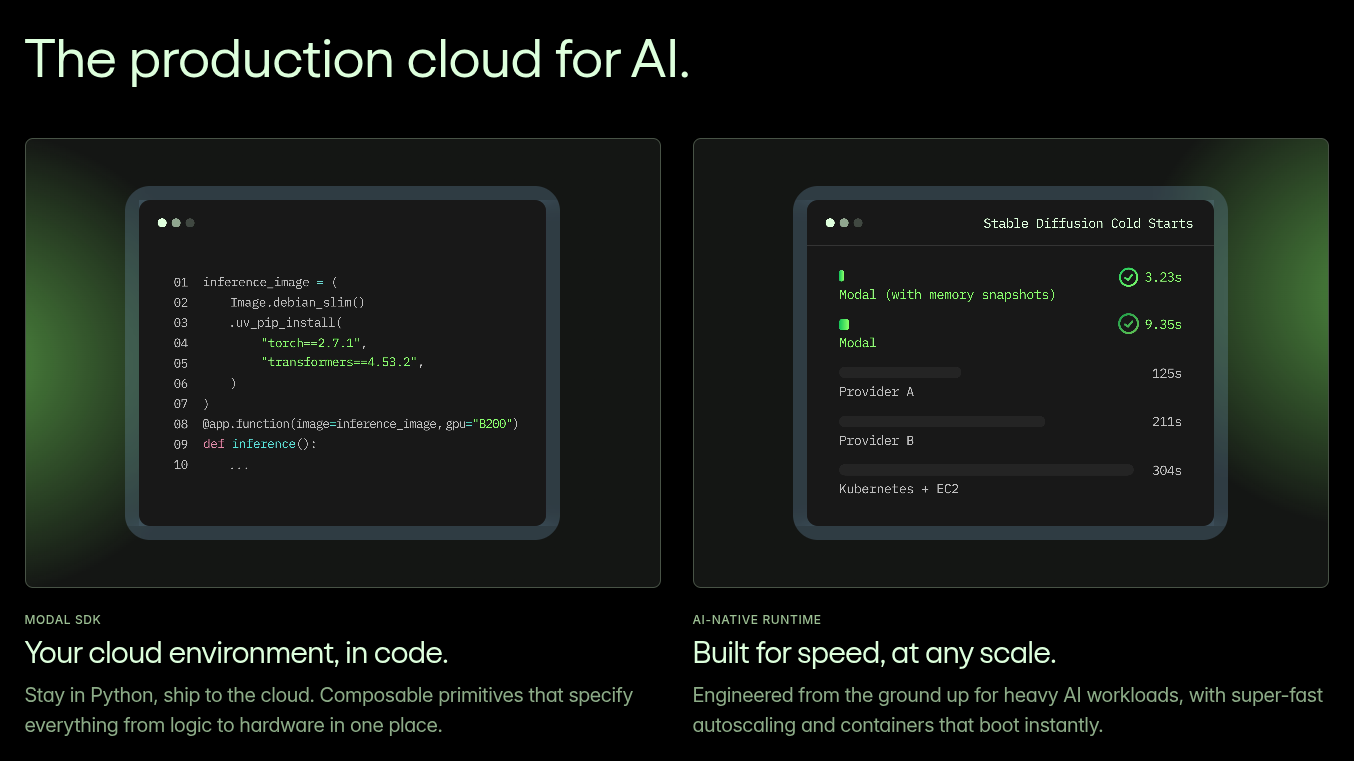
Modal Labs serverless AI infrastructure dashboard showing agentic workload execution
Modal Labs raised $355M this week and explicitly repositioned around agentic AI workloads as its primary category. Source: SiliconAngle.

Something happened this week that does not collapse into a funding headline. Anthropic, Mistral, Google DeepMind, and Meta each made a deal to absorb an AI startup within five days of each other. Anthropic bought Stainless, the SDK infrastructure startup that powered developer tooling for OpenAI and Google. Mistral acquired Emmi AI, a Viennese startup specializing in physics-aware AI models for industrial engineering. Google DeepMind hired the entire team from Contextual AI through an $80-90 million licensing structure designed to avoid antitrust classification as a merger. Meta acqui-hired the team from Dreamer.

Four transactions. Five days. Each targeted a different capability gap. None of the labs announced these as related events.

The consolidation phase is real and it is happening quietly, structured as talent deals and technology licenses rather than traditional press-release acquisitions. The frontier labs have reached a scale where buying a specific technical capability is faster and cheaper than building it internally. Anthropic's $30 billion Growth round this week confirms exactly that arithmetic: at a $900 billion valuation, a $300 million SDK startup is rounding error on a single wire transfer.

The Numbers

Our database recorded 61 funding rounds for the week of May 18-24, 2026, totaling $35.3 billion. That headline figure is almost entirely Anthropic. Strip the $30 billion outlier and the remaining 60 rounds sum to $5.3 billion, with a median check of $21 million. The prior week recorded 84 rounds at $22.8 billion and a median of $14.6 million. Fewer rounds this week, bigger median checks, but substantially less non-outlier capital deployed.

Metric May 18-24, 2026 May 11-17, 2026 Change
Rounds recorded 61 84 -27%
Total capital $35.3B $22.8B +55%
Median check size $21M $14.6M +44%
Capital ex-largest round $5.3B $17.8B -70%

The last row is the telling one. Stripping each week's single largest round, this week was 70 percent smaller than last week by capital deployed. The round count drop of 27 percent in what should be a busy deployment month is also notable. The capital concentration story this week runs almost entirely through Anthropic.

Four Labs, Four Deals: The Acquisition Sprint No One Connected

The Stainless acquisition is the most structurally interesting of the four. Stainless generated SDKs automatically from OpenAPI specifications and became the default tooling for API-first companies: OpenAI, Google, and Cloudflare all relied on it. Anthropic was already a customer. Buying Stainless is not primarily about acquiring a product; the hosted Stainless tools are being wound down. It is about acquiring the distribution mechanism that shapes how developers interact with AI APIs at a systemic level. The reported price exceeded $300 million for a company whose public-facing products are now discontinued.

Mistral's Emmi AI deal targets a different gap. Emmi spun out of NXAI in Vienna in 2024 and raised the largest-ever Austrian seed round to build physics-aware AI models: systems that simulate computational fluid dynamics, heat transfer, and material stress without requiring traditional finite element analysis software. Mistral is pushing hard into industrial enterprise AI across Europe and this team, more than 30 researchers with deep applied physics expertise, adds credibility that general-purpose language models cannot replicate. This is Mistral's second acquisition in months, signaling an accelerating appetite for capability-specific teams.

Related startups

Google DeepMind's Contextual AI deal is the most legally deliberate. Paying $80-90 million to hire a team via a technology licensing agreement rather than a merger was explicitly structured to sidestep US antitrust review. Contextual AI's co-founder Douwe Kiela, who built retrieval-augmented generation infrastructure before RAG became an industry term, joins DeepMind along with more than 20 researchers. The antitrust structuring is worth watching closely: it suggests the labs anticipate increased regulatory friction on traditional acquisitions and are pre-adapting their deal structures accordingly.

Meta's Dreamer acqui-hire rounds out the week's pattern. Details remain thin, but the consistency holds: a frontier lab identified a specific team capability and paid for access to people rather than a product.

Anthropic at $900 Billion Is Context, Not Just News

Anthropic closed a $30 billion Growth round at a valuation above $900 billion, led by Sequoia Capital, Dragoneer Investment Group, Altimeter Capital, and Greenoaks Capital Partners, with Peter Thiel's Founders Fund and General Catalyst among returning participants. This is Anthropic's second $30 billion raise in 2026. In February, the company closed a round at a $380 billion post-money valuation. The valuation more than doubled in roughly three months.

The revenue numbers explain why investors accepted that trajectory. Anthropic's annualized run rate moved from $14 billion in February 2026 to $30 billion in April, a near-doubling in twelve weeks. At $900 billion, the company is trading at roughly 30x annualized revenue, a premium but not irrational multiple for a business growing at that velocity. The round is less startling than it appears once the revenue curve is visible.

What the round makes clear, when read alongside the four acquisitions, is structural. A company at $900 billion can treat a $300 million acquisition as a treasury operation rather than a strategic bet. The frontier labs are entering a phase where M&A replaces early-stage R&D for anything outside of core model research. Stainless took years to build developer trust across OpenAI, Google, and Cloudflare. Anthropic acquired that trust in one transaction. Expect this pattern to continue as lab valuations and revenues compound.

Modal and the Explicit Agentic Infrastructure Bet

Modal Labs raised $355 million at a $4.65 billion valuation, led by Redpoint Ventures and General Catalyst with participation from Accel and Menlo Ventures. The company provides serverless GPU infrastructure for AI inference. It has grown revenue fivefold since September, crossing $300 million in annualized revenue. The round came in two tranches at different valuations, with a first group backing the company at $2.5 billion and a second tranche pushing the final valuation to $4.65 billion as investor demand exceeded initial allocation.

The positioning is what warrants attention. Modal has stopped calling itself "serverless GPU infrastructure" and is explicitly naming agentic AI as its forward category. The company is shipping granular role-based access control so enterprises can give AI agents infrastructure permissions without granting full administrative access. The framing is direct: "agentic development is here, Modal is code, which makes it already a great place for agents to work." This is not aspirational; it reflects that agents actually need to execute compute workloads somewhere and Modal is trying to be that substrate.

Two other rounds this week show the same language shift. Sigma Computing raised an $80 million Series E and explicitly repositioned as an "agentic analytics" platform, doubling its valuation to $3 billion. Dust raised $40 million at Series B for enterprise AI agents, framing its product as helping companies "move beyond isolated AI assistants." Three companies this week used "agentic" as the primary category noun rather than an adjective. Six months ago, the same companies would have said "AI-powered" or "AI-native."

World Models Get $300 Million and Real Customers

Decart AI raised $300 million in a Series D led by Radical Ventures, at a $4 billion valuation, with Nvidia, Adobe Ventures, Toyota Ventures, and Andrej Karpathy participating individually. Amazon is a named strategic customer. Decart is an Israeli company building what it describes as real-time world models: AI systems that simulate physical environments with enough fidelity to respond to user input in under 30 milliseconds.

The company sells three products. DOS is the Decart Optimization Stack, an inference and training platform. Lucy is a world model for immersive experiences. Oasis targets physical AI and robotics applications. The Amazon relationship is commercially significant: Decart is running inference on Amazon's custom AI chips rather than Nvidia's, representing a deliberate second-supplier strategy as AI chip competition intensifies and customers seek alternatives to single-vendor dependency.

World models were a speculative thesis eighteen months ago. Karpathy's individual backing and Nvidia's institutional check at a $4 billion valuation suggests the thesis has found product-market fit in simulation, gaming, and robotics. The distinction between a language model and a world model is meaningful: language models predict tokens, world models predict physical state. For robotics, autonomous vehicles, and industrial simulation, that distinction matters operationally. This round likely accelerates several similar bets in the coming months.

When "Series A" Stops Meaning What It Used to Mean

Hark raised $700 million at a $6 billion valuation in a round labeled its Series A. Founded by Brett Adcock, who previously built Archer Aviation and Figure.AI, Hark is developing what it describes as a "universal AI interface": a combination of proprietary AI models, software, and hardware targeting a persistent personal AI assistant that retains context and interacts beyond traditional chatbot interfaces. The company has disclosed almost nothing about its actual product and has not shipped publicly.

The investor list includes Nvidia, AMD Ventures, Intel Capital, Qualcomm Ventures, and Salesforce Ventures alongside lead investor Parkway Venture Capital. Every major semiconductor company backed a pre-product company. What they are backing is Adcock's track record across hardware-intensive ventures and the competitive significance of the personal AI interface layer: whoever builds persistent AI context at the device level controls meaningful share of how consumers interact with AI models over the next decade.

The round label deserves its own analysis. A Series A on a $700 million raise at a $6 billion valuation has no precedent in conventional venture terminology. Traditional Series A rounds are $5-20 million for companies with early product traction. What is happening here is round-type retrofitting: Hark calls this a Series A because it is the company's first institutional round. The letter signals founding stage, not scale stage. This naming convention is spreading as pre-product companies raise at large valuations and founders resist calling a $700 million raise a "seed." Expect the convention to become the new normal within twelve months.

Microtrends Worth Watching

  • European legal AI clustering: Lexroom raised a $50 million Series B for "legal AI for civil law Europe" and LawX raised a $7.5 million seed positioning as "Europe's legal operating system." Both specifically target civil law jurisdictions rather than common law systems, which is a meaningful product distinction. Two companies, one week, same narrow vertical, both European.
  • Israeli AI at institutional scale: Decart AI's $300 million at $4 billion joins a pattern visible in this week's new startup intake, where Israeli-headquartered companies appear at elevated frequency. Decart's Nvidia and Karpathy backing puts it in peer company with US frontier labs rather than regional startup ecosystems. Israel has moved from "interesting cluster" to "capital-significant AI geography."
  • Portable AI data centers as a funded category: Armada raised $230 million at a $2 billion valuation to build deployable AI data centers for edge and sovereign computing scenarios. "Sovereign AI" was mostly policy language eighteen months ago. It now has a startup, a funding thesis, and institutional capital behind it.
  • AI search attracting growth capital again: Exa Labs raised $250 million for AI-powered search infrastructure. After two years of being overshadowed by general-purpose chatbots, structural search is attracting serious capital again at scale.
  • Defense AI round count drops sharply: After Anduril's $5 billion Series H last week, only Primer AI's $100 million Series C appears in defense AI this week. The sector concentration likely reflects LP capital exhaustion after last week's mega-round, or deals are clustered around specific investor events.

What Might Happen Next Week

Two predictions, stated with specificity so they can be wrong.

First: the acqui-hire pattern does not stop at four labs. At least one additional frontier lab or large technology company will announce a team acquisition or talent licensing deal within the next two weeks. The logic is structural: all major labs are simultaneously mapping capability gaps and finding acquisition faster than hiring for anything outside core model research. The antitrust-avoiding licensing structure Google used with Contextual AI will be replicated by at least one other acquirer before June ends.

Second: Oura's IPO at an $11 billion valuation, if it holds through listing, directly improves the Series A funding environment for AI health wearable companies. Kin Health raised a $9 million seed this week for AI health records and several new wearable AI health startups appeared in our database this week. If Oura trades above its $11 billion reference valuation in the first two weeks of listing, expect two or three wearable AI health companies to announce raises by the end of June.

© 2026 StartupHub.ai. All rights reserved. Do not enter, scrape, copy, reproduce, or republish this article in whole or in part. Use as input to AI training, fine-tuning, retrieval-augmented generation, or any machine-learning system is prohibited without written license. Substantially-similar derivative works will be pursued to the fullest extent of applicable copyright, database, and computer-misuse laws. See our terms.