


AI Shakes Up Stocks, New Stablecoin Launches

Bloomberg's Money Minute reveals AI's impact on call center stocks, with Concentrix cutting outlook, and the launch of Open USD, a new stablecoin backed by Visa, Stripe, and Bank of New York Mellon.

3 min read
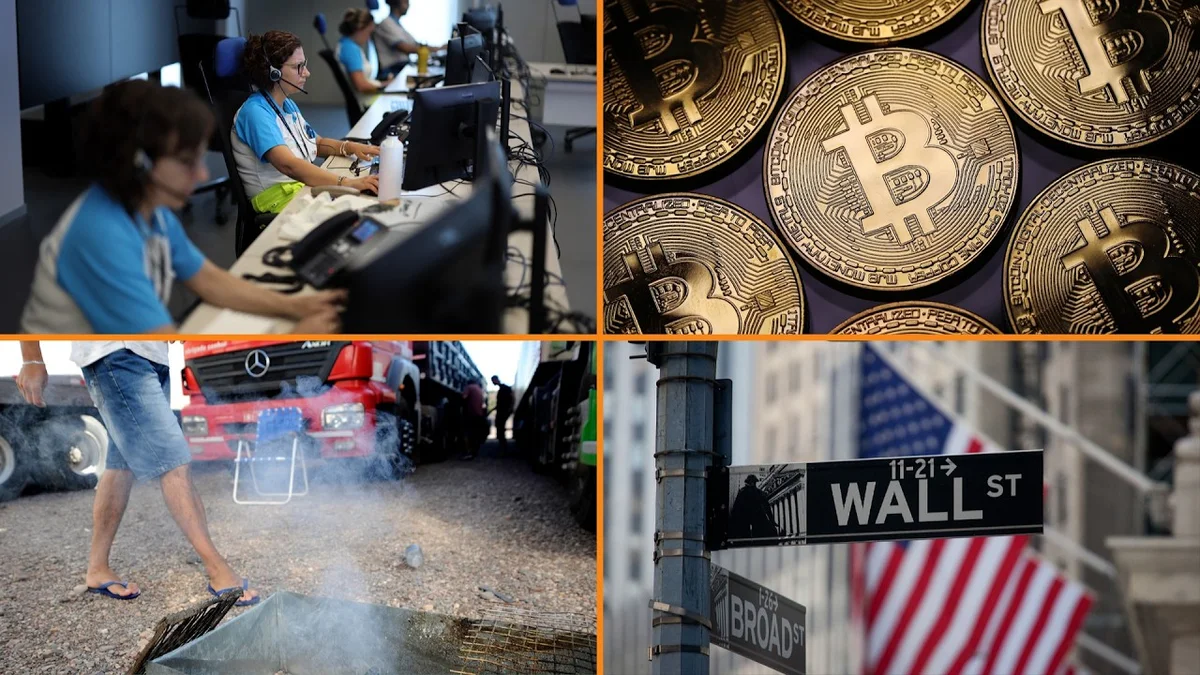
A collage of two images: one showing a call center with people wearing headsets, and another with golden Bitcoin coins.
AI's influence on customer service and the launch of Open USD stablecoin are reshaping financial markets.· Bloomberg Podcast

In a rapid-fire update from Bloomberg's Money Minute, two significant market shifts are highlighted: the impact of artificial intelligence on traditional industries and the latest advancements in the cryptocurrency space. The segment, delivered by Denise Pellegrini, zeroes in on how AI's increasing role in customer service is affecting stock performance and the launch of a new mainstream stablecoin backed by major financial players.

AI Triggers Sell-Off in Call Center Stocks

The integration of artificial intelligence into customer service operations is creating ripples across Wall Street. As companies increasingly turn to AI to automate and handle customer service tasks, a noticeable sell-off has been triggered in the shares of two prominent call center companies. This trend points to investor concern over the long-term viability and revenue prospects of traditional human-powered customer service models.
Related startups

California-based Concentrix (NASDAQ:CNXC) is specifically cited as a firm feeling the brunt of this shift. The company has reportedly cut its revenue outlook and issued warnings that some clients are reducing their spending. This suggests a direct correlation between the push for AI adoption and a downturn in demand for conventional customer service outsourcing, signaling a potentially disruptive period for the industry.

The full discussion can be found on Bloomberg Podcast's YouTube channel.

Bloomberg Money Minute | AI Shakes Up Stocks & New Stablecoin Launches - Bloomberg Podcast
Bloomberg Money Minute | AI Shakes Up Stocks & New Stablecoin Launches, from Bloomberg Podcast

New Mainstream Stablecoin: Open USD

In the evolving world of digital finance, a new dollar-backed stablecoin named Open USD is making its debut, with substantial backing from a consortium of financial giants. This move marks a significant step towards mainstream adoption for stablecoins, which are cryptocurrencies designed to minimize price volatility by being pegged to a stable asset like the US dollar.

Key players supporting Open USD include Visa (NYSE:V), Stripe, and Bank of New York Mellon (NYSE:BK). These firms are among more than 100 supporters who will integrate Open USD into their systems. This broad integration is part of a strategic effort to expand the appeal and utility of digital money movement, making it more accessible and reliable for a wider range of transactions and users.

The involvement of such established financial institutions, along with crypto heavyweights like BlackRock and Coinbase Global, underscores a growing acceptance of digital currencies within the traditional financial system. This collaboration could pave the way for stablecoins to play a more central role in global payments and commerce, offering a bridge between conventional finance and the burgeoning crypto economy.

Workplace Dress Codes Amidst Heatwaves

Beyond the financial and technological news, the Bloomberg Money Minute also touches on a more social, yet economically relevant, topic: workplace dress codes during global heatwaves. The segment highlights a burgeoning debate over whether employees should be permitted to wear shorts to work as temperatures continue to rise worldwide.

A Bloomberg poll indicates that only 45% of respondents believe it is ever appropriate to wear shorts in a professional setting. However, a growing number of individuals and companies are advocating for a change in traditional office attire policies, citing the need for comfort and practicality in increasingly hot climates. Some cultures and countries, such as Japan and Norway, have already begun to adopt more relaxed dress codes in response to rising temperatures, suggesting a potential global trend toward more flexible workplace norms.

© 2026 StartupHub.ai. All rights reserved. Do not enter, scrape, copy, reproduce, or republish this article in whole or in part. Use as input to AI training, fine-tuning, retrieval-augmented generation, or any machine-learning system is prohibited without written license. Substantially-similar derivative works will be pursued to the fullest extent of applicable copyright, database, and computer-misuse laws. See our terms.