


AI Promises Healthcare Cost Reduction

Shiv Rao of Abridge discusses how AI is being used by healthcare companies to reduce costs by automating administrative tasks and improving accuracy in patient care.

6 min read
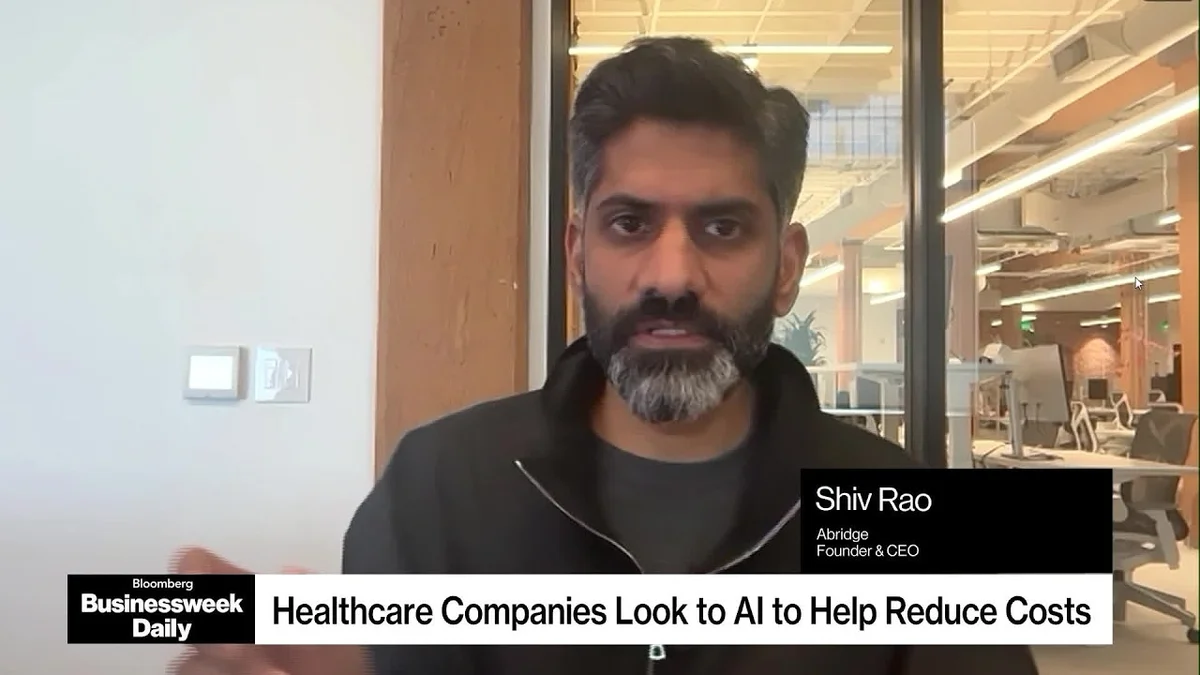
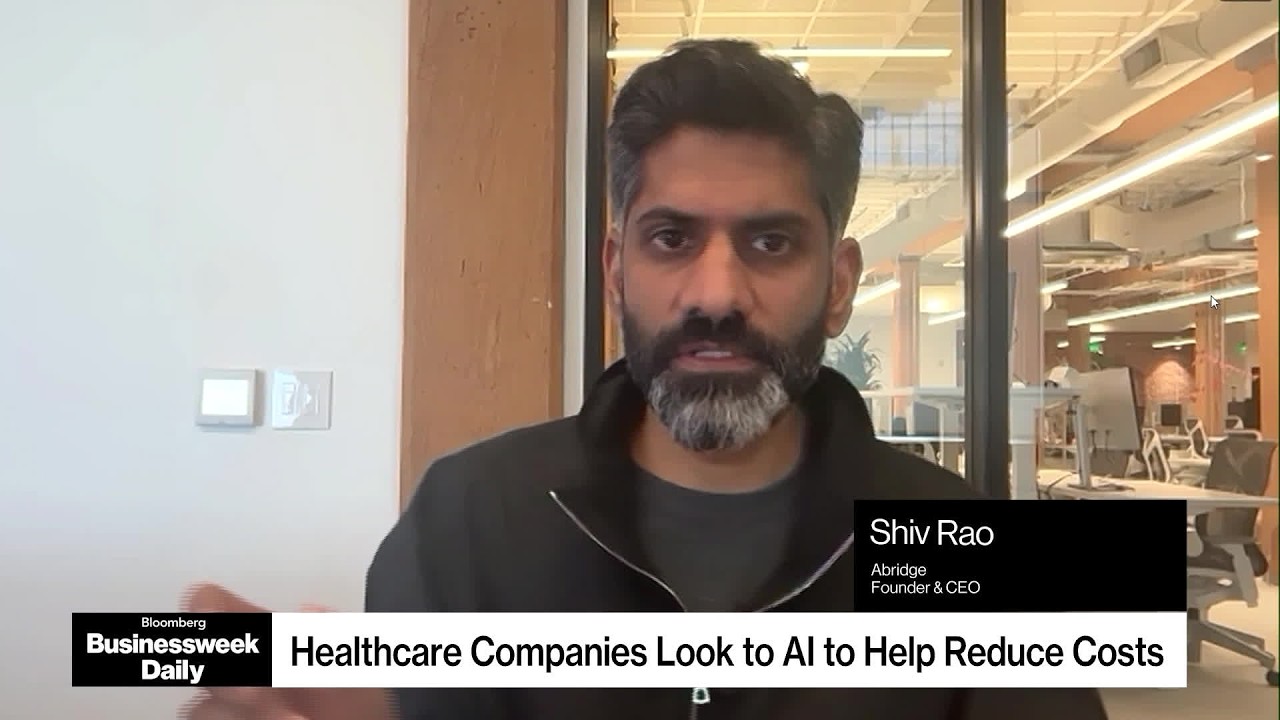
Shiv Rao, CEO of Abridge, in a video interview about AI in healthcare.
Bloomberg Podcast
Visual TL;DR
Healthcare Costs RisingDriver
From the article 2 mentionsIn the ongoing effort to control escalating costs within the healthcare sector, artificial intelligence is emerging as a powerful ally.
AI as AllyCore
From the articleIn the ongoing effort to control escalating costs within the healthcare sector, artificial intelligence is emerging as a powerful ally.
Automate Admin TasksEffect
From the articleHe highlighted the significant administrative workload that often detracts from direct patient care, noting that AI can "assist, augment, and even automate" many of these tasks.
Improve AccuracyEffect
improving accuracy in patient care
From the article 3 mentionsCompanies are exploring AI solutions to streamline operations, improve efficiency, and ultimately reduce the financial burden on both providers and patients.
Streamline OperationsContext
From the article 2 mentionsCompanies are exploring AI solutions to streamline operations, improve efficiency, and ultimately reduce the financial burden on both providers and patients.
Improve EfficiencyContext
From the articleCompanies are exploring AI solutions to streamline operations, improve efficiency, and ultimately reduce the financial burden on both providers and patients.
Abridge TechnologyCore
From the article 7 mentionsShiv Rao, Founder & CEO of Abridge, a company focused on using AI in healthcare, explained the core value proposition of their technology.
Reduce CostsOutcome
ultimately reduce the financial burden on providers and patients
From the article 3 mentionsRao connected these advancements directly to the goal of reducing healthcare costs.
Contents(3)

In the ongoing effort to control escalating costs within the healthcare sector, artificial intelligence is emerging as a powerful ally. Companies are exploring AI solutions to streamline operations, improve efficiency, and ultimately reduce the financial burden on both providers and patients.

Shiv Rao, Founder & CEO of Abridge, a company focused on using AI in healthcare, explained the core value proposition of their technology. "We want to bring the most important people in healthcare, patients, and their clinicians, closer together," Rao stated. He highlighted the significant administrative workload that often detracts from direct patient care, noting that AI can "assist, augment, and even automate" many of these tasks.

Automating the Administrative Burden

Rao elaborated on how Abridge's technology addresses the time-consuming nature of clinical documentation. "When you or your family member visits a doctor, you've seen them turn their back towards you, they're typing into a record, they're distracted, perhaps by all the calls they're getting, they're not able to be fully present, focused on delivering the best experience and the best outcome," he described. Abridge AIms to change this by having its AI handle the note-taking, allowing clinicians to maintain eye contact and focus on the patient.

The full discussion can be found on Bloomberg Podcast's YouTube channel.

Healthcare Companies Look to AI to Help Reduce Costs - Bloomberg Podcast
Healthcare Companies Look to AI to Help Reduce Costs, from Bloomberg Podcast

The AI's capability extends to accurately capturing the nuances of patient-clinician conversations. This includes not only the medical details but also the patient's history, symptoms, and the clinician's plan. "We can turn that app on and then just fully focus on being present, making eye contact, listening to your patient because the technology is taking notes for them," Rao explained. This also extends to other tasks that happen next or afterward, such as inputting diagnoses and orders correctly for reimbursement.

Improving Accuracy and Efficiency

Rao emphasized the importance of accuracy in the AI's output, particularly for billing and reimbursement. "We need to document that correctly, accurately, and then put in that information in a very specific way in order to get reimbursed," he noted. He also highlighted the challenge of handling multiple languages and specialties, stating that AI must be able to "work for all the different specialties" and "understand all the different language that was used in the conversation."

The company is scaling its operations, aiming to process a significant volume of patient encounters. "We're at scale now. So we're live across well over 300 of the largest health systems in the country, and in the next 12 months will touch well over 100 million encounters," Rao revealed. This growth is underpinned by a commitment to transparency and continuous improvement, ensuring that the AI's performance is constantly measured and refined.

The Role of AI in healthcare cost reduction

Rao connected these advancements directly to the goal of reducing healthcare costs. By automating tasks and improving accuracy, AI can lead to more efficient billing cycles and a reduction in administrative overhead. "We measure how well we're doing across all those different layers of the stack, and we're always improving," he said, underscoring the iterative nature of AI development in this sensitive field. He also pointed out that accurately capturing information is essential for reimbursement, which directly impacts the financial health of healthcare providers.

The underlying technology relies on sophisticated AI models. "At the bottom of the stack, there's speech recognition. And really, no doctor out there knows how to pronounce all the different medications for the chemotherapies out there," Rao admitted. "Our challenge is to recognize all the ways they say these words, the symptoms, the medications, the diagnoses, and the procedures." This requires robust natural language processing capabilities to ensure that the AI can accurately interpret and transcribe complex medical discussions.

Rao, who also has a background in venture capital and investing in healthcare technology, shared his perspective on the industry's adoption of AI. "I used to be an investor for a large healthcare system, and we started a machine learning in healthcare program where my co-founders and professors at Carnegie Mellon were also working on these kinds of technologies," he recalled. "These last four years, especially in healthcare, I think you've got to this is technology that is just absolutely unprecedented." He believes that AI is not just a tool but a fundamental shift in how healthcare can be delivered more efficiently and affordably.

© 2026 StartupHub.ai. All rights reserved. Do not enter, scrape, copy, reproduce, or republish this article in whole or in part. Use as input to AI training, fine-tuning, retrieval-augmented generation, or any machine-learning system is prohibited without written license. Substantially-similar derivative works will be pursued to the fullest extent of applicable copyright, database, and computer-misuse laws. See our terms.