


AI Native Organizations Run on Skills

QuantumBlack's Imad Touil says AI-native scale depends on governed, portable skills, not just models and tools.

8 min read
Diagram of agentic software stack with skills, workflows and governance layers
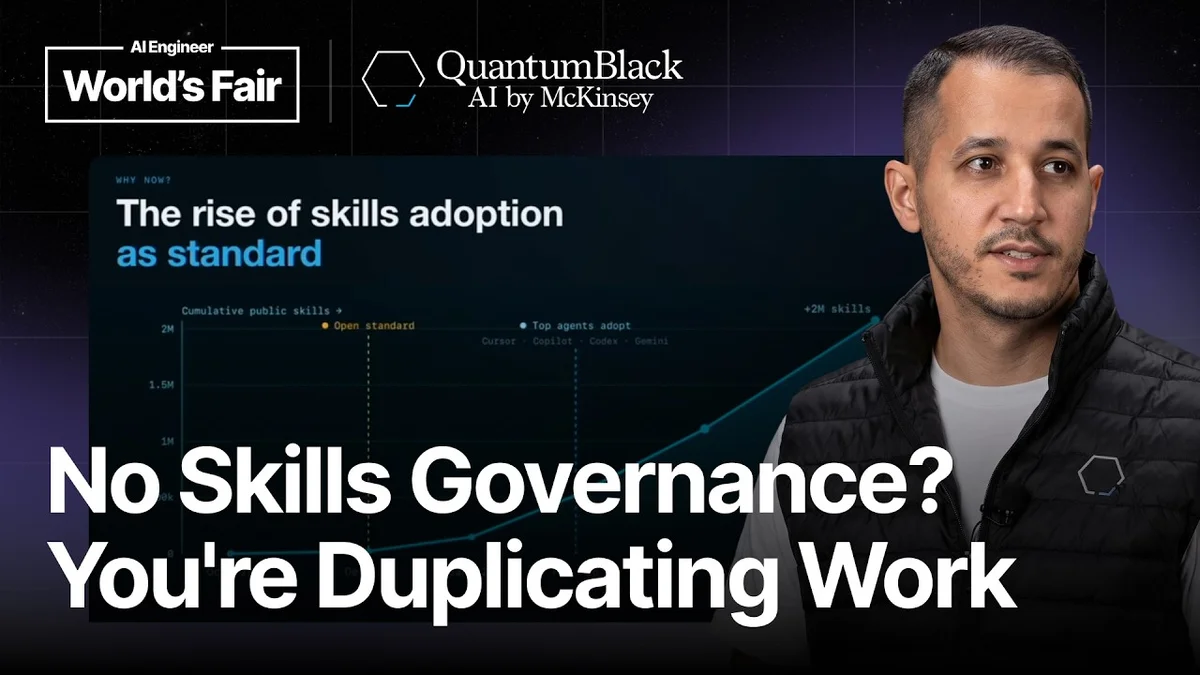
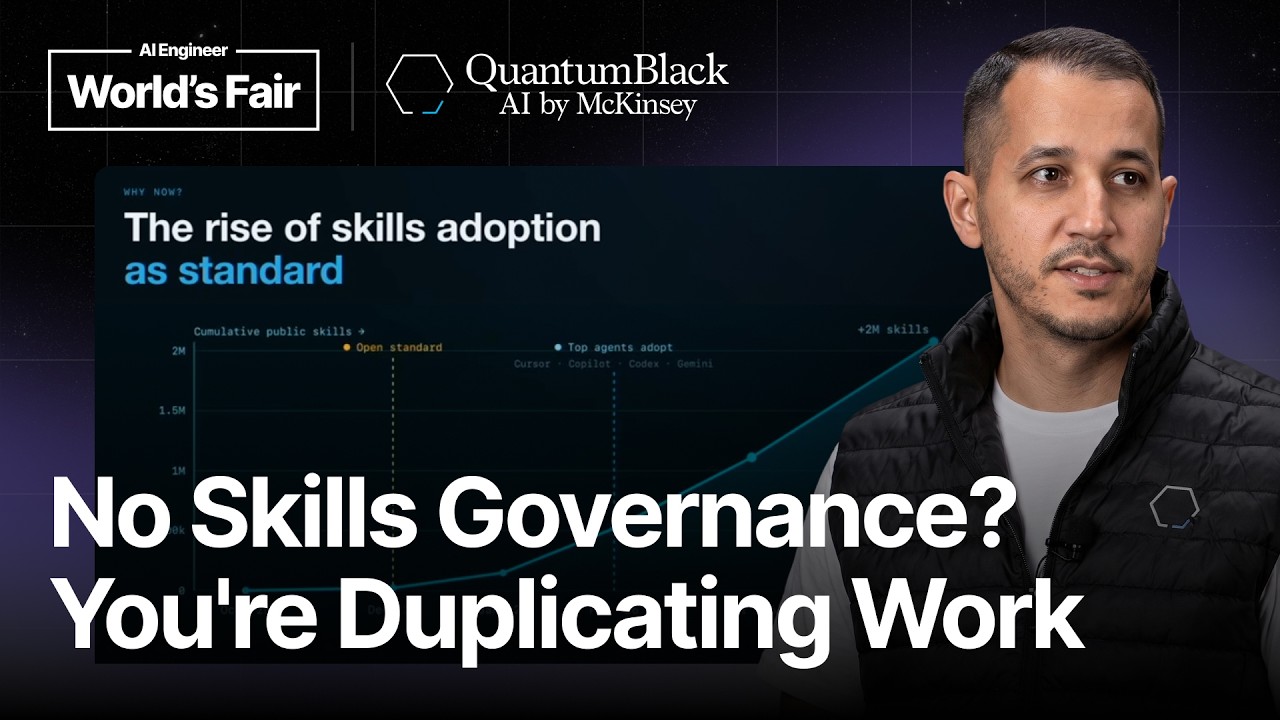
QuantumBlack's Imad Touil at AI Engineer World's Fair on structuring and scaling agent skills· AI Engineer
Visual TL;DR
Duplication rising across teamsDriver
From the article 2 mentions15 teams, 5 to 12 skills per team, and duplication rising for six months.
Two-loop agentic stackCore
Inner code agent harness plus outer workflows of skills, subagents and MCPs
From the articleTouil splits the agentic software stack into two loops.
Skills hold organizational knowhowEffect
Portability breaks when knowhow sits only in model prompts or hidden context
Governance decides scalingDriver
Without governance, productivity lifts stall, costs climb and quality gaps widen
Governed, portable skillsOutcome
QuantumBlack's Imad Touil maps versioned skills as the unit of reuse
From the article 2 mentionsWithout governed skills, productivity lifts stall, costs climb, and quality gaps widen team by team.
Duplication rising across teamsDriver
From the article 2 mentions15 teams, 5 to 12 skills per team, and duplication rising for six months.
Two-loop agentic stackCore
Inner code agent harness plus outer workflows of skills, subagents and MCPs
From the articleTouil splits the agentic software stack into two loops.
Skills hold organizational knowhowEffect
Portability breaks when knowhow sits only in model prompts or hidden context
Skills registry and marketplaceContext
Enablement layer catalogs skills, workflow marketplace and knowledge graph together
From the article 3 mentionsUnder both sit enablement components: environment sandbox, MCP gateway, model gateway, knowledge graph and skills registry plus workflow marketplace.
Context layer stitches loopsContext
Project instructions, tool schemas, conversation memory and retrieved codebase chunks
From the articleThe inner loop is the code agent harness: context manager, tools and MCPs, memories and state, and skills loader.
Governance decides scalingDriver
Without governance, productivity lifts stall, costs climb and quality gaps widen
Governed, portable skillsOutcome
QuantumBlack's Imad Touil maps versioned skills as the unit of reuse
From the article 2 mentionsWithout governed skills, productivity lifts stall, costs climb, and quality gaps widen team by team.
Benchmark and simulationOutcome
Touil's benchmark plus simulation test whether governed skills actually scale
Contents(8)

15 teams, 5 to 12 skills per team, and duplication rising for six months. That is the reality Imad Touil, distinguished engineer at QuantumBlack, AI by McKinsey, mapped at AI Engineer to argue AI native organizations run on skills.

AI Native Organizations Run on Skills - AI Engineer
AI Native Organizations Run on Skills, from AI Engineer

Touil's point is blunt. Without governed skills, productivity lifts stall, costs climb, and quality gaps widen team by team.

The two loops no one talks about

Touil splits the agentic software stack into two loops. The inner loop is the code agent harness: context manager, tools and MCPs, memories and state, and skills loader.

The outer loop is workflows: skills, subagents, MCP servers and hooks. Under both sit enablement components: environment sandbox, MCP gateway, model gateway, knowledge graph and skills registry plus workflow marketplace.

The context layer stitches it together. Project instructions like CLAUDE.md or AGENTS.md, tool and MCP schemas, conversation memory, human in the loop, and retrieved files or codebase chunks.

From product increment to platform reality

Most teams picture four steps: specify, design, break into tasks, implement. Touil says that is only the product increment.

At scale the flow starts earlier with product strategy, market research, competitive analysis and customer interviews, then discovery and user stories. Then data product delivery: pipelines, quality validation, catalog assets.

Then platform engineering ops: provision infrastructure as code, launch, observe, fix incidents, loop again. No single workflow covers mobile, internal platforms and customer facing systems at once.

Skills are the only place knowhow lives

Hooks just fire events. MCP servers are mostly consumed, not built. Subagents mainly shrink context windows.

That leaves skills as the deterministic core. Touil calls workflows harness blueprints, and skills as the unit that makes them behave consistently in runtime.

Anthropic launched Skills for Claude in October and made the Agent Skills specification an open standard, a move positioned like its earlier push to make Model Context Protocol a de facto tool standard. By December the spec was donated to the Linux Foundation backed Agentic AI Foundation, with portability pitched across Claude, OpenAI, Microsoft (NASDAQ:MSFT) Copilot and others.

What good skills look like

Touil borrows directly from microservices. Skills should be reusable, modular, discoverable, portable across harnesses, specialized for one task, composable without conflicts, consistent and cost efficient.

Cost comes from progressive disclosure. The right skill at the right time reduces tokens. That makes knowhow executable, portable and cheap.

His example is data retention policy. A single skill encodes the regulation, but a real feature needs composable pieces: disclosure standards, GDPR rules, fill in templates. A regulatory disclosure review workflow pulls them automatically and emits an audit report, with gaps feeding back into the codebase.

Why governance decides whether this scales

Without governance, Touil warns of a new technical debt class. Duplication explodes when teams on the same stack rebuild the same skill.

Quality degrades if skills are not tested against tasks and against new models. Discovery fails without a catalog. Ownership blurs. Composability does not happen by default.

Security is concrete. Skills can contain scripts and prompts, so prompt injection and insecure pulls are real. Permissions matter because some skills encode sensitive business logic.

The benchmark and the simulation

Touil cited a recent skills bench across auto engineering and cybersecurity tasks. Models did well alone and better with skills applied for more deterministic outcomes.

Then he ran a simulated org of 15 teams over six months. Unmanaged, teams create and use skills but with no visibility. Utilization is uneven, duplication persists, and productivity correlates tightly with skill quality.

Governed, the pattern flips. A published skill is discovered and pulled by the next engineer via the harness. Duplication drops, quality and security converge, token spend falls.

How to adopt without stalling

Touil's adoption path is staged. Individuals create, test and use skills with a chosen toolset.

Teams share and co evolve them. Then the centralized platform takes over: catalog with metadata and search, MCP and CLI to pull skills into IDEs or sandboxes, dependency graph, versioning and lifecycle, access control, evaluation and observability.

Governance sits above the tech. Architects, engineering leads, infra and security owners must own domains and enforce policies. Extend the same model to whole workflows, not just skills, so a new engineer can pull a workflow with its required skills, run it, and push improvements back.

Why this matters now

The shift is from tools to knowhow. MCP solved tool calling. Skills solve repeatable judgment.

For enterprises, that changes the bottleneck. Model quality keeps improving, but enterprise value now depends on whether procedures are captured as versioned, searchable skills rather than tribal chat prompts.

The market is already crowded. Alphabet Inc. (NASDAQ:GOOGL) and others now have skill like mechanisms, and GitHub, Cursor and Microsoft have adopted the open Agent Skills spec to create network effects where every skill works across harnesses. StartupHub.ai data shows how noisy the comparison is: MCP itself scores 36/100, while You sits at 71/100 with VERIFIED financials of $80M raised in Series A in 2023. Against tracked peers, Perplexity AI at 72/100 and Google at 74/100 sit just ahead, with Lucidworks at 52/100.

For startups, the opening is a skills registry and evaluation layer. Touil notes registries are still forming and internal developer portal vendors are racing to add them. The simplest eval today is static checks against Anthropic best practices: if a skill is not structured to be invoked correctly, it will not be high quality.

Auto evolving skills are the next hype. Closed loops that rewrite skills sound attractive, but without guardrails they amplify the same governance failures faster.

QuantumBlack brings weight here. Acquired by McKinsey in 2015 after starting in Formula 1 analytics, it sees platform fragmentation across industries daily. Touil has spent 18 years in those orgs, which explains the focus on lifecycle and access control over demos.

Skills registry, skills evaluation, auto evolving. That is the order to watch. Get the first two right, or the third will scale your mistakes.

© 2026 StartupHub.ai. All rights reserved. Do not enter, scrape, copy, reproduce, or republish this article in whole or in part. Use as input to AI training, fine-tuning, retrieval-augmented generation, or any machine-learning system is prohibited without written license. Substantially-similar derivative works will be pursued to the fullest extent of applicable copyright, database, and computer-misuse laws. See our terms.