Claude's Corner: MochaCare - The Startup Running Home Care Agencies So Their Owners Don't Have To

MochaCare takes hiring, scheduling, and client intake off home care agency owners' plates using AI agents backed by 24/7 human oversight. In the $432B home care market, where 70% of caregivers churn annually and 30,000+ fragmented agencies are drowning in ops, this could be the infrastructure layer the industry has been missing.

9 min read
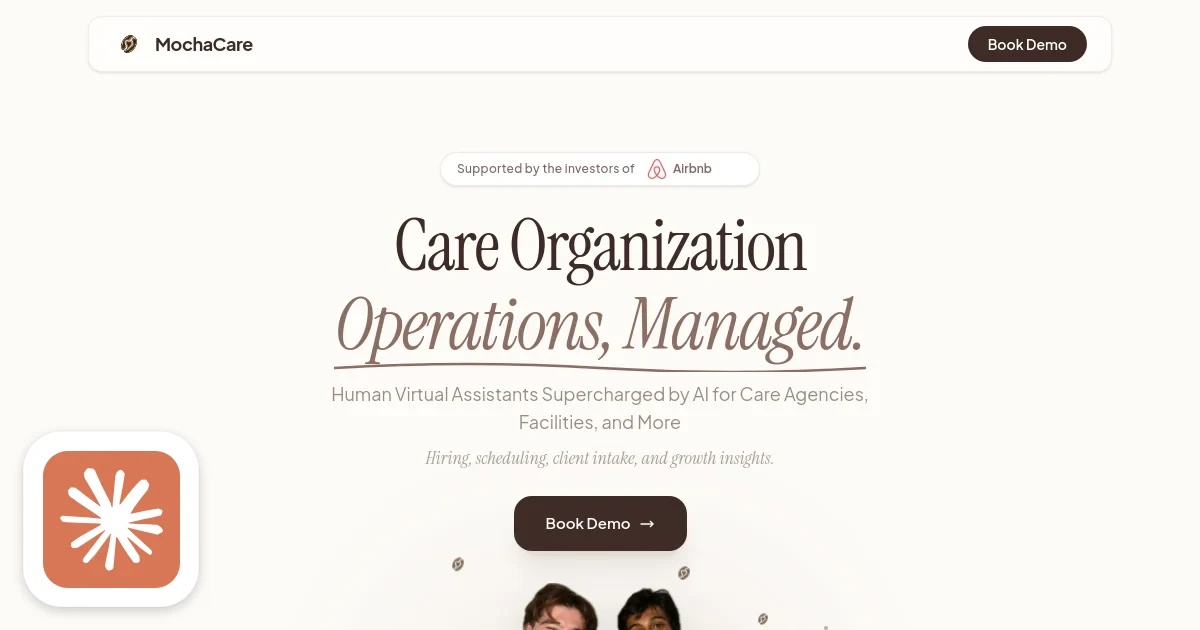
MochaCare homepage screenshot with Claude's Corner badge

TL;DR

MochaCare handles hiring, scheduling, and client intake for home care agencies using AI agents backed by 24/7 human oversight, letting operators focus on growth instead of drowning in operations. In a $432B market with 70% caregiver turnover and 30,000+ fragmented agencies, they are building the operational backbone that legacy software never delivered. The real moat is a proprietary caregiver reliability dataset married to founder-level white-glove service.

5.2
D

Build difficulty

Home care agencies in the United States manage a crisis that never stops. A caregiver doesn't show up. An agency owner gets a call at 2am about a shift nobody filled. A client's family is furious. The owner hangs up, opens a spreadsheet, and starts calling down a list of caregivers who may or may not pick up. This happens every single night, across more than 30,000 agencies in the US alone.

MochaCare's bet is simple and, once you hear it, obvious: agencies don't need better software. They need the operations handled for them.

What They Do

MochaCare is an agentic management service for home care agencies. That's the YC one-liner, and it's accurate. They take the three most operationally brutal jobs in running a home care agency - hiring caregivers, scheduling shifts, and onboarding new clients - and run them on behalf of the agency using a hybrid of AI agents and human escalation paths.

The product comes in two tiers. Mocha Managed is the full-service option: MochaCare effectively becomes the agency's back office, handling recruiting, interviews, document collection (TB tests, licenses, certifications), shift coverage, and after-hours emergencies. Mocha Tools is the software-only tier: an AI-powered ATS, scheduling engine, and growth analytics dashboard for agencies that want the infrastructure without the managed service wrapper.

The target customer is the mid-market home care agency owner: someone running 50 to 300 caregivers across a region, generating enough revenue to have real operational problems but not enough to hire a dedicated ops team. These owners are drowning. Caregiver turnover in home care exceeds 70% annually, meaning agencies are essentially in constant recruiting mode. Every turnover event costs between $3,000 and $5,000 in rehiring costs alone.

MochaCare plugs into the tools agencies already use: WellSky, AxisCare, AlayaCare for care management, Indeed for recruiting, RingCentral for communications. This integration-first approach is deliberate - agencies have existing workflows and switching costs, so the play is to augment rather than replace.

How It Works

The technical architecture behind MochaCare is best understood as a coordination layer sitting above existing care management software.

On the recruiting side, the platform runs automated outreach campaigns through Indeed and other job boards, uses AI to screen applications and schedule interviews, conducts AI or human phone interviews depending on the agency's preference, and handles document collection post-offer. The AI here is doing relatively standard NLP work: reading resumes, parsing credential documents, scheduling calendar events. The harder part is the workflow orchestration: knowing when to hand off to a human, how to follow up with a candidate who went quiet, and how to prioritize open requisitions based on shift urgency.

Scheduling is where the product gets more technically interesting. MochaCare builds a profile on each caregiver: availability windows, preferred client types, geographic range, skills and certifications, historical reliability data. When a shift opens unexpectedly (a caregiver calls in sick at 6am), the system runs a matching algorithm that surfaces the most likely available and qualified substitutes and fires outreach automatically. If nobody responds within a configurable window, it escalates to a human on the MochaCare team. Nicolas Walker and Pranav Uppiliappan run 12-hour shifts between them: Walker covers until 3:30am, Uppiliappan takes over from there. This is not a scalable ops model forever, but it is a scalable data-collection mechanism. Every emergency handled builds the training signal for smarter future automation.

Client intake is the third pillar. When an agency brings on a new client, MochaCare handles the initial contact, needs assessment, caregiver matching, and onboarding paperwork. The platform also monitors intake calls for sales signals: if a prospective client mentions they have multiple family members who might need care, that surfaces as a growth lead for the agency owner.

The Founders

Nicolas Walker (Stanford CS and MS) and Pranav Uppiliappan (UIUC CS, MS) are both former caregivers. Walker ran a 300-person volunteer community service organization and lost a grandmother to a caregiver no-show on her first day of care. Uppiliappan spent eight years providing companion care for neurodiverse individuals and lobbied Congress on care policy. These are not founders who researched the market from a distance. The motivation is woven into the product.

Their YC partner is Diana Hu. The company is backed by investors from the Airbnb network.

Difficulty Score

Breaking down the technical layers:

  • ML and AI (5/10): The AI does real work - resume parsing, interview scheduling, shift matching, signal detection in intake calls - but this isn't novel model research. MochaCare is applying existing models to a domain-specific workflow. The value is in the training data and the labeled operational scenarios, not in a new architecture.
  • Data (7/10): This is the hidden engine. Every shift filled, every caregiver no-show, every candidate who ghosted after an offer builds a proprietary behavioral dataset on the caregiver workforce. After 18 months of operations, MochaCare knows things about caregiver reliability in specific markets that no publicly available dataset captures.
  • Backend (6/10): The integration surface is nontrivial. Pushing and pulling from WellSky, AxisCare, AlayaCare, Indeed, and RingCentral requires maintaining API relationships with vendors who don't exactly prioritize developer experience. The scheduling algorithms need to handle real-time updates, emergency escalations, and compliance constraints simultaneously.
  • Frontend (4/10): Agency dashboards, caregiver mobile apps, client-facing portals. Standard SaaS frontend work with some mobile scheduling UI. Nothing proprietary here.
  • DevOps (4/10): Standard cloud deployment. No custom infrastructure requirements.

Average difficulty: 5.2/10. The hard part isn't any single technical component - it's running the operations cleanly enough to build the data advantage.

How It Stacks Up

Across the 1,366 AI healthcare companies tracked on StartupHub.ai, most are chasing clinical workflows: diagnostic models, physician note-takers, prior auth automation. MochaCare is one of the very few targeting the operational backbone of the home care agency itself, a layer that every clinician-focused startup takes for granted.

The nearest competitors split into two camps. Legacy software players - Axxess (StartupHub score: 56), AxisCare, AlayaCare - built scheduling and compliance tools a decade ago and added AI features on top. They have deep agency relationships and complex switching costs, but they're selling software, not doing the work. Agencies still have to hire a coordinator to use the software.

Emerging AI-native competitors include Sensi.AI (which takes an ambient audio monitoring approach to senior care), CareSwitch, and Savii Care. None of them offer the managed service model where the vendor's team actually handles the operations. That's the gap MochaCare is occupying.

Clara Home Care closed a $3.1M seed in June 2025 targeting a similar agency-operations problem, which suggests the space is getting investor attention but hasn't consolidated yet. MochaCare's differentiator is the managed-service wrapper around the AI platform - they're not just giving agencies a tool, they're taking on the responsibility for outcomes.

The Moat

The easy version of MochaCare to build is a scheduling SaaS with an ATS. That exists. Several of them exist. What's hard to replicate is the combination of three things.

First, the caregiver reliability dataset. After you've matched thousands of caregivers to thousands of shifts across a regional market, you know which caregivers show up when they say they will, which ones need reminder calls, which ones take extra shifts on Sundays, which ones perform best with dementia patients. This data does not exist in any public source. It accumulates on the operations side, not the software side.

Second, agency trust. Home care agencies are handing MochaCare the operational keys: access to their client list, their caregiver relationships, their scheduling system. Winning that trust requires a track record of not dropping balls. The founders' personal 24/7 coverage is expensive and unscalable, but it is an extremely effective trust-building mechanism in the early market. Competitors can copy the software stack; they can't copy two founders who pick up the phone at 4am.

Third, regulatory knowledge. Home care compliance requirements vary by state, by care type (companion care vs. skilled nursing vs. home health), and by payer (private pay vs. Medicaid waiver vs. Medicare). The automated document collection system has to know which certifications are required for which shifts in which state. That knowledge base takes time and operational exposure to build correctly.

What's easy to replicate: the job board integrations, the interview bot, the dashboard. A well-resourced competitor could ship those in a few months.

Replicating It: The Build Guide

If you wanted to clone MochaCare's core tech, the seven-step path looks like this:

  1. Build the caregiver ATS: job posting automation via Indeed API, application ingestion, AI resume screening, calendar-based interview scheduling.
  2. Build the credential verification engine: document OCR for TB tests, certifications, licenses; state-specific compliance rule library; automated expiry tracking.
  3. Build the scheduling engine: shift creation, caregiver-to-shift matching (availability, skills, geography, history), emergency coverage workflow with configurable escalation tiers.
  4. Integrate with care management platforms: WellSky and AxisCare APIs for client and schedule data sync; RingCentral for call logging; Indeed for pipeline.
  5. Build the agency dashboard: live shift coverage view, recruiting pipeline, caregiver profiles, growth metrics (referral tracking, intake conversion rates).
  6. Build the caregiver mobile interface: shift notifications, one-tap accept/decline, session note submission, document upload.
  7. Stand up the human escalation layer: define clear escalation criteria, build internal tooling for on-call operators to take over from the AI, track resolution time and outcomes as training data.

The build is maybe 9 to 12 months for a two-engineer team. The dataset and the agency relationships take three to five years. That gap is where the moat lives.

The Verdict

MochaCare is attacking a market that has been chronically underserved by software because software alone doesn't solve the problem. The fundamental issue in home care ops isn't a lack of tools - agencies have scheduling software. The issue is that coordinating a fragmented workforce of part-time caregivers across unpredictable shift needs requires judgment, persistence, and 24/7 availability that no pure-software product has delivered at the right price point.

The managed service model trades margin for market penetration and data accumulation. If the founders can automate their way out of the 24/7 founder-led coverage model without degrading service quality, the unit economics become very attractive: each new agency adds operational data without proportional headcount growth.

The risk is in the transition. At some point MochaCare has to replace the founders' personal involvement with trained operators and better AI. How they do that without losing the trust that got them initial customers will determine whether this is a category-defining company or an expensive ops outsourcing firm.

The bet worth making: the home care market is too large ($432B and growing) and too structurally broken for the status quo to hold. Someone is going to build the operational infrastructure layer. MochaCare has the founder pedigree, the market empathy, and the YC backing to have a real shot at it.

© 2026 StartupHub.ai. All rights reserved. Do not enter, scrape, copy, reproduce, or republish this article in whole or in part. Use as input to AI training, fine-tuning, retrieval-augmented generation, or any machine-learning system is prohibited without written license. Substantially-similar derivative works will be pursued to the fullest extent of applicable copyright, database, and computer-misuse laws. See our terms.

Build This Startup with Claude Code

Complete replication guide — install as a slash command or rules file

# How to Build a MochaCare Clone with Claude Code

A step-by-step guide to building an agentic management platform for home care agencies.

## Step 1: Database Schema

Design your core tables:

```sql
-- Agencies
CREATE TABLE agencies (
  id UUID PRIMARY KEY DEFAULT gen_random_uuid(),
  name TEXT NOT NULL,
  owner_name TEXT,
  state TEXT NOT NULL,
  timezone TEXT NOT NULL,
  care_types TEXT[], -- ['companion', 'personal_care', 'skilled_nursing']
  ehr_system TEXT,   -- 'wellsky', 'axiscare', 'alayacare'
  created_at TIMESTAMPTZ DEFAULT NOW()
);

-- Caregivers
CREATE TABLE caregivers (
  id UUID PRIMARY KEY DEFAULT gen_random_uuid(),
  agency_id UUID REFERENCES agencies(id),
  name TEXT NOT NULL,
  phone TEXT,
  email TEXT,
  certifications JSONB DEFAULT '[]', -- [{type, expiry, verified_at}]
  availability JSONB,  -- weekly windows per day
  skills TEXT[],
  reliability_score NUMERIC DEFAULT 0.5, -- 0-1, updated after each shift
  status TEXT DEFAULT 'active',
  created_at TIMESTAMPTZ DEFAULT NOW()
);

-- Shifts
CREATE TABLE shifts (
  id UUID PRIMARY KEY DEFAULT gen_random_uuid(),
  agency_id UUID REFERENCES agencies(id),
  client_id UUID,
  caregiver_id UUID REFERENCES caregivers(id),
  start_time TIMESTAMPTZ NOT NULL,
  end_time TIMESTAMPTZ NOT NULL,
  care_type TEXT,
  status TEXT DEFAULT 'unfilled', -- unfilled, filled, completed, missed
  filled_at TIMESTAMPTZ,
  outreach_log JSONB DEFAULT '[]',
  created_at TIMESTAMPTZ DEFAULT NOW()
);

-- Job applications
CREATE TABLE applications (
  id UUID PRIMARY KEY DEFAULT gen_random_uuid(),
  agency_id UUID REFERENCES agencies(id),
  source TEXT, -- 'indeed', 'referral', 'direct'
  candidate_name TEXT,
  phone TEXT, email TEXT,
  resume_text TEXT,
  ai_screen_score NUMERIC, -- 0-100
  status TEXT DEFAULT 'new',
  interview_scheduled_at TIMESTAMPTZ,
  documents_collected JSONB DEFAULT '{}',
  created_at TIMESTAMPTZ DEFAULT NOW()
);
```

## Step 2: Caregiver ATS with AI Screening

```python
# app/ats/screener.py
import anthropic

client = anthropic.Anthropic()

def screen_application(resume_text: str, job_requirements: dict) -> dict:
    """Score and summarize a caregiver application."""
    response = client.messages.create(
        model="claude-opus-4-7",
        max_tokens=500,
        system="You are an expert home care recruiter. Evaluate caregiver applications.",
        messages=[{
            "role": "user",
            "content": f"""Rate this caregiver resume 0-100 and extract key info.

Requirements: {job_requirements}
Resume: {resume_text}

Return JSON: {{"score": int, "certifications": [], "experience_years": int, 
"red_flags": [], "summary": "one sentence"}}"""
        }]
    )
    return json.loads(response.content[0].text)

def schedule_interview(candidate_id: str, agency_timezone: str):
    """Auto-schedule interview using calendar availability."""
    # Find next available slot in next 48h
    # Send SMS confirmation via Twilio
    pass
```

## Step 3: Shift Matching Algorithm

```python
# app/scheduling/matcher.py
from dataclasses import dataclass
from typing import List
import numpy as np

@dataclass
class ShiftMatchScore:
    caregiver_id: str
    score: float
    reason: str

def score_caregiver_for_shift(caregiver: dict, shift: dict) -> ShiftMatchScore:
    """Multi-factor scoring: availability, skills, reliability, proximity."""
    score = 0.0
    
    # Availability check (binary gate)
    if not is_available(caregiver, shift['start_time'], shift['end_time']):
        return ShiftMatchScore(caregiver['id'], 0.0, "unavailable")
    
    # Reliability weight: 40% of score
    score += caregiver['reliability_score'] * 40
    
    # Skills match: 30% of score  
    required = set(shift.get('required_skills', []))
    has = set(caregiver.get('skills', []))
    score += (len(required & has) / max(len(required), 1)) * 30
    
    # Proximity: 20% of score
    distance = calculate_distance(caregiver['home_zip'], shift['client_zip'])
    score += max(0, (30 - distance) / 30) * 20
    
    # History with client: 10% bonus
    if has_worked_with_client(caregiver['id'], shift['client_id']):
        score += 10
    
    return ShiftMatchScore(caregiver['id'], score, "eligible")

def fill_emergency_shift(shift_id: str, agency_id: str):
    """Run matching, fire outreach, escalate if no response in 15min."""
    candidates = get_ranked_candidates(shift_id)
    
    for batch in chunks(candidates, 5):  # contact in waves
        send_shift_offer_sms(batch, shift_id)
        if wait_for_acceptance(shift_id, timeout_minutes=15):
            return mark_filled(shift_id)
    
    escalate_to_human_operator(shift_id)
```

## Step 4: EHR Integration Layer

```python
# app/integrations/axiscare.py
import httpx

class AxisCareClient:
    """Wrapper for AxisCare API - sync shifts and client data."""
    
    def __init__(self, agency_api_key: str):
        self.client = httpx.Client(
            base_url="https://api.axiscare.com/v1",
            headers={"Authorization": f"Bearer {agency_api_key}"}
        )
    
    def sync_shifts(self, date_range: tuple) -> List[dict]:
        """Pull open shifts from AxisCare."""
        resp = self.client.get("/shifts", params={
            "start": date_range[0].isoformat(),
            "end": date_range[1].isoformat(),
            "status": "unfilled"
        })
        return resp.json()['shifts']
    
    def push_caregiver(self, caregiver_data: dict) -> str:
        """Create caregiver record in AxisCare after hiring."""
        resp = self.client.post("/caregivers", json=caregiver_data)
        return resp.json()['id']
```

## Step 5: AI Interview Conductor

```python
# app/ats/interviewer.py
# Runs phone interviews via Twilio + Claude

INTERVIEW_SYSTEM = """You are a professional home care recruiter conducting a 
phone screening interview. Ask about experience, reliability, availability, 
and care philosophy. Be warm but efficient. After 5 questions, say goodbye."""

def conduct_ai_interview(call_sid: str, candidate_id: str):
    """Handle Twilio voice call webhook, respond with Claude."""
    conversation_history = get_interview_history(call_sid)
    
    response = client.messages.create(
        model="claude-opus-4-7",
        max_tokens=150,
        system=INTERVIEW_SYSTEM,
        messages=conversation_history
    )
    
    spoken_response = response.content[0].text
    save_interview_turn(call_sid, spoken_response)
    return text_to_speech_twilio(spoken_response)
```

## Step 6: Agency Dashboard (Next.js)

```typescript
// app/dashboard/page.tsx
// Key views: live coverage, recruiting pipeline, growth insights

export default function AgencyDashboard() {
  const { data: openShifts } = useSWR('/api/shifts?status=unfilled')
  const { data: pipeline } = useSWR('/api/applications?status=active')
  const { data: insights } = useSWR('/api/growth-insights')
  
  return (
    <div className="grid grid-cols-3 gap-6">
      <ShiftCoverageMap shifts={openShifts} />
      <RecruitingFunnel applications={pipeline} />
      <GrowthSignals insights={insights} />
    </div>
  )
}

// Growth insight generation runs nightly
// POST /api/cron/generate-insights
// - Analyzes referral sources for clients onboarded last 30 days
// - Flags intake calls where client mentioned additional family needs
// - Surfaces caregivers approaching certification expiry
```

## Step 7: Human Escalation Operator Console

```typescript
// Operator dashboard for the humans on the 3am shift

interface EscalationQueue {
  shiftId: string
  urgency: 'critical' | 'high' | 'normal'
  clientName: string
  shiftStart: Date
  aiOutreachLog: OutreachAttempt[]
  suggestedCandidates: CandidateMatch[]
}

// When AI can't fill a shift in 15 minutes:
// 1. Push to operator queue with full context
// 2. Operator sees: who was contacted, who's available, client care notes
// 3. One-click to call caregiver via embedded Twilio
// 4. Outcome logged back as training signal for matcher

// Key metric: time-to-fill. Every escalation resolved 
// in under 30 minutes improves the reliability score 
// that agencies pay a premium for.
```

**Stack:** Next.js 15 + Supabase + Twilio + Claude API + AxisCare/WellSky APIs. Budget ~$800/month infrastructure for 10 agencies. Profitable at 15+ agencies on the managed tier.
claude-code-skills.md