


Agentic Sites Puts Adobe's AI Speed to Test

Adobe's Carlos Sanchez demoed Agentic Sites that personalize AEM blocks in 1.1 seconds using Cerebras and Gemma 4, grounded on the site's own content.

6 min read
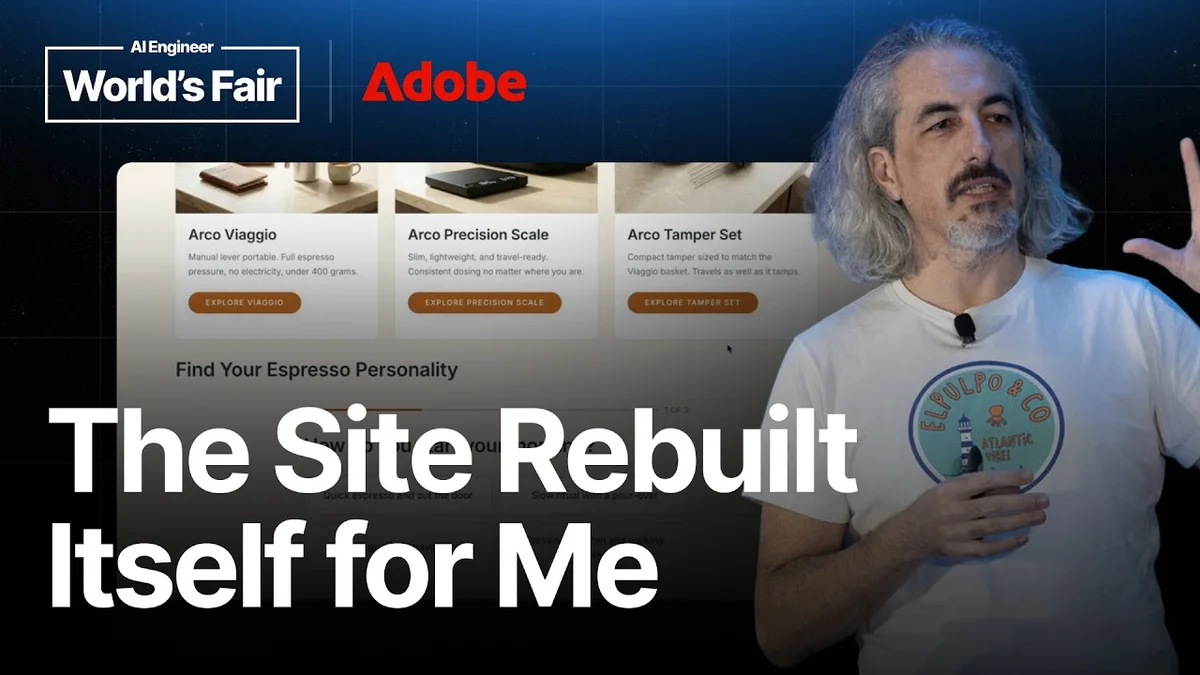
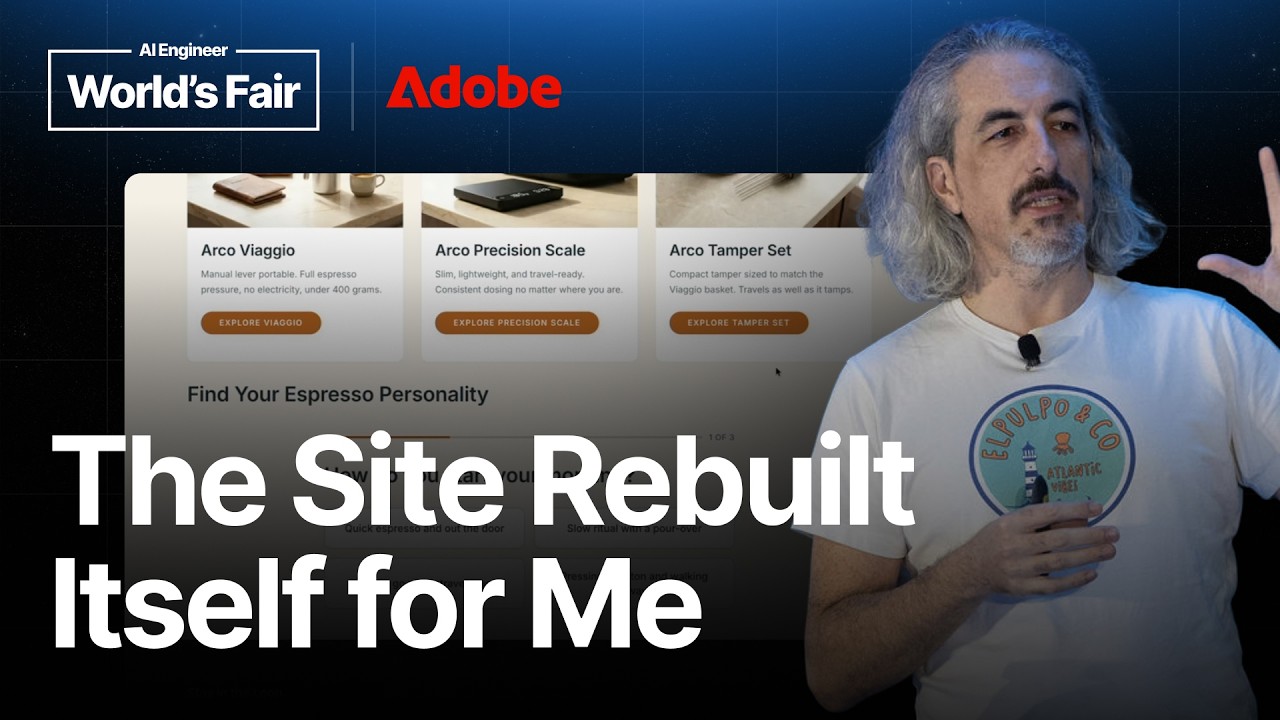
Adobe Agentic Sites demo showing hyper-personalized website blocks generated by AI
Carlos Sanchez demos Agentic Sites personalizing AEM blocks in real time with Cerebras Gemma 4.· AI Engineer
Visual TL;DR
Agentic Sites demoCore
Carlos Sanchez showcased live at AI Engineer conference on Adobe Experience Manager
From the article 3 mentionsAgentic Sites generated a personalized page in 1.1 seconds live on stage at AI Engineer.
Cerebras fast inferenceCore
From the article 3 mentionsA backend service does reasoning over a vector database and calls LLM providers, with Cerebras used for fast inference and alternatives like Bedrock tested.
Intent driven personalizationDriver
Adapts page blocks to what visitor is trying to accomplish in real time
From the articleThe goal is intent driven personalization that adapts the page to what the visitor is trying to do right now.
1.1 second generationOutcome
Hero, products, navigation, and CTAs personalized within the threshold window
From the article 6 mentionsSanchez said Adobe targets 1 to 2 seconds for generation because proven data shows faster sites drive more conversions.
RAG grounded on site contentContext
Vector corpus built from full site keeps brand guidelines and blocks hallucination
From the articleAll generated text is grounded on a RAG corpus built from the full site, so brand guidelines stay intact.
Agentic Sites demoCore
Carlos Sanchez showcased live at AI Engineer conference on Adobe Experience Manager
From the article 3 mentionsAgentic Sites generated a personalized page in 1.1 seconds live on stage at AI Engineer.
Browsing signals feed engineContext
Continuously recorded pages visited and time on each shape personalization inputs
From the article 2 mentionsInstead of hallucinating a whole site, the engine personalizes blocks like the hero card, products, blog feeds, navigation and calls to action.
Intent driven personalizationDriver
Adapts page blocks to what visitor is trying to accomplish in real time
From the articleThe goal is intent driven personalization that adapts the page to what the visitor is trying to do right now.
RAG grounded on site contentContext
Vector corpus built from full site keeps brand guidelines and blocks hallucination
From the articleAll generated text is grounded on a RAG corpus built from the full site, so brand guidelines stay intact.
AEM Edge DeliveryCore
Framework pushes rendering to edge for hyper personalized web experiences
From the articleContent lives on AEM Edge Delivery Services, a framework that pushes rendering to the edge for speed.
Cerebras fast inferenceCore
From the article 3 mentionsA backend service does reasoning over a vector database and calls LLM providers, with Cerebras used for fast inference and alternatives like Bedrock tested.
1.1 second generationOutcome
Hero, products, navigation, and CTAs personalized within the threshold window
From the article 6 mentionsSanchez said Adobe targets 1 to 2 seconds for generation because proven data shows faster sites drive more conversions.
Marketers retain controlEffect
Editors approve layouts, blocks, and brand guardrails before any generation runs
Contents(5)

Agentic Sites generated a personalized page in 1.1 seconds live on stage at AI Engineer.

Agentic Sites Puts Adobe's AI Speed to Test - AI Engineer
Agentic Sites Puts Adobe's AI Speed to Test, from AI Engineer

Principal scientist Carlos Sanchez built the demo inside Adobe (NASDAQ:ADBE) Experience Manager to show hyper-personalized websites working at edge speed.

What Agentic Sites actually do

The goal is intent driven personalization that adapts the page to what the visitor is trying to do right now.

Instead of hallucinating a whole site, the engine personalizes blocks like the hero card, products, blog feeds, navigation and calls to action.

All generated text is grounded on a RAG corpus built from the full site, so brand guidelines stay intact.

How the stack is wired

Content lives on AEM Edge Delivery Services, a framework that pushes rendering to the edge for speed.

A backend service does reasoning over a vector database and calls LLM providers, with Cerebras used for fast inference and alternatives like Bedrock tested.

Browsing signals are recorded continuously, including pages visited and time on each page, then fed to the LLM to pick personas like exploring.

Why 1.1 seconds is the threshold

Sanchez said Adobe targets 1 to 2 seconds for generation because proven data shows faster sites drive more conversions.

Evaluation runs continuously with Promptfoo, which systematically tests prompts and models side by side.

On a 15 prompt test set for the demo coffee gear site, Cerebras with Gemma 4 averaged 1.1 seconds while the next best provider averaged 4.6 seconds.

The demo showed 2,300 tokens per second and an LLM time of 1 second for a query about a coffee machine for camping, which returned tailored copy and recommendations for Agile and Nano brewers.

Cerebras has previously reported wafer scale inference above 1,800 tokens per second on Llama 3.1 8B and record 3,000 tokens per second on OpenAI models.

Where marketers keep control

Marketers define personalization strategy in natural language and choose how many persona groups to use, such as buyers versus information seekers.

In the live example it turned an AI engineering events site into a search box that built Europe AI conferences lists and side by side comparisons on the fly.

He extended the same query to a voice assistant on Google TV to argue agentic pages work beyond the browser.

Why this matters

Alphabet Inc. (NASDAQ:GOOGL) and Adobe are both pushing agentic personalization as the product layer, not the research layer, with Adobe's Agent Orchestrator already in beta for Experience Platform.

The demo reframes the bottleneck from model quality to inference economics, since each personalized page needs an LLM call and fresh RAG retrieval.

That favors wafer scale inference vendors like Cerebras and Groq over general GPU clouds, and it pressures CMS rivals to match edge plus AI latency.

StartupHub.ai data shows You raised $80M in its 2023 Series A and tracks Promptfoo among peers including Perplexity AI, Alphabet Inc. (NASDAQ:GOOGL), Lucidworks, matey and Dante.

Adobe's comparison makes the point explicit: Promptfoo lets teams prove whether speed is good enough when accuracy is similar across providers.

The gap not covered is cost at scale, governance of auto generated blocks, and how Adobe will price per generation when every visitor becomes an audience of one.

© 2026 StartupHub.ai. All rights reserved. Do not enter, scrape, copy, reproduce, or republish this article in whole or in part. Use as input to AI training, fine-tuning, retrieval-augmented generation, or any machine-learning system is prohibited without written license. Substantially-similar derivative works will be pursued to the fullest extent of applicable copyright, database, and computer-misuse laws. See our terms.