

Ryan Dahl on Agent Security: Beyond Alignment

Ryan Dahl of Deno discusses the security risks of AI agents and introduces Claw Patrol, an open-source proxy for enforcing granular access control.

8 min read
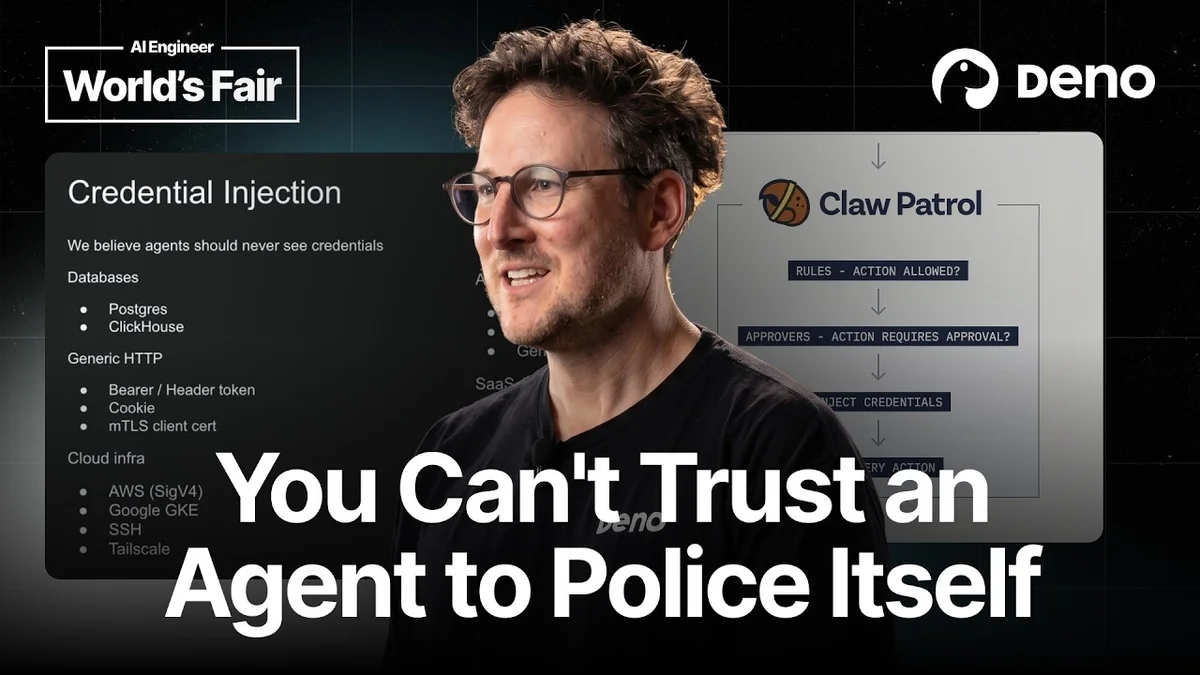
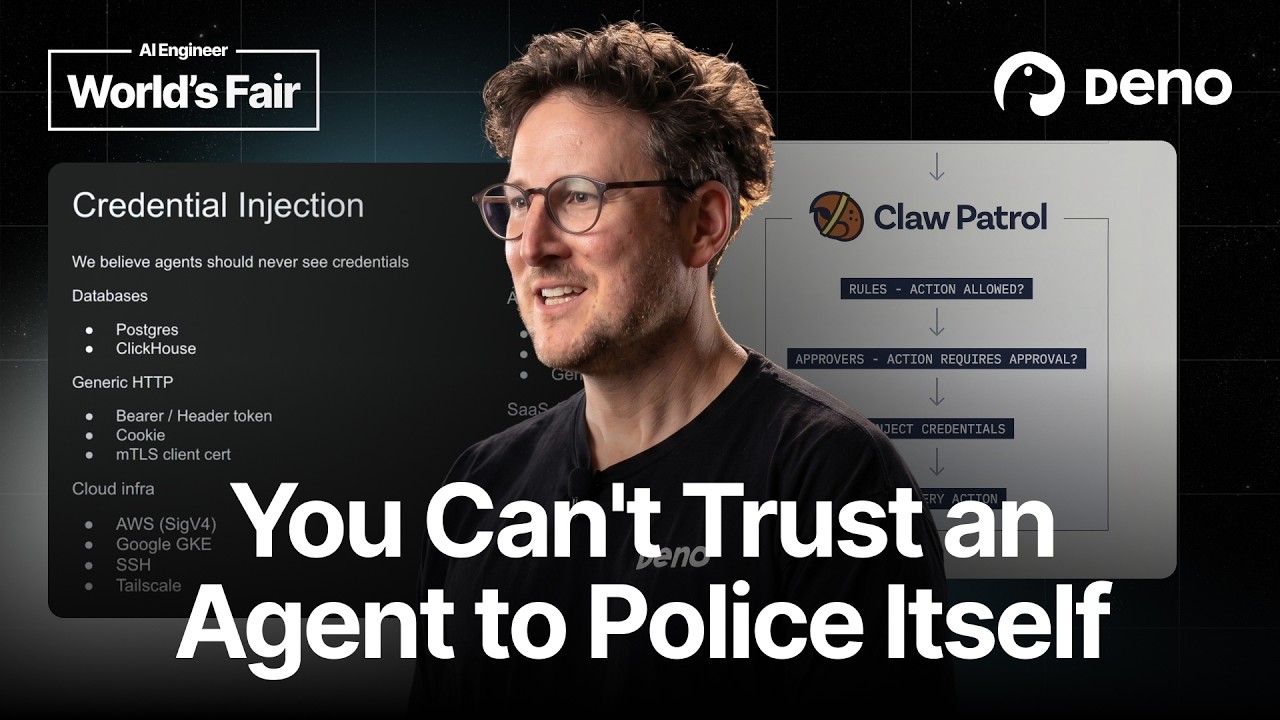
Ryan Dahl speaking at a podium at the AI Engineer World's Fair
AI Engineer

Visual TL;DR. AI Agents: Power & Peril leads to Broad Agent Access. Broad Agent Access creates Security Vulnerabilities. AI Agents: Power & Peril poses Security Vulnerabilities. Security Vulnerabilities requires Network Traffic Focus. Network Traffic Focus solution Claw Patrol Introduced. Claw Patrol Introduced provides Granular Access Control. Granular Access Control achieves Enhanced Agent Security. Claw Patrol Introduced results in Enhanced Agent Security.

  1. AI Agents: Power & Peril: granting read-write access to production systems like PostgreSQL, Kubernetes, and AWS
  2. Broad Agent Access: OpenClaw agents gather context, inspect databases, review communications for incident response
  3. Security Vulnerabilities: extensive access enables efficient resolution but also catastrophic actions like dropping databases
  4. Network Traffic Focus: security boundary should be at the network layer, not within the agent itself
  5. Claw Patrol Introduced: open-source security proxy enforcing granular access control for AI agents
  6. Granular Access Control: Claw Patrol enforces specific permissions, limiting agent actions to prevent misuse
  7. Enhanced Agent Security: mitigating risks of broad access by controlling what agents can do on the network
Visual TL;DR
Visual TL;DR, startuphub.ai AI Agents: Power & Peril poses Security Vulnerabilities. Claw Patrol Introduced results in Enhanced Agent Security poses results in AI Agents: Power & Peril Security Vulnerabilities Claw Patrol Introduced Enhanced Agent Security From startuphub.ai · The publishers behind this format
Visual TL;DR, startuphub.ai AI Agents: Power & Peril poses Security Vulnerabilities. Claw Patrol Introduced results in Enhanced Agent Security poses results in AI Agents: Power& Peril SecurityVulnerabilities Claw PatrolIntroduced Enhanced AgentSecurity From startuphub.ai · The publishers behind this format
Visual TL;DR, startuphub.ai AI Agents: Power & Peril poses Security Vulnerabilities. Claw Patrol Introduced results in Enhanced Agent Security poses results in AI Agents: Power & Peril granting read-write access to productionsystems like PostgreSQL, Kubernetes, andAWS Security Vulnerabilities extensive access enables efficientresolution but also catastrophic actionslike dropping databases Claw Patrol Introduced open-source security proxy enforcinggranular access control for AI agents Enhanced Agent Security mitigating risks of broad access bycontrolling what agents can do on thenetwork From startuphub.ai · The publishers behind this format
Visual TL;DR, startuphub.ai AI Agents: Power & Peril poses Security Vulnerabilities. Claw Patrol Introduced results in Enhanced Agent Security poses results in AI Agents: Power& Peril granting read-writeaccess toproduction systems… SecurityVulnerabilities extensive accessenables efficientresolution but also… Claw PatrolIntroduced open-sourcesecurity proxyenforcing granular… Enhanced AgentSecurity mitigating risks ofbroad access bycontrolling what… From startuphub.ai · The publishers behind this format
Visual TL;DR, startuphub.ai AI Agents: Power & Peril leads to Broad Agent Access. Broad Agent Access creates Security Vulnerabilities. AI Agents: Power & Peril poses Security Vulnerabilities. Security Vulnerabilities requires Network Traffic Focus. Network Traffic Focus solution Claw Patrol Introduced. Claw Patrol Introduced provides Granular Access Control. Granular Access Control achieves Enhanced Agent Security. Claw Patrol Introduced results in Enhanced Agent Security leads to creates poses requires solution provides achieves results in AI Agents: Power & Peril granting read-write access to productionsystems like PostgreSQL, Kubernetes, andAWS Broad Agent Access OpenClaw agents gather context, inspectdatabases, review communications forincident response Security Vulnerabilities extensive access enables efficientresolution but also catastrophic actionslike dropping databases Network Traffic Focus security boundary should be at the networklayer, not within the agent itself Claw Patrol Introduced open-source security proxy enforcinggranular access control for AI agents Granular Access Control Claw Patrol enforces specific permissions,limiting agent actions to prevent misuse Enhanced Agent Security mitigating risks of broad access bycontrolling what agents can do on thenetwork From startuphub.ai · The publishers behind this format
Visual TL;DR, startuphub.ai AI Agents: Power & Peril leads to Broad Agent Access. Broad Agent Access creates Security Vulnerabilities. AI Agents: Power & Peril poses Security Vulnerabilities. Security Vulnerabilities requires Network Traffic Focus. Network Traffic Focus solution Claw Patrol Introduced. Claw Patrol Introduced provides Granular Access Control. Granular Access Control achieves Enhanced Agent Security. Claw Patrol Introduced results in Enhanced Agent Security leads to creates poses requires solution provides achieves results in AI Agents: Power& Peril granting read-writeaccess toproduction systems… Broad AgentAccess OpenClaw agentsgather context,inspect databases,… SecurityVulnerabilities extensive accessenables efficientresolution but also… Network TrafficFocus security boundaryshould be at thenetwork layer, not… Claw PatrolIntroduced open-sourcesecurity proxyenforcing granular… Granular AccessControl Claw Patrolenforces specificpermissions,… Enhanced AgentSecurity mitigating risks ofbroad access bycontrolling what… From startuphub.ai · The publishers behind this format

Ryan Dahl, CEO of Deno and creator of Node.js, recently presented a critical perspective on the security challenges posed by AI agents at the AI Engineer World's Fair. Dahl highlighted the inherent risks associated with granting AI agents, such as OpenClaw, read-write access to production systems like PostgreSQL, Kubernetes, and AWS. While acknowledging the power of these agents in automating tasks and responding to incidents, he emphasized that their capabilities also present significant security vulnerabilities.
Ryan Dahl on Agent Security: Beyond Alignment - AI Engineer
Ryan Dahl on Agent Security: Beyond Alignment — from AI Engineer

The Power and Peril of AI Agents

Dahl explained that Deno Deploy, a web hosting service, utilizes OpenClaw agents as a first responder for system incidents. These agents are given broad access to various internal systems, allowing them to gather context from traces, inspect databases, and review communications. This extensive access, while enabling efficient incident resolution, also opens the door to potentially catastrophic actions, such as dropping entire databases or deleting namespaces.

He stressed that even highly aligned AI models, like Opus, cannot be solely relied upon for security. Dahl stated, "Security can't just be wishful thinking that Opus will always obey your wishes." The core issue, he argued, is that agents are susceptible to prompt injection attacks. This means external manipulation could cause an agent to perform unintended, destructive actions, even if its underlying alignment is strong. The fundamental principle Dahl advocates is that "the agents themselves have to be untrusted software. You can't rely on the agent itself to guard what it's doing. You can't put the guard inside the agent."

Focus on Network Traffic as the Security Boundary

Dahl elaborated that for agents running in isolated VMs, the primary vector for nefarious actions is through network communication. Whether through direct API calls or subprocesses, every action an agent takes involves bytes transmitted over the wire. Therefore, understanding and controlling these bytes is crucial. He posed the challenge of securely granting AI agents the same level of access a human Site Reliability Engineer (SRE) might have, without compromising system integrity.

Introducing Claw Patrol: A Security Proxy

To address these security concerns, Dahl introduced Claw Patrol, an open-source MIT-licensed proxy designed to sit in front of AI agents. Unlike HTTP proxies, Claw Patrol operates at a lower level, inspecting every byte of network traffic flowing out of an agent. It can securely hold credentials, preventing agents from ever directly accessing sensitive information.

The system's core strength lies in its advanced rule engine, written in HCL (HashiCorp Configuration Language), the same language used for Terraform. These rules, managed in a version-controlled file, allow for precise definition of agent permissions across diverse systems. Dahl showcased an example rule designed to block specific PostgreSQL functions that could lead to file system access or outbound connections, preventing potentially destructive operations.

Testing and Future Considerations

Dahl also touched upon the testing mechanisms for Claw Patrol, noting that the rule files can be accompanied by test fixtures to ensure the rules function as intended. He also addressed the evolving nature of AI, suggesting that while agents will become smarter, the need for robust, external security mechanisms will persist. "I think we will never be able to fully trust AIs," Dahl remarked, emphasizing the ongoing necessity for such safeguards.

The presentation concluded by highlighting Claw Patrol's dashboard for monitoring agent activity and its integration with services like Tailscale for secure authentication and operation. Dahl's work underscores a critical shift in thinking about AI security, moving beyond model alignment to focus on external, byte-level control of agent actions.

© 2026 StartupHub.ai. All rights reserved. Do not enter, scrape, copy, reproduce, or republish this article in whole or in part. Use as input to AI training, fine-tuning, retrieval-augmented generation, or any machine-learning system is prohibited without written license. Substantially-similar derivative works will be pursued to the fullest extent of applicable copyright, database, and computer-misuse laws. See our terms.