
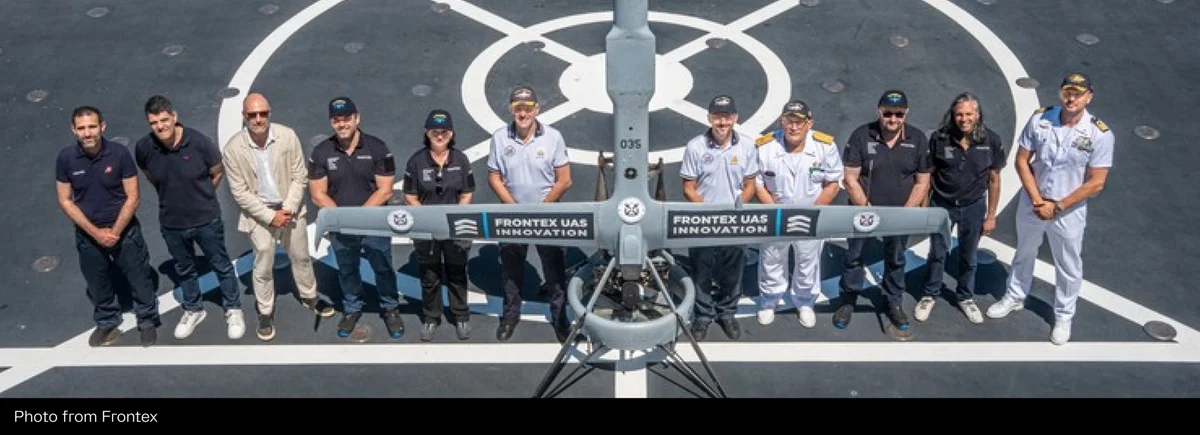
Shield AI's V-BAT unmanned aerial vehicle has achieved Specific Assurance and Integrity Level III (SAIL III) authorization for maritime operations in Europe, the highest granted to date for such missions. This significant regulatory milestone, achieved during a Frontex (the European Border and Coast Guard Agency) mission aboard the Italian Coast Guard patrol vessel Dattilo, underscores the growing operational trust in autonomous systems. The announcement details how this authorization was secured through rigorous evaluation of the V-BAT's airworthiness, mission readiness, and specific operational authorization requirements.
The V-BAT brings a notable operational pedigree to its deployments. It has previously served aboard U.S. Navy and U.S. Coast Guard vessels, operated in the Aegean, and flown daily in Ukraine under challenging electronic jamming conditions. Additionally, it is in service with the Royal Netherlands Navy, under contract in Poland, and has been selected by Japan for maritime ISR and by India for army operations.
Earning operational trust for the V-BAT hinges on three core pillars: airworthiness, mission readiness, and operational authorization. Airworthiness ensures the aircraft in the field precisely matches the engineers' tested and documented design, involving pre-delivery acceptance testing and ongoing evaluation of any configuration changes. Mission readiness focuses on reliability and the aircraft's ability to be ready when needed, a factor supported by design simplifications and a reported mission-readiness rate above 98 percent. Operational authorization, however, is mission-specific. It requires demonstrating that a particular aircraft configuration, operating area, and mission plan meet the safety requirements of aviation authorities, such as the Italian Civil Aviation Authority (ENAC) in this case.
StartupHub.ai data indicates a strong market trend toward increased regulatory acceptance of advanced uncrewed systems for complex missions. Companies like Anduril Industries, which focuses on integrated defense systems and has secured substantial funding, are also pushing the boundaries of autonomous operations. Anduril, which has raised over $2 billion according to Crunchbase, is a key player in this evolving defense technology sector. Shield AI's achievement with SAIL III authorization for V-BAT signals a maturing market where regulatory bodies are increasingly comfortable with the safety and reliability of uncrewed platforms, potentially accelerating adoption for other companies in the autonomous defense space.



