
The billionaire guest on The Diary Of A CEO Clips said we are in a bubble, just not the one we remember from 2000.
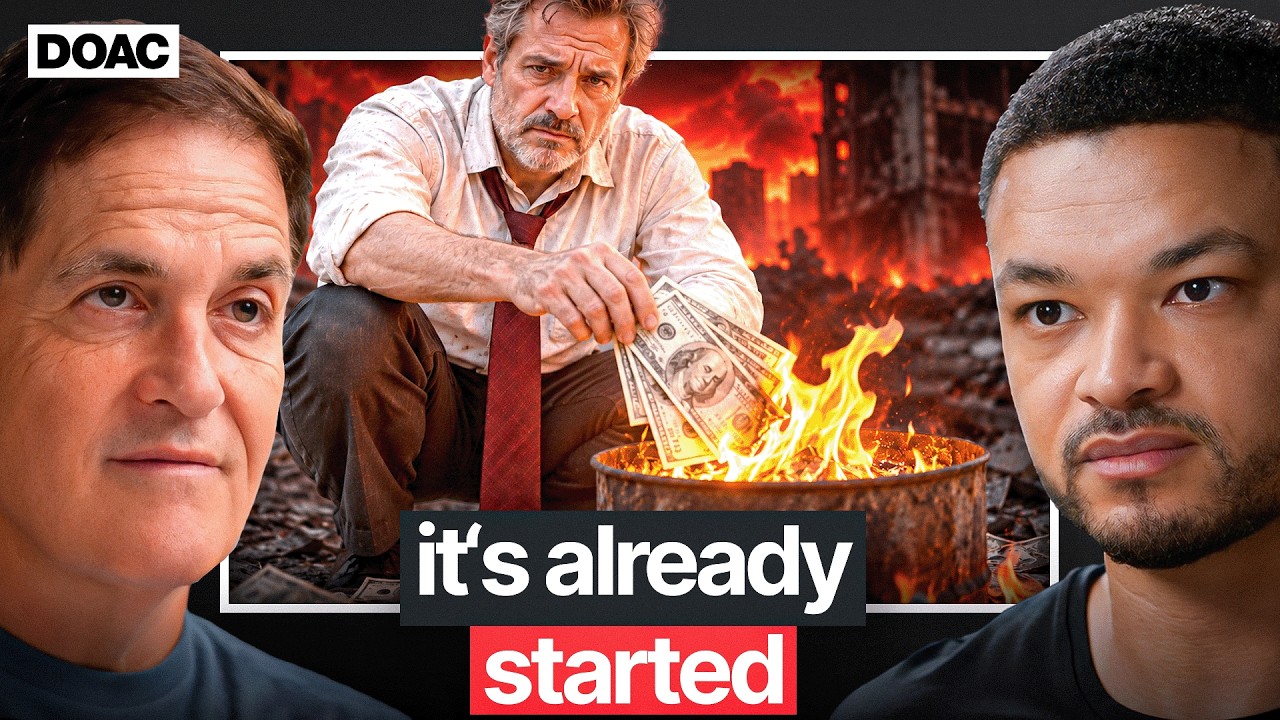
Every stock is a meme stock now, he argued. Bitcoin, Micron, Google, Apple all swing 18 percent on a penny miss, not because intrinsic value moved 18 percent, but because buyers and sellers trade them like baseball cards on anticipated news. I think he is right about the trading. I am not convinced he has proven the bubble will pop the way he implies.
That skepticism matters because his own history cuts both ways.
He built Broadcast.com in the analog internet era and lived through the crash he cites. Dell and Amazon went way up high, got crushed, then Amazon bled money for years before it became worth trillions, he said. His point was there will be winners. He just does not know if it is Anthropic or OpenAI.
It is a fair concession. Creative destruction is coming, he said, and the path will be painful like it was for Terre Haute, Indiana when RCA records and then CDs and DVDs vanished. People still make money on music. Different jobs appear. That is the optimistic case he allows, even while warning about meme-stock pricing.
Where he gets sharper, and more security-relevant, is his claim about what AI actually is.
Cuban said AI is not smart. It is predictive, not deterministic. Ask four models the same question and you get four answers. Nudge the prompt and the same model gives you a different answer. It cannot consume live video without latency, does not know consequences, and has no inherent ethics.
He would trust a guide dog over any model to cross a four-way intersection. That is a punchline. It is also his threat model.
On hacking, he said security people tell him AI has not invented anything new. No novel exploit, no new approach for stealing data. What it does have is unlimited agents to brute force every combination on the same lists defenders already have. The attacker requirement is not local access or a new zero-day. It is remote, scalable, and cheap: spin up agents and grind.
Those days where defense could rely on the attacker lacking resources are gone, he said. The same brute force can be used on defense to find your own holes proactively. I buy that framing. It is honest about capability without mysticism. What he does not show is a patched or unpatched system, a CVE, or a demo where this actually breached a target at scale. The claim is architectural, not empirical.
He extends that brute force logic to economics.
Models need more power and more GPUs than all the power and GPUs used before last year, he said. That is not intelligence, it is brute force. Until AI can do more with less power, not more power doing more, constraints bite. Data centers draw protests. Hyperscalers borrow more than they make, rates keep rising, and a $40 billion debt load gets unfinanceable fast. He warned of a private credit debt bubble and cited Ray Dalio's view that the U.S. has already crossed the curve toward a debt-laden, currency-risk future.
He singled out Nvidia and Jensen Huang as subsidizing half the industry because they have the cash, while others, he said Meta among them, borrow beyond cash flow. The assertion that many data centers will become pickleball courts was a metaphor, not a forecast, about what happens if efficiency does not improve.
There is a limit to this bear case that markets already see.
Prediction markets are not pricing a near-term crack as highly as the rhetoric suggests. Polymarket put the chance of an AI bubble burst by Dec. 31, 2026 at 9.4%, and by at 22.5%, per CryptoSlate, with odds moving on liquidity and trading activity. That is a small but rising chance, not a consensus call. If Cuban is right that everything trades on perceived value, those low odds are themselves part of the meme-stock dynamic he describes.
And he is not a doomer on utility.
He said AI is incredible, just not smart the way people mean smart. Smart is aggregating inputs, knowing where to look, identifying the right problem, and acting in real time with consequences. He runs about 25 agents on his phone, he said, for the tedious work he would have paid an intern $15 to $20 an hour to do. For Cost Plus Drugs, agents flag every lawsuit and bid by big conglomerates and draft Open Records Act emails he never had time to staff before. He tells his kids, 17, 20 and 23, to learn agents or be out-produced by someone who does.
The edge, in his telling, is not access to information. Everyone with a phone can ask Claude or Gemini anything. The edge is knowing how to take four different answers, know what is right and wrong, and apply it. That is also where his skepticism about recursive self-improvement lands. He said he would change his mind when a minimal-resource AI can solve hard problems without massive compute, like a 12-year-old with no resources figuring things out. More GPUs and better algorithms alone do not meet that bar for him.
Elon Musk came up as the counterpoint. Cuban called Musk the best entrepreneur of our lifetimes and a brilliant salesman who has to raise a lot of money. Forecasts that work becomes a choice and humanoid robots take over are overblown until latency and power constraints are solved, in his view. People will also rebel, he said, and build communes without the technology, just as they protest data centers now.
What is still gated is the proof either way. He asserts models are immediately out of date the moment they ship, that bifurcation of training data between Gemini, Claude and Grok defeats the purpose, and that adversarial inputs can make full self-driving react wrong. He does not name a benchmark, a live video test, or a fully cited hacking incident. And the Tesla example from the host, that crash rates are significantly lower with self-driving, goes unrebutted with data.
If you are building right now, take his advice literally. Learn to run agents, learn to ask better questions, and budget for power and debt risk the way you budget for GPUs. Assume AI will brute force your defenses before it outsmarts you.


