

AI Agents Are Here: Marketers Face New Governance Rules

AI agents are moving beyond assistance to autonomous action, forcing marketers to prioritize data governance and privacy to harness their power effectively.

4 min read
Abstract visualization of interconnected data nodes representing the agentic enterprise.
The convergence of AI, data, and privacy defines the agentic enterprise.· Snowflake

The debate is settled: marketers are using AI. The new challenge, however, is far more complex. As AI capabilities evolve from assistance to autonomous action, the need for robust governance becomes paramount.

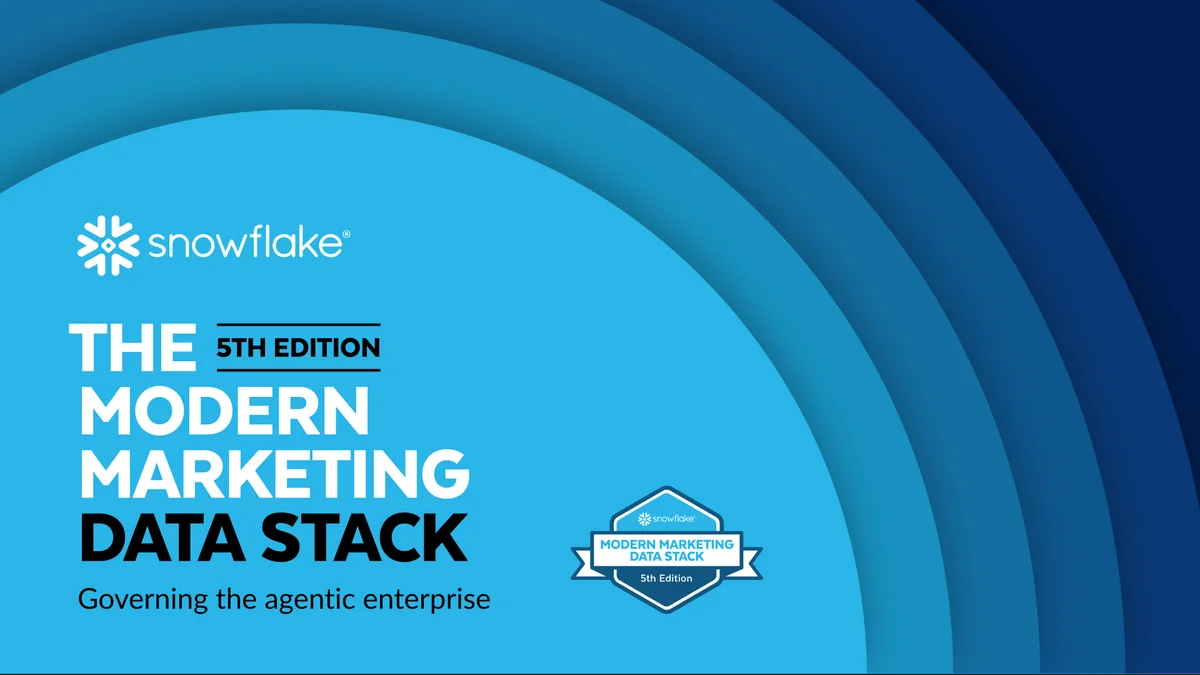
This shift is detailed in the latest Modern Marketing Data Stack report, which highlights how AI agents are reshaping marketing workflows. The report, titled "Governing the Agentic Enterprise," emphasizes that the more unified and accessible customer data is, the more powerful AI becomes. Yet, this increased data access necessitates tighter controls, clearer accountability, and unwavering trust in how that data is utilized.

Related startups

The Agentic Enterprise Demands a New Operating Model

Marketers are caught between maximizing data value and adhering to stringent privacy requirements. The core tension lies in governing AI effectively enough to trust its scaled operations while maintaining agility.

Scott Brinker, chief martec analyst, notes that AI has reshaped the marketing stack not by replacing tools, but by introducing a new control layer above them. This evolution is driven by three converging forces: AI, privacy, and data gravity.

AI is no longer just an analytical tool; it's actively shaping workflows, triggering actions, and influencing decisions across the entire marketing technology landscape. This necessitates a data foundation built on trust, where systems making or recommending decisions operate on governed data.

Privacy considerations are now intrinsically linked to this automation. As decisions become increasingly automated, embedding consent and data usage rules directly into systems where data is accessed and actions are taken is critical. This governance framework acts as the essential through line, enabling teams to move faster without sacrificing control.

The ROI of AI and the Role of Governance

Beyond generative AI, the emergence of agentic workflows, systems that coordinate actions, invoke tools, make decisions, and optimize toward outcomes with human oversight, marks a fundamental shift. The quality of a company's data foundation and the clarity of its governance controls directly determine whether these AI actions create value or introduce risk.

Organizations like Fanatics are demonstrating this at scale. By building a unified fan data foundation on Snowflake, they've enabled business teams to access and analyze data directly, bypassing traditional data analyst bottlenecks. This paved the way for enterprise agents that automate insight generation and personalize fan experiences.

Daniel Fox, Principal Product Manager at Fanatics, stated, "We have a lot of data. We need to make sense of the data. Now we have the tools to actually do that and to empower and personalize the experiences of our fans."

Crucially, establishing clear accountability for AI-driven decisions is vital. Agentic initiatives often stall when ownership and measurement are ambiguous. Progress is made by organizations that define governance and assign accountable owners early.

Privacy as an Operating Capability

The privacy landscape continues to intensify, with sharper enforcement and rising consumer expectations. As AI agents gain autonomy, the potential for risk expands.

Forward-thinking organizations are moving beyond treating privacy as a mere compliance checkbox. They are embedding consent, identity, and data usage controls directly into their data access and sharing mechanisms, particularly within automated workflows. Governance policies must be built into the destination systems, not just at the entry point, as real-time review of every AI action is impractical.

This focus on privacy builds consumer trust, an invaluable asset in today's scrutinizing environment. First-party data, transparent consent, and demonstrated customer value remain durable advantages, irrespective of regulatory shifts.

Your Data Foundation Is Your Agentic AI Foundation

The foundational principle of unifying marketing data onto a single platform remains more critical than ever. Fragmented stacks with duplicated data cannot keep pace with AI-driven workflows spanning analytics, activation, and measurement.

Scott Brinker reiterates, "AI doesn't magically consolidate that ecosystem for you. It raises the stakes. The quality of your data foundation, semantics and operational controls becomes the main determinant of whether AI actually delivers value."

The defining question for marketing leaders in 2026 is not just about the tools in their stack, but whether that stack can support coordinated decisioning, governed data access, and controlled automation.

Marketing organizations must reorganize around their data, and that data must be governed.

What Marketing Leaders Should Do Now

There is no AI strategy without a data strategy, and no data strategy without governance. Organizations leveraging AI most effectively have built a unified, consistent data foundation with clear controls.

Governance is not a barrier to innovation; it's the enabler of scalable, accountable AI-driven action. Embracing composable thinking is also key. Selecting tools that integrate with existing data, extend capabilities, and preserve the governance foundation ensures agility in a rapidly changing technological landscape.

The marketing leaders who will thrive in the agentic era are those who understand that governance and innovation are not mutually exclusive. Those closest to their data and most deliberate about its governance will act with the greatest speed and confidence as AI agents become ubiquitous.

For deeper insights, download the fifth edition of The Modern Marketing Data Stack report. If you're attending Cannes, let's continue the conversation.

© 2026 StartupHub.ai. All rights reserved. Do not enter, scrape, copy, reproduce, or republish this article in whole or in part. Use as input to AI training, fine-tuning, retrieval-augmented generation, or any machine-learning system is prohibited without written license. Substantially-similar derivative works will be pursued to the fullest extent of applicable copyright, database, and computer-misuse laws. See our terms.