

StarCloud CEO: AI's Energy Needs Drive Space Data Centers

StarCloud CEO Philip Johnston discusses building data centers in space to meet AI's energy demands, the challenges of space engineering, and their ambitious growth plans.

9 min read
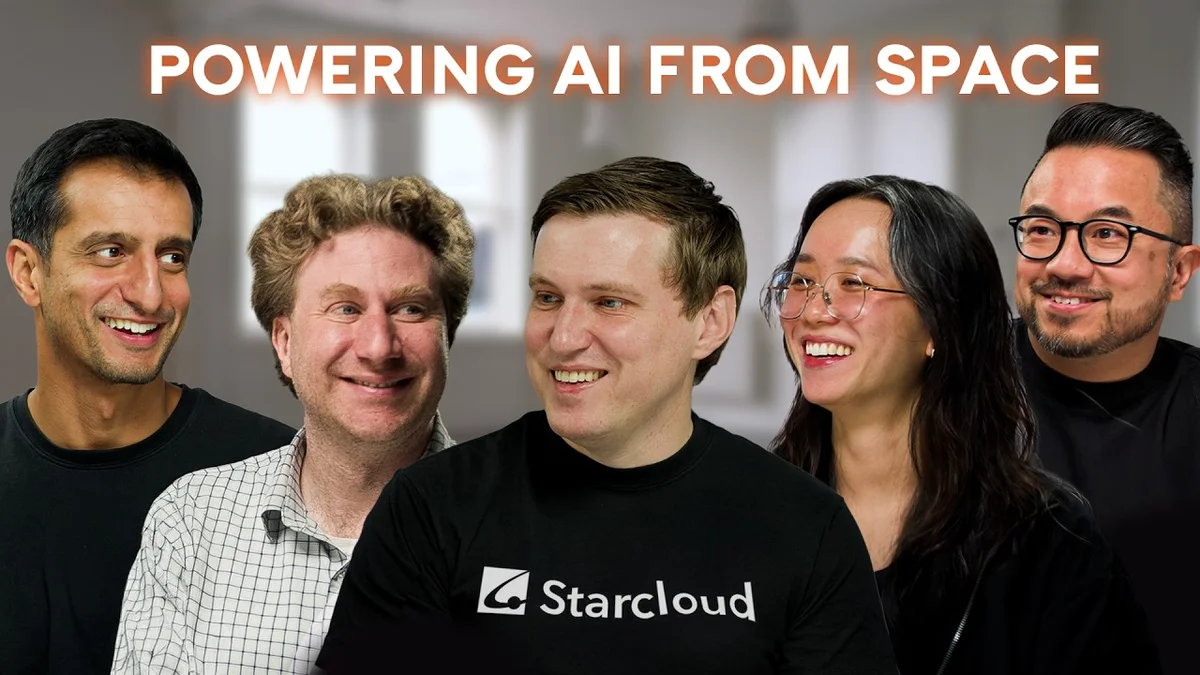
Philip Johnston, Founder & CEO of StarCloud, speaking at a round table discussion.
YC

Visual TL;DR. AI Energy Bottleneck drives StarCloud CEO Johnston. StarCloud CEO Johnston proposes Space Data Centers. Space Data Centers enables Unlimited Solar Power. Space Data Centers starts with StarCloud One. StarCloud One faces Engineering Challenges. Unlimited Solar Power powers Future of AI Computing. Engineering Challenges leads to Future of AI Computing.

  1. AI Energy Bottleneck: AI's power needs quickly running up against terrestrial energy project constraints
  2. StarCloud CEO Johnston: Philip Johnston co-founded StarCloud, pioneering space data centers for AI
  3. Space Data Centers: building data centers in orbit to access almost unlimited low-cost solar energy
  4. StarCloud One: first ambitious step, securing significant funding and unicorn status quickly
  5. Engineering Challenges: overcoming space engineering hurdles for ambitious growth and future scale
  6. Unlimited Solar Power: leveraging abundant solar energy in orbit, offsetting launch costs
  7. Future of AI Computing: addressing AI's energy demands with a bold, scalable space-based solution
Visual TL;DR
Visual TL;DR, startuphub.ai AI Energy Bottleneck drives StarCloud CEO Johnston. StarCloud CEO Johnston proposes Space Data Centers. Space Data Centers enables Unlimited Solar Power. Unlimited Solar Power powers Future of AI Computing drives proposes enables powers AI Energy Bottleneck StarCloud CEO Johnston Space Data Centers Unlimited Solar Power Future of AI Computing From startuphub.ai · The publishers behind this format
Visual TL;DR, startuphub.ai AI Energy Bottleneck drives StarCloud CEO Johnston. StarCloud CEO Johnston proposes Space Data Centers. Space Data Centers enables Unlimited Solar Power. Unlimited Solar Power powers Future of AI Computing drives proposes enables powers AI EnergyBottleneck StarCloud CEOJohnston Space DataCenters Unlimited SolarPower Future of AIComputing From startuphub.ai · The publishers behind this format
Visual TL;DR, startuphub.ai AI Energy Bottleneck drives StarCloud CEO Johnston. StarCloud CEO Johnston proposes Space Data Centers. Space Data Centers enables Unlimited Solar Power. Unlimited Solar Power powers Future of AI Computing drives proposes enables powers AI Energy Bottleneck AI's power needs quickly running upagainst terrestrial energy projectconstraints StarCloud CEO Johnston Philip Johnston co-founded StarCloud,pioneering space data centers for AI Space Data Centers building data centers in orbit to accessalmost unlimited low-cost solar energy Unlimited Solar Power leveraging abundant solar energy in orbit,offsetting launch costs Future of AI Computing addressing AI's energy demands with abold, scalable space-based solution From startuphub.ai · The publishers behind this format
Visual TL;DR, startuphub.ai AI Energy Bottleneck drives StarCloud CEO Johnston. StarCloud CEO Johnston proposes Space Data Centers. Space Data Centers enables Unlimited Solar Power. Unlimited Solar Power powers Future of AI Computing drives proposes enables powers AI EnergyBottleneck AI's power needsquickly running upagainst terrestrial… StarCloud CEOJohnston Philip Johnstonco-foundedStarCloud,… Space DataCenters building datacenters in orbit toaccess almost… Unlimited SolarPower leveraging abundantsolar energy inorbit, offsetting… Future of AIComputing addressing AI'senergy demands witha bold, scalable… From startuphub.ai · The publishers behind this format
Visual TL;DR, startuphub.ai AI Energy Bottleneck drives StarCloud CEO Johnston. StarCloud CEO Johnston proposes Space Data Centers. Space Data Centers enables Unlimited Solar Power. Space Data Centers starts with StarCloud One. StarCloud One faces Engineering Challenges. Unlimited Solar Power powers Future of AI Computing. Engineering Challenges leads to Future of AI Computing drives proposes enables starts with faces powers leads to AI Energy Bottleneck AI's power needs quickly running upagainst terrestrial energy projectconstraints StarCloud CEO Johnston Philip Johnston co-founded StarCloud,pioneering space data centers for AI Space Data Centers building data centers in orbit to accessalmost unlimited low-cost solar energy StarCloud One first ambitious step, securing significantfunding and unicorn status quickly Engineering Challenges overcoming space engineering hurdles forambitious growth and future scale Unlimited Solar Power leveraging abundant solar energy in orbit,offsetting launch costs Future of AI Computing addressing AI's energy demands with abold, scalable space-based solution From startuphub.ai · The publishers behind this format
Visual TL;DR, startuphub.ai AI Energy Bottleneck drives StarCloud CEO Johnston. StarCloud CEO Johnston proposes Space Data Centers. Space Data Centers enables Unlimited Solar Power. Space Data Centers starts with StarCloud One. StarCloud One faces Engineering Challenges. Unlimited Solar Power powers Future of AI Computing. Engineering Challenges leads to Future of AI Computing drives proposes enables starts with faces powers leads to AI EnergyBottleneck AI's power needsquickly running upagainst terrestrial… StarCloud CEOJohnston Philip Johnstonco-foundedStarCloud,… Space DataCenters building datacenters in orbit toaccess almost… StarCloud One first ambitiousstep, securingsignificant funding… EngineeringChallenges overcoming spaceengineering hurdlesfor ambitious… Unlimited SolarPower leveraging abundantsolar energy inorbit, offsetting… Future of AIComputing addressing AI'senergy demands witha bold, scalable… From startuphub.ai · The publishers behind this format

In a bold move to tackle the escalating energy demands of artificial intelligence, StarCloud, a company co-founded by Philip Johnston, is pioneering the development of data centers in space. The ambitious venture, which aims to leverage the abundant solar energy available in orbit, has already secured significant funding and achieved unicorn status less than two years after its inception.

The Problem: AI's Energy Bottleneck

Philip Johnston, CEO of StarCloud, highlights the growing constraint on building new energy projects on Earth to meet the power needs of AI. "We are very quickly running up on constraints on where we can build new energy projects terrestrially," Johnston explained on the Light Cone podcast. By shifting data centers to space, StarCloud gains access to "almost unlimited low-cost energy in the form of solar." While acknowledging the costs associated with launch, Johnston pointed to the rapidly decreasing price of space access, citing advancements from companies like SpaceX.

The full discussion can be found on YC's YouTube channel.

Building the First Data Centers in Space - YC
Building the First Data Centers in Space, from YC

From Space-Based Solar to Data Centers

The initial concept for StarCloud, then named Lumin Orbit, was space-based solar power, a concept dating back to the 1960s. However, the significant energy loss (95%) during transmission from space to Earth proved to be a major hurdle. Johnston realized that even with space-based solar, the primary demand for that power would still be data centers. This led to a pivot, with StarCloud focusing on placing the compute infrastructure directly into space. The break-even launch cost for this model was calculated to be around $500 per kilogram, a figure they believe is becoming increasingly achievable.

StarCloud One: A Bold First Step

The company's first satellite, StarCloud 1, launched in November 2025, carrying five GPUs, including an Nvidia H100 and two from ARM. The journey to get the H100 ready involved extreme measures, such as submerging components in phase-change material for thermal management and rapid testing. "It is a miracle that it works to be honest," Johnston admitted, highlighting the startup agility that allowed them to achieve this for a fraction of the cost quoted by larger aerospace companies.

The launch itself was an emotional moment for the 12-person team who traveled to Florida to witness the event. The successful deployment of StarCloud 1 was even featured by Jensen Huang at the GTC conference. The satellite is currently in a mid-inclination orbit, and the company plans for future iterations to fly over the poles for continuous solar exposure.

Engineering Challenges and Future Scale

Addressing the core engineering challenges, Johnston emphasized the dual focus on heat dissipation in a vacuum and ensuring chips function in a high-radiation environment. StarCloud is developing proprietary solutions for thermal management, aiming for radiators that are significantly lighter and cheaper per watt of dissipation than those used on the International Space Station. For radiation, the team is conducting extensive testing and implementing shielding and software mitigations.

The company has already secured contracts with government entities and plans to scale significantly. StarCloud 3 will be a 200-kilowatt, 3-ton spacecraft, with 50 of them fitting per Starship launch, offering approximately 10 megawatts of compute capacity per launch. StarCloud has filed for a constellation of 88,000 such satellites, projecting a total compute capacity of 20 gigawatts, which is about 20 times the entire US power grid's capacity.

Investor Skepticism and the Future of Space Computing

Initially, the idea of space data centers faced significant skepticism from investors. Johnston recalled applying to Y Combinator once before and facing rejection from over 100 VCs when seeking seed funding. However, the current landscape is shifting, with a growing recognition of the potential for hard tech and space ventures. "People think that software doesn't have a moat anymore," Johnston observed, which has driven interest towards hardware and deep tech.

StarCloud's vision is to make compute power more accessible and sustainable, addressing the bottlenecks created by AI's energy consumption on Earth. As launch costs continue to fall and the demand for computational resources grows, data centers in space are poised to play a critical role in the future of computing.
© 2026 StartupHub.ai. All rights reserved. Do not enter, scrape, copy, reproduce, or republish this article in whole or in part. Use as input to AI training, fine-tuning, retrieval-augmented generation, or any machine-learning system is prohibited without written license. Substantially-similar derivative works will be pursued to the fullest extent of applicable copyright, database, and computer-misuse laws. See our terms.