Today, we're tracking the surprising dip in chip stocks amidst tariff fears, the latest creative capabilities of ChatGPT Images, and a fascinating LLM-driven test that exposed numerous bugs in Ethereum infrastructure. Plus, we'll dive into SpaceX's acquisition of Cursor and OpenAI's response.
In this episode
- Nepal floods August 2026: Amazon Deploys Relief
- OpenAI vs Anthropic IPO prediction Tightens
- Claude's Corner: Valgo - The Insurance Layer Physical AI Has Been Missing
- ARM and Chip Stocks Pull Back on Tariff Fears as ServiceNow, Amazon Lead AI Software Surge
- SpaceX acquires Cursor: OpenAI Cuts Ties
- Agentic Engineering Is Now Writing All the Code
- Prediction Market Arbitrage: 6 Opportunities Live Now, Up to 277% ROI
- AI video generation tested in Tennis (:30)
- ChatGPT Images: Bring Your Ideas to Life
- LLM Tests Expose Cracks in Ethereum Infrastructure
Transcript
Ada: Welcome to Today in AI, I'm Ada.
Sam: And I'm Sam. Today, we're starting with a bit of a mixed bag in the markets, Ada, with chip stocks pulling back while AI software names surge.
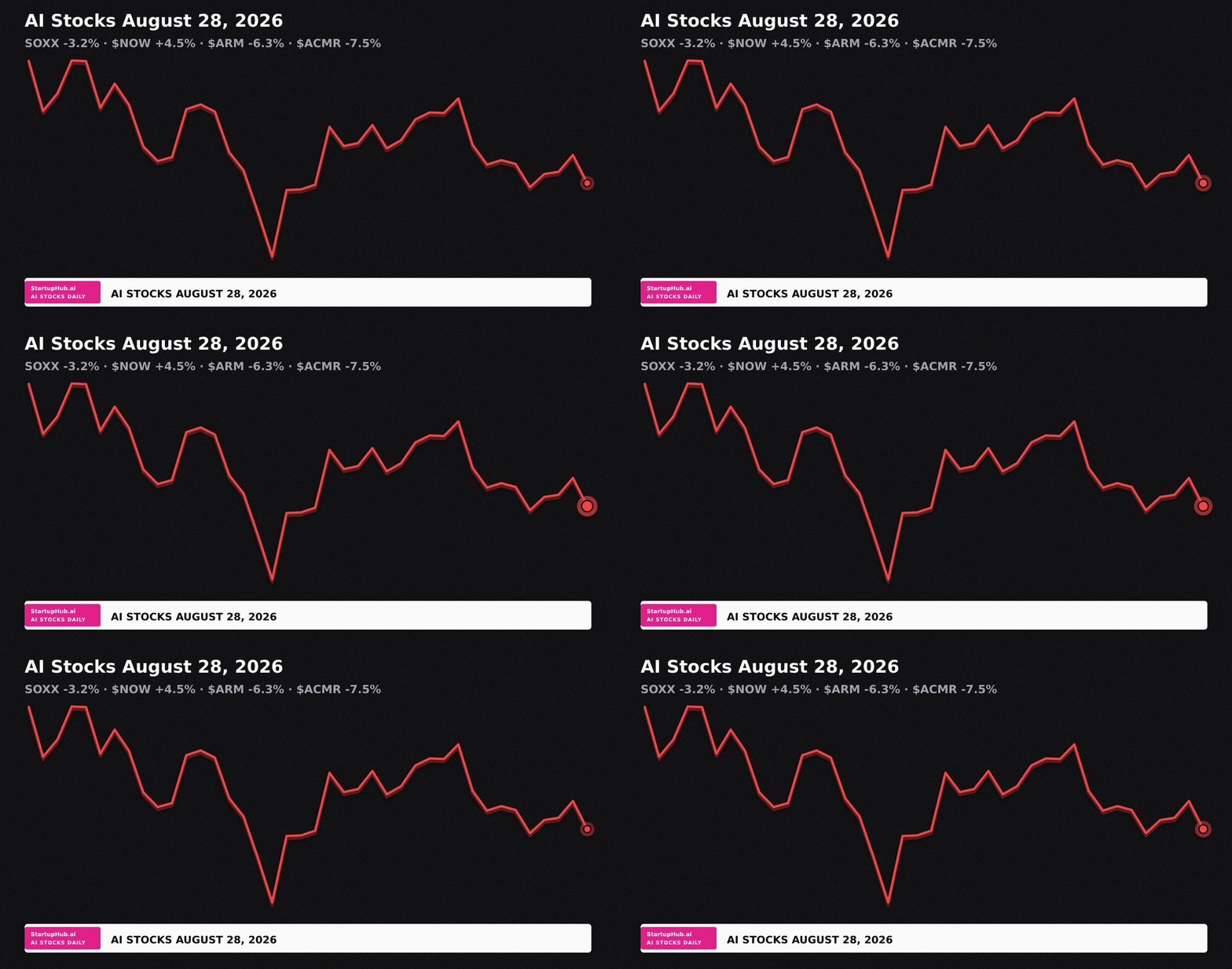
Ada: That's right, Sam. It's a tale of two sectors. The SOXX index, which tracks semiconductors, dropped by three point two percent on Friday. This was largely driven by fears of expanded semiconductor tariffs. We saw ARM fall six point three percent, ACMR plunged seven point five percent, and even NVIDIA slid four point six percent, really bearing the brunt of this sell-off.
Sam: And this is a significant shift from what we've seen recently. Just yesterday, we were talking about a two percent gain for SOXX. The tariff fears are a big deal because the semiconductor supply chain is so globally integrated. Any new tariffs could disrupt that delicate balance, impacting production costs and ultimately, profitability for these companies. It’s a classic example of geopolitical concerns directly hitting market sentiment.
Ada: Absolutely. But on the flip side, AI software is having a moment. ServiceNow, for instance, just crossed one billion dollars in AI annual contract value. This is a huge milestone and really highlights the rapid adoption of AI solutions in enterprise software. Amazon, too, is leading the charge here, among other names in the AI software space.
Sam: It underscores the fundamental difference between hardware and software. While hardware can be vulnerable to supply chain and tariff issues, the demand for AI-driven efficiency and innovation in software continues to accelerate. Companies are clearly seeing tangible benefits from integrating AI, and that's reflected in these impressive contract values. It’s a strong indicator that AI isn't just a buzzword anymore, it's a core component of business strategy.
Ada: Moving from market dynamics to creative capabilities, Sam, ChatGPT Images is really stepping up its game. It now allows users to create finished designs complete with layouts and text. We saw a demonstration of this with a 'Magic Manga Girl' video, showcasing dynamic AI-generated art.
Sam: This is a big leap beyond just generating standalone images. The ability to integrate layouts and text means ChatGPT is moving closer to being a full-fledged design assistant. For creators, marketers, or even just hobbyists, this could significantly streamline the design process. Imagine quickly prototyping an ad campaign or illustrating a short story with a few prompts. It democratizes design in a way we haven't quite seen before.
Ada: Exactly. It's about reducing the friction from idea to execution. Instead of needing multiple tools or specialized skills, you can potentially get a much more polished output directly from the AI. It's not just about generating art, it's about generating finished products that are ready for use. This could impact everything from social media content to simple website mockups.
Sam: Speaking of big moves and shifts, we have some interesting news regarding SpaceX and OpenAI. SpaceX has acquired Cursor, and as a result, OpenAI will cut ties with Cursor on November twelfth, two thousand twenty-six. OpenAI is citing past contract violations and safety needs for its next model, Astra, as the reasons.
Ada: This is a significant development. Cursor is a well-known AI code editor, and its acquisition by SpaceX, a company deeply involved in advanced technology and AI for its space missions, makes strategic sense. However, OpenAI's decision to sever ties suggests a deeper tension, likely around data usage, intellectual property, or perhaps even competitive concerns. The mention of 'safety needs for Astra' is particularly telling, indicating OpenAI's increasing focus on securing its core models and data.
Sam: It highlights the complexities and sometimes contentious relationships within the AI ecosystem. When a company like OpenAI, which supplies foundational models, sees a partner acquired by a major player, it can trigger re-evaluations of existing agreements. The 'contract violations' aspect is certainly intriguing and suggests there might have been specific clauses related to ownership changes or data security that were breached. It's a reminder that even in the collaborative world of tech, strategic interests and proprietary concerns often take precedence.
Ada: Absolutely. It's a high-stakes game, and control over foundational models and the data they consume is paramount. Now, let's talk about some fascinating findings from Black Hat Asia two thousand twenty-six. LLM-driven differential testing across thirty Ethereum nodes found ninety-eight bugs in all eleven major clients, ranging from EVM crashes to API inconsistencies.
Sam: This is huge for the blockchain world. Ethereum is a cornerstone of decentralized finance and web three, and finding this many bugs across all major clients with LLM-driven testing is both concerning and incredibly valuable. It demonstrates the power of AI in identifying vulnerabilities that traditional testing methods might miss. Differential testing, where you compare the outputs of multiple implementations given the same input, is already robust, but adding LLMs to generate those inputs intelligently is a game-changer.
Ada: It really exposes cracks in the Ethereum infrastructure that need immediate attention. From a security perspective, ninety-eight bugs, including EVM crashes, could have significant implications for the stability and reliability of the network. This isn't just about minor glitches; these are fundamental issues that could be exploited. The fact that LLMs were able to uncover these highlights their potential as advanced security auditing tools.
Sam: Exactly. It's a double-edged sword: concerning that these bugs exist, but reassuring that AI can help us find them. It forces the developers of these Ethereum clients to address these issues proactively, strengthening the entire ecosystem. This kind of AI-powered testing could become standard practice across critical infrastructure, not just in blockchain, but in any complex software system where reliability and security are paramount.
Ada: Moving to a lighter note, OpenAI is continuing its exploration into AI video generation with a new test called Tennis, a thirty-second AI video built on a repetitive win-focused vocal hook and sports visuals.
Sam: This is another step in OpenAI's journey into generating more complex and dynamic video content. The focus on a repetitive vocal hook and sports visuals suggests they're experimenting with how AI can generate compelling, short-form, and perhaps even viral content. It's a contained environment for testing consistency, motion, and audio-visual synchronization.
Ada: It's all about pushing the boundaries of what's possible in AI media creation. While a thirty-second tennis video might seem simple, the underlying technology to generate consistent visual elements, realistic motion, and synchronized audio is incredibly complex. These tests are crucial for refining the models that will eventually lead to much longer, more intricate, and narratively rich AI-generated videos.
Sam: And finally, in Claude's Corner today, we're looking at Valgo, which is building the insurance layer physical AI has been missing. Valgo creates probabilistic simulation tools that let insurers price risk for autonomous systems.
Ada: This is a critical piece of the puzzle for deploying physical AI systems like autonomous vehicles or robots. The founders are Stanford PhDs who co-authored the textbook on safety validation, paired with a twelve-year actuary. This combination of deep technical expertise and insurance risk assessment is precisely what's needed to tackle the hardest unsolved problem in physical AI deployment: how do you insure something that's constantly learning and operating in unpredictable real-world environments?
Sam: It's a huge hurdle. Traditional insurance models aren't equipped to handle the dynamic and often black-box nature of AI-driven systems. Valgo's approach, using probabilistic simulations, is smart. It allows insurers to quantify and price the risks associated with these systems in a way that's data-driven and robust, rather than relying on guesswork. This could unlock massive investment and broader adoption of physical AI by providing the financial safety net needed.
Ada: Exactly. Without a clear way to assess and insure risk, the deployment of autonomous systems will always be limited. Valgo is addressing a foundational problem that, once solved, could accelerate the integration of AI into our physical world significantly. It's the kind of infrastructure play that often goes unnoticed but is absolutely essential.
Sam: That's all for today's top stories in AI. For more details on these and other developments, head over to startuphub.ai.
Ada: We'll be back tomorrow with more updates. Thanks for listening to Today in AI.