
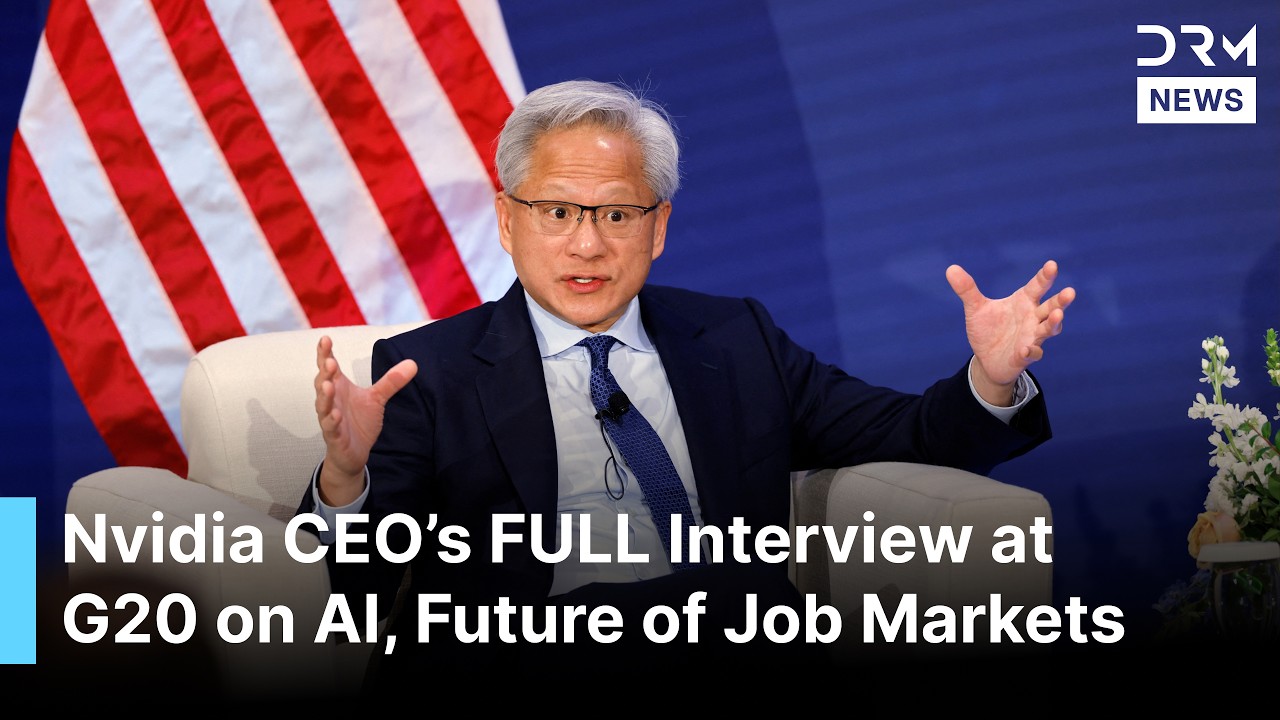
Nvidia's CEO declares AGI is practically here, GPT-6 Astra brings full computer control to developers, and Databricks empowers marketers with AI-driven insights. Plus, we explore the surprising reality of tech layoffs and AI's impact on wages.
In this episode
- Jensen Huang AGI practically already G20
- AI animal communication may arrive by 2030
- Databricks Genie One Targets Marketing Data Gap
- Astra swarm workflows cracked DEF CON puzzles
- Physicists Use LLMs, Skip the Panic
- Matt Mullenweg Revives 2007 Piplet Concept at WordCamp US 2026
- Rippling vs Deel: The Global Workforce Platforms That Look Similar But Are Not
- big tech layoffs 2025 broke the stability myth
- GPT-6 Astra API Brings Computer Use to Developers
- Torsten Slok Apollo AI wage study: pay, not jobs
Transcript
Ada: Welcome to Today in AI, I'm Ada.
Sam: And I'm Sam. Today, we're diving into Jensen Huang's bold AGI prediction, the massive expansion of GPT-6 Astra's capabilities, and how Databricks is finally bridging the gap for marketers with intelligent data access.
Ada: Let's kick things off with a statement that's sure to generate some buzz. Nvidia CEO Jensen Huang told G20 partners that the world has practically reached AGI today, and he predicts we'll hit full AGI within two years. He framed this not as a sci-fi fantasy, but as infrastructure economics.
Sam: That's a pretty powerful claim, Ada, especially coming from the head of the company that's essentially building the picks and shovels for this revolution. Framing it as infrastructure economics really shifts the conversation. It's not about if, but when, and how we build the foundational systems to support it. It underscores the massive investment and strategic planning happening at the highest levels of government and industry.
Ada: Exactly. It suggests that the bottleneck isn't the theoretical possibility anymore, but the practical deployment and scaling of the necessary compute and data centers. It also puts a lot of pressure on governments and companies to prepare for a world where AI capabilities are far more advanced than many currently anticipate. It implies a race to build out the 'AI grid,' so to speak, to power this next era.
Sam: Moving from grand predictions to practical advancements, GPT-6 Astra is making some significant moves. The Astra API now brings full computer use to developers, complete with background control, asynchronous tools, and steering. This is available in ChatGPT, Codex, and, crucially, the API.
Ada: This is a huge leap from yesterday's news about Astra running your desktop. This isn't just about a user interface anymore; it's about programmatic control. Developers can now integrate Astra's ability to operate a computer directly into their applications. Think about the potential for automated workflows, complex data manipulation, or even creating new kinds of agentic software that can interact with any application on a system.
Sam: Right, the background control and asynchronous tools are key here. It means Astra can be working on tasks without needing constant foreground attention, and it can handle multiple operations concurrently. This opens up entirely new paradigms for how we build and interact with software, moving towards a much more autonomous and integrated AI experience within our digital environments.
Ada: It also raises the stakes for safety and security, which we touched on yesterday with the critical cyber leap. Giving an AI this level of control requires robust guardrails and careful implementation. But the potential for productivity gains and innovation is enormous.
Sam: Absolutely. On a different but equally impactful note, Databricks has introduced Genie One, targeting a significant gap in marketing data. Genie One is pitched as a data-smart coworker that lets marketers query governed data in plain English without needing to rebuild context.
Ada: This is a game-changer for marketing teams. Historically, marketers have struggled to access and analyze the rich data locked away in their company's data warehouses, often relying on data scientists or analysts to pull reports. Genie One democratizes that access. By allowing natural language queries on governed data, it empowers marketers to ask their own questions, get immediate answers, and iterate on their strategies much faster.
Sam: The 'without rebuilding context' part is particularly important. Marketers often deal with complex customer journeys and campaign histories. Genie One understands that context, so they don't have to start from scratch with every query. This saves immense time and reduces the friction between marketing intuition and data-driven insights. It's about bringing the data directly to the decision-makers in a usable format.
Ada: It also highlights the continued trend of AI making specialized tools more accessible to a broader audience. Data science expertise remains critical, but AI is increasingly providing interfaces that allow domain experts to leverage complex data infrastructure without needing to become data engineers themselves.
Sam: Shifting gears to a more sobering topic, the big tech layoffs of 2025 are still making waves, breaking what many considered the 'stability myth.' We're hearing stories from four big tech workers who lost $180,000 to $250,000 jobs, applied for around eight thousand positions, and are now facing health insurance costs of $2,600.
Ada: These are stark reminders that even in a booming AI economy, job security in tech isn't guaranteed. The numbers are staggering, eight thousand applications for highly skilled individuals speaks volumes about the current job market saturation, especially for certain roles. And the health insurance costs highlight a broader systemic issue, particularly for those in the US, where employment is so often tied to benefits.
Sam: It challenges the perception that a high-paying tech job automatically translates to long-term stability. The rapid pace of technological change, coupled with macroeconomic factors, means that even established companies are making tough decisions. It forces a re-evaluation of career planning and financial preparedness for many in the industry.
Ada: Absolutely. It's a critical counter-narrative to the often overly optimistic view of the tech sector, showing the human cost behind these corporate shifts.
Sam: Speaking of jobs and economics, Torsten Slok from Apollo has released an interesting AI wage study. He finds that AI exposure since the advent of ChatGPT has lowered wage growth, but notably, it has not significantly impacted employment across three hundred occupations.
Ada: This is a nuanced but important finding. It suggests that while AI might be making certain roles more efficient, potentially reducing the need for higher pay in those areas, it's not yet leading to widespread job displacement. Instead, it's shifting the value proposition of human labor. Workers might be performing similar tasks, but AI's assistance could be dampening wage increases by making them more productive with less specialized effort.
Sam: It aligns with the idea of augmentation rather than full automation for many roles. AI tools are making existing workers more capable, which means companies might not need to pay as much for those specific human skills, or they can achieve more with the same number of employees. It's a subtle but significant economic effect that we'll need to watch closely as AI matures.
Ada: It also highlights that the narrative of 'AI taking all the jobs' might be oversimplified. The reality appears to be more about a transformation of work and a recalibration of wages in response to increased productivity and efficiency.
Sam: Before we wrap up, a fun one: Bloomberg reports that billionaire Jeremy Coller predicts two-way animal communication could arrive by 2030, as AI accelerates research, specifically citing work with crows.
Ada: Now this is something out of a science fiction novel! While it sounds far-fetched, the advancements in AI for pattern recognition and language modeling are truly incredible. Crows, in particular, are known for their complex communication and problem-solving skills. If AI can decipher and then help us generate responses in their 'language,' it would revolutionize our understanding of the natural world.
Sam: It's a testament to the broad and unexpected applications of AI. From infrastructure economics to talking to animals, AI continues to push the boundaries of what we thought was possible. And eight years isn't that far away when you consider the pace of AI development.
Ada: Indeed. That's all the time we have for today. For deeper dives into these stories and more, visit startuphub.ai.
Sam: Thanks for tuning in to Today in AI.



