
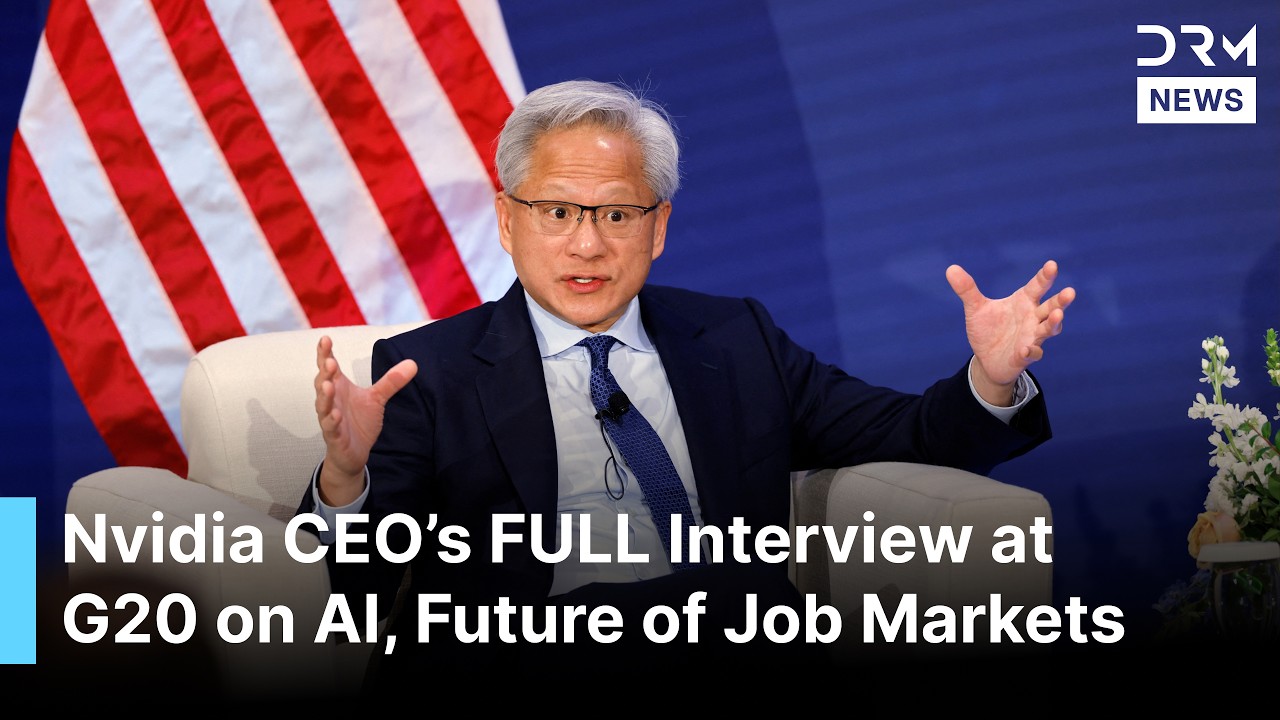
Jensen Huang AGI practically already G20 is the claim Nvidia's CEO made in a G20 talk published by DRM News, saying the world has practically reached general intelligence now and will formally do so within two years.
He immediately hedged it.
AGI means a lot or nothing, he said. What matters is whether enterprises can put that intelligence to productive work.
What practically AGI means in Huang's telling
The core idea is the token. A token is the mathematical output of many calculations, then reassembled into images, paragraphs, answers or new ideas.
Like energy 100 to 200 years ago, intelligence is invisible and hard to measure until you use it, he argued. Now it has a unit price: dollars per million tokens, a direct parallel to dollars per kilowatt-hour.
Huang described AI as a five-layer cake. Energy at the bottom, then chips, then data center infrastructure, then models, then data and applications on top.
Most people think AI is the model layer, he said. The value is in the top layer, where companies add purpose, context and access. Even a freshly hired MIT PhD needs that surrounding to be productive, and so will AGI systems.
He pushed a familiar Nvidia line on agentic AI. Large language models wrapped in agent scaffolding for memory, tools and collaboration become digital agents, then physical ones when plugged into robots, cars or lab equipment.
Why the infrastructure framing matters more than the AGI label
This is a sales pitch for sovereign buildout, not a research claim.
Huang told G20 partners every country needs its own infrastructure to support researchers, startups and industry, and that once local compute exists, local activity follows. The US advantage, he said, is scale: nearly $1 trillion in US infrastructure investment this year alone, spanning chip fabs to AI factories, with a goal of 100 gigawatts by the end of the decade.
At $50 to $60 billion per gigawatt, he put the cost of that scale explicitly. His argument for Nvidia: general purpose GPUs across every cloud, data center, edge and robotic system are replaceable and software-upgradable, so expensive infrastructure does not strand when models change. Fourteen architecture generations in, that interchangeability is the moat.
He also made a deregulatory case. The worst outcome is not adopting AI and falling behind, he said. Safety is the builder's responsibility, and regulation should target real harms, not hypothetical ones, while accelerated progress makes models more factual and less hallucinatory.
The skeptical note is right there in the transcript. There is no benchmark, no definition of AGI, no test for practically already. Without that, practically AGI is unfalsifiable.
For enterprises the takeaway is narrower than the headline. Huang said Nvidia itself runs Cursor, Anthropic and OpenAI tools off the shelf while building its own, and advises every country and company to do the same: use everything you can, but build what you must so you do not outsource all intelligence.
What is not answered is who pays for the data and application layer that actually captures value, and how G20 economies without cheap power or chip supply get past layers one and two without depending entirely on US stacks.
Huang's ambition pitch landed on scale: things that took ten years will take one, and $100 trillion industries are now in play. Practically AGI is less a milestone than permission to invest bigger.



